Overhand Throwing Overhand Throwing Mechanics Mechanics and the - - PDF document

overhand throwing overhand throwing mechanics mechanics
SMART_READER_LITE
LIVE PREVIEW

Overhand Throwing Overhand Throwing Mechanics Mechanics and the - - PDF document

Overhand Throwing Overhand Throwing Mechanics Mechanics and the Glenohumeral Joint and the Glenohumeral Joint Tracey Kobayashi City College of San Francisco Department of Physical Education and Dance The structure of the shoulder complex


slide-1
SLIDE 1

Glenohumeral Injury - T. Kobayashi 1

Overhand Throwing Mechanics

and the Glenohumeral Joint

Overhand Throwing Mechanics

and the Glenohumeral Joint

Tracey Kobayashi City College of San Francisco

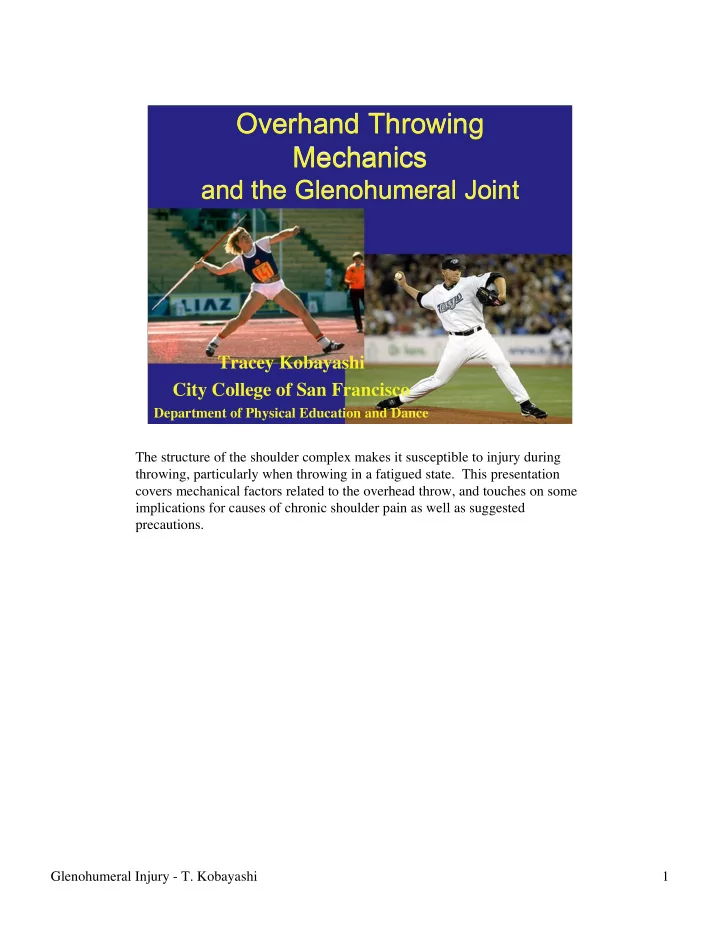
Department of Physical Education and Dance The structure of the shoulder complex makes it susceptible to injury during throwing, particularly when throwing in a fatigued state. This presentation covers mechanical factors related to the overhead throw, and touches on some implications for causes of chronic shoulder pain as well as suggested precautions.

slide-2
SLIDE 2

Glenohumeral Injury - T. Kobayashi 2

Gross Structure Gross Structure

Review of Gross Structure (name bones & muscles)

  • Bones: scapula; clavicle; humerus
  • Joints: glenohumeral; scapulothoracic; acromioclavicular; sternoclavicular
  • Rotator Cuff muscles provide dynamic stability to the joint via mainly

compressive forces.

slide-3
SLIDE 3

Glenohumeral Injury - T. Kobayashi 3

Joint Structure Joint Structure

Glenohumeral Joint -- ball & socket configuration allows three-dimensional mobility

  • shallowness of the glenoid fossa and large humeral head aid mobility at the

expense of stability

  • vacuum effect assisted by the glenoid labrum, balance of muscular forces &

joint fluid provides stability

  • surrounding joint capsule and ligaments provide static stability
  • surrounding muscles provide dynamic stability

Acromioclavicular and Sternoclavicular Joints: stabilized primarily through ligaments Acromial Arch (acromion and coracoacromial ligament): inhibits upward movement of the humeral head Throwing issues, as we’ll see later, arise due to instability of the glenohumeral joint

slide-4
SLIDE 4

Glenohumeral Injury - T. Kobayashi 4

Shoulder Angle Conventions Shoulder Angle Conventions

Some conventions for describing shoulder movements and position with influence on the throwing motion:

  • Flexion / Extension
  • Internal / External Rotation
  • Horizontal Abduction/Adduction
slide-5
SLIDE 5

Glenohumeral Injury - T. Kobayashi 5

Pitching Phases Pitching Phases

Pitching Phases (from Stodden, et al, 2005).

  • Wind-up: ends at knee up
  • Stride: ends at foot contact
  • Arm Cocking: ends at maximum external rotation

Critical instant - maximum internal Torque occurs during this phase Max External Rotation 150o - 210o

  • Arm Acceleration: ends after release
  • Arm Deceleration: ends after maximum internal rotation

Critical instant - max compressive force

  • Follow-through
slide-6
SLIDE 6

Glenohumeral Injury - T. Kobayashi 6

Anatomical Issue Humeral Head Distraction Anatomical Issue Humeral Head Distraction

Anterior Translation

  • Tensile failure of supporting

musculature during deceleration

  • Rotator Cuff
  • Biceps Brachii
  • Caused by rotator cuff and/or

biceps fatigue -> increased ligament loads

Generally, most shoulder pain in pitchers and other overhand throwing athletes is related to humeral head distraction, usually anterior translation. Distraction can be attributed largely to tensile failure of the supporting musculature (rotator cuff - mid inferior area of supraspinatus most common - and biceps brachii). This failure is caused by fatigue due to high loads. Excessive external rotation during cocking -> increased eccentric loads on rotator cuff -> fatigue -> increased demand on the Inferior Glenohumeral ligament, the primary constraint to external rotation in abduction. Rotator cuff compresses humeral head in cavity for additional support. As rotator cuff fatigues, it exerts less control, increasing ligament loads. Role of biceps: provides elbow flexion torque and glenohumeral compression. Max elbow flexion torque must occur early enough before compression or it will be required to exert a higher maximum force. Biceps fatigue can strain the ligament structures.

slide-7
SLIDE 7

Glenohumeral Injury - T. Kobayashi 7

  • Tearing
  • Grinding
  • “Pinching”
  • Soft Tissue Strain

Anatomical Issue Humeral Head Distraction Anatomical Issue Humeral Head Distraction

Effects

Distraction Force > 100% body weight may put rotator cuff and labrum at risk Repetitive Trauma -> chronic pain

  • Tearing: compressive force from translation, joint laxity & high (380 N)

anterior force during cocking.

  • Grinding: rapid internal rotation with above.
  • Labrum “trapped” between humeral head and glenoid rim (acute)
  • Soft tissue strain: strain of gh joint restraints concurrent with humeral head

subluxation

slide-8
SLIDE 8

Glenohumeral Injury - T. Kobayashi 8

  • Internal rotation torque during cocking
  • Compressive force during deceleration

Kinematics and Kinetics Two Critical Instants Kinematics and Kinetics Two Critical Instants

Factors Relating to Shoulder Distraction

Internal rotation torque during cocking

  • least stable in abduction combined with external rotation
  • shoulder position @ max ext rotation (184 + 14o): greater external rotation
  • high peak external rotation & abduction torques

Compressive force during arm deceleration

  • posterior & compressive forces resist distraction (biceps)
  • horizontal abduction torque resists horizontal adduction
  • external rotatory torque resists internal rotation

Changes in throwing mechanics during a game session (Barrentine et al)

  • @ foot contact: +5o abduction; +5o horizontal adduction; +8o external

rotation

  • arm cocking and acceleration: -4o external rotation;
  • @ release: -4o abduction
slide-9
SLIDE 9

Glenohumeral Injury - T. Kobayashi 9

Applications Applications

Max Throws/Game

2 + 0.6 106 + 16 17-18 2 + 0.4 91 + 16 15-16 2 + 0.4 76 + 16 13-14 2 + 0.5 68 + 18 11-12 2 + 0.6 52 + 15 8-10 GAMES / WK MAX / GAME AGE 89 + 22 62 + 21 45 + 25 27 + 22 17-18 77 + 20 62 + 23 38 + 23 25 + 20 15-16 70 + 20 56 + 20 36 + 21 30 + 22 13-14 58 + 18 55 + 23 35 + 20 27 + 20 11-12 51 + 19 43 + 16 34 + 16 21 + 18 8-10 4 DAY REST 3 DAY REST 2 DAY REST 1 DAY REST AGE

Recommended Rest for Min Throws

slide-10
SLIDE 10

Glenohumeral Injury - T. Kobayashi 10

Applications Applications

Recommended Ages for Learning Various Pitches

17 + 2 Screw ball 16 + 2 Fork ball 16 + 2 Slider 15 + 3 Knuckle ball 14 + 2 Curve ball 10 + 3 Change-Up 8 + 2 Fastball Age Pitch

slide-11
SLIDE 11

Glenohumeral Injury - T. Kobayashi 11

Applications Applications

  • Glenohumeral internal rotation deficit

in those with impingement.

  • Higher maximum external rotation

associated with injury/pain, Cues

Internal rotation: throwing shoulder -8.5o in normal pitchers.

slide-12
SLIDE 12

Glenohumeral Injury - T. Kobayashi 12

Applications Applications

  • Conditioning
  • Muscular & General Endurance
  • Muscular Strength
  • Range of Motion
  • Training
  • Teach proper throwing mechanics
  • Keep age-related progression in mind
  • Don't throw to fatigue

Prevention Appropriate Conditioning & Training

Specific Conditioning

  • Shoulder exercises
slide-13
SLIDE 13

Glenohumeral Injury - T. Kobayashi 13

Prevention Prevention

CAVEAT: no one is perfectly symmetrical; structural imbalance can easily be mistaken for muscular imbalance

Scan for Static Soft Tissue Imbalance

Muscular imbalance can create uneven or unintended stress on articulations and bones. An appropriate conditioning program can be designed to correct it. If the individual doesn't respond to "fixes," the imbalance may be due to the formation of the body's bony structures. If so, it’s possible tampering with them could cause damage.

slide-14
SLIDE 14

Glenohumeral Injury - T. Kobayashi 14

Prevention Prevention

  • Frontal/Posterior Views
  • Inversion/Eversion
  • Internal/External rotation
  • Valgus/Varus (often structural)
  • Iliac Levelness (often structural)
  • Sagittal View - Plumb Line Passes Through:
  • Ankle: anterior aspect of malleolus
  • Knee: posterior aspect of patella
  • Hip: femoral head & iliac crest
  • Shoulder: through glenohumeral joint
  • Head: behind top of ear

Scan for Static Soft Tissue Imbalance

Name exercises for

  • inversion/eversion
  • internal/external rotation
  • pelvic tilt downward/upward
  • hyperkyphosis
slide-15
SLIDE 15

Glenohumeral Injury - T. Kobayashi 15 Andrews JR, Fleisig G. How many pitches should I allow my child to throw? American Sports Medicine Institute. 1996. Anguinaldo A, Buttermore J, Chambers H. Sequential body motion and shoulder joint torque between baseball pitchers of various levels. Proceedings

  • f the Gait and Clinical Movement Analysis Society Meeting. 2004.

Barrentine RF, Takada Y, Fleisig GS, et al. Kinematic and EMG changes in baseball pitching during a simulated game, in Proceedings of the Twenty-First Annual Meeting of the American Society of Biomechanics. Clemson University, South Carolina. 1997. Fleisig GS, Andrew JR, Dillman CJ, Escamilla RF. Kinetics of baseball pitching with implications about injury mechanisms. American Journal of Sports Medicine, 23(2): 233-239. 1995. Stodden DF, Fleisig GS, McLean SP, Andrews JR. Relationship of biomechanical factors to baseball pitching velocity: within pitcher variation. Journal of Applied Biomechanics, 21: 44-56. 2005. WernerSL, Gill TJ., Murray TA, Cook TD. Relationships between throwing mechanics and shoulder distraction in professional baseball pitchers. American Journal of Sports Medicine, 29(3): 354-358. 2001.