Parent Stress Prior To An Autism Spectrum Disorder Diagnostic - - PowerPoint PPT Presentation

parent stress prior to an autism spectrum
SMART_READER_LITE
LIVE PREVIEW

Parent Stress Prior To An Autism Spectrum Disorder Diagnostic - - PowerPoint PPT Presentation

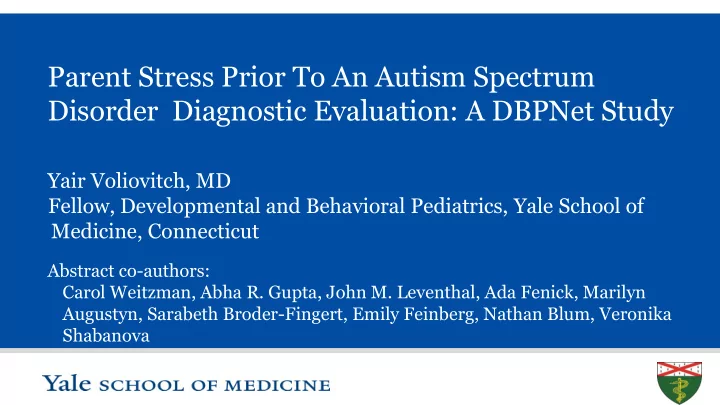
Parent Stress Prior To An Autism Spectrum Disorder Diagnostic Evaluation: A DBPNet Study Yair Voliovitch, MD Fellow, Developmental and Behavioral Pediatrics, Yale School of Medicine, Connecticut Abstract co-authors: Carol Weitzman, Abha R.


slide-1
SLIDE 1

S L I D E 1

Parent Stress Prior To An Autism Spectrum Disorder Diagnostic Evaluation: A DBPNet Study

Yair Voliovitch, MD Fellow, Developmental and Behavioral Pediatrics, Yale School of Medicine, Connecticut

Abstract co-authors: Carol Weitzman, Abha R. Gupta, John M. Leventhal, Ada Fenick, Marilyn Augustyn, Sarabeth Broder-Fingert, Emily Feinberg, Nathan Blum, Veronika Shabanova

slide-2
SLIDE 2

S L I D E 2

Disclosures

Funded by:

  • National Institute of Mental Health # R01MH104355.
  • No conflicts of interest.
slide-3
SLIDE 3

S L I D E 3

Autism and Parental Stress

  • Parental stress is high in parents with children with ASD, even

compared with parents of children with other developmental delays.

  • Post-diagnostic parental stress is associated with:
  • 1. Impaired parenting skills
  • 2. Impaired family functioning & decreased family quality of life
  • 3. Disturbances in marital relationships
  • 4. Difficulties with child behavior
  • Higher levels of social support, after the diagnosis of ASD, moderate

parental stress.

slide-4
SLIDE 4

S L I D E 4

What We Do Not Know

  • Studies of stress in parents of children with ASD have been

examined after diagnosis.

  • No study to date, however, has examined the stress parents are

experiencing prior to diagnosis.

slide-5
SLIDE 5

S L I D E 5

Purpose

To examine:

  • 1. The relationships prior to diagnostic evaluation between:

–parent-rated ASD symptoms and adaptive functioning in their child and –parental stress

  • 2. Whether social support moderates these relationships
slide-6
SLIDE 6

S L I D E 6

Hypothesis

PARENTAL STRESS Adaptive functioning ASD Symptoms Social support

slide-7
SLIDE 7

S L I D E 7

Overview – Project EARLY

  • Multisite, randomized controlled trial.
  • To test the effectiveness of a family navigator in reducing time to

diagnosis and increasing access to treatment services in underserved, primarily minority children at risk of ASD, compared with care coordination only.

  • 3 primary sites:

– Boston Medical Center (6 pediatric primary care clinics) – Yale New Haven Hospital (2 pediatric primary care clinics) – Children’s Hospital of Philadelphia (2 pediatric primary care clinics)

  • This study focused on baseline data
slide-8
SLIDE 8

S L I D E 8

Inclusion criteria

  • Children aged 15-27 months
  • Screened positive for ASD at a primary care visit,
  • r parent or clinician-identified concerns.
  • No previous diagnosis of ASD
slide-9
SLIDE 9

S L I D E 9

ASD Symptoms Modified Checklist for Autism in Toddlers/Revised Parental stress Adaptive functioning Social support

Measures

slide-10
SLIDE 10

S L I D E 10

Modified Checklist for Autism in Toddlers/Revised : MCHAT-R

  • Screening tool for autism with 20 questions.
  • Score lower than 3  no need of follow up
  • Score equal or greater than 3  administer MCHAT-R follow up

interview and if score is greater than 2, represents a medium risk

  • Score greater than 7 represents a high-risk for autism
slide-11
SLIDE 11

S L I D E 11

Adaptive functioning Adaptive Behavior Assessment System Modified Checklist for Autism in Toddlers/Revised Parental stress Social support

Measures

slide-12
SLIDE 12

S L I D E 12

Adaptive Behavior Assessment System: ABAS-3

  • Three subscales:
  • 1. Self-direction
  • 2. Social
  • 3. Communication
  • Score lower than 7 considered below average.
  • Score lower than 5 considered low.
slide-13
SLIDE 13

S L I D E 13

Social support Medical Outcome Study Social Support Survey Adaptive Behavior Assessment System Modified Checklist for Autism in Toddlers/Revised Parental stress

Measures

slide-14
SLIDE 14

S L I D E 14

Medical Outcome Study Social Support Survey: MO-SSSS

  • Comprised of 19 questions.
  • Scored on a 1-5 scale, where 5 represents the greatest feeling of

support.

slide-15
SLIDE 15

S L I D E 15

Parental stress Parenting Stress Index – short form (PSI-SF)

  • Total stress score
  • Difficult child subscale
  • Parent-child dysfunctional

interaction subscale Adaptive Behavior Assessment System Medical Outcome Study Social Support Survey Modified Checklist for Autism in Toddlers/Revised

Measures

slide-16
SLIDE 16

S L I D E 16

Parental Stress Index- Short Form (PSI-SF)

  • Total score and 2 subscales:
  • 1. Difficult child subscale
  • 2. Parent-child dysfunctional interaction subscale
  • Stress is considered clinically significant for a score greater than the

85th percentile.

slide-17
SLIDE 17

S L I D E 17

Covariates

  • Demographics

–Child age and gender –Parental age –Race –Ethnicity –Insurance status –Born in the United States –Marital status –Parental education

  • Family resources
  • Enrollment in EI
  • WIC nutrition program
  • Food stamps
  • Subsidized housing
  • Cash assistance
  • Psychosocial stressors
  • Domestic violence
  • Substance use
slide-18
SLIDE 18

S L I D E 18

Data analysis – 1st hypothesis

To examine the relationship between parent-rated ASD symptoms and adaptive functioning in their child and parental stress:

  • 1. Calculated unadjusted associations between the MCHAT and ABAS scores with PSI-

SF, using Pearson correlation (r)

  • 2. Adjusted Associations by :
  • Adding variables from the unadjusted associations at p<0.10 to the model.
  • Performing multivariable linear regression, using stepwise selection with p=0.15 for

entry and remaining in the model.

slide-19
SLIDE 19

S L I D E 19

Data analysis – 2nd hypothesis

To examine whether social support moderates these relationships:

  • 1. We used the Interaction terms between social support and MCHAT-R, as well as

social support and ABAS subscales in the same model, to assess effect modification.

slide-20
SLIDE 20

S L I D E 20

Results Baseline characteristics (N=317)

Child demographics Male 70% Child age, mean (SD) 21.8 months (3.45) Parent demographics Parent age, mean (SD) 31.8 years (7.3) Black/African-American 57% Hispanic 28% Public insurance 82% Born in the United States 62% Married 55% High school/GED or higher 82%

slide-21
SLIDE 21

S L I D E 21

Results Family Resources and Psychosocial Stressors

Variable Percent reporting Receiving EI 46% Receiving WIC nutrition program 67% Receiving food stamps 62% Receiving subsidized housing 20% Receiving cash assistance 22% Domestic/sexual assault support 3% Reported substance abuse 4%

slide-22
SLIDE 22

S L I D E 22

Results Key variables

Variable Mean (SD) MCHAT-R score 8.6 (3.0) ABAS

  • Communication
  • Social
  • Self-direction

4.7 (2.4) 5.2 (2.5) 5.2 (3.0) MO-SSSS 3.8 (1.0) PSI-SF

  • Total stress
  • Parent/child dysfunction
  • Difficult child

88.6 (25.4) 27.7 (8.4) 31.3 (10.5)

slide-23
SLIDE 23

S L I D E 23

Variable Total Stress Parent-Child Dysfunction Subscale Difficult Child Subscale Total Stress Score β (SE) Parent-Child Dysfunction Subscale β (SE) Difficult Child Subscale β (SE) MCHAT-R score 0.14* 0.17** 0.19*** 1.1 (0.4)* 0.4 (0.2)* 0.4 (0.2)* ABAS

  • Self-Direction
  • Social
  • Communication
  • 0.19***
  • 0.11*
  • 0.06
  • 0.16**
  • 0.13*
  • 0.08
  • 0.23***
  • 0.14*
  • 0.07
  • 0.3 (0.1)*
  • 0.6 (0.2)**

MO-SSSS

  • 0.38***
  • 0.32***
  • 0.25***
  • 9.0 (1.4)***
  • 2.7 (0.5)***
  • 2.4 (0.6)***

Unadjusted1

Hypothesis 1

Adjusted Model

1Pearson correlation for continuous predictor

*p<0.05, **p<0.01, ***p<0.001

slide-24
SLIDE 24

S L I D E 24

Hypothesis 2

  • Social support did not moderate the association between

parent-rated ASD symptoms and adaptive functioning and parental stress.

slide-25
SLIDE 25

S L I D E 25

Conclusions

First hypothesis

  • After adjusting for multiple variables, parent-rated ASD symptoms

were shown to have a positive association with parental stress level before a diagnostic evaluation was completed.

  • Only one subscale of the adaptive function measure, the self-

direction subscale, had a negative association with parental stress. Second hypothesis

  • While higher social support negatively correlates with parental

stress, it does not moderate the effect of symptoms or adaptive functioning on parental stress.

slide-26
SLIDE 26

S L I D E 26

Clinical implications

  • Our study is the first to assess parental stress before an evaluation is

completed in children at risk for ASD.

  • This study provides a glimpse into the parental minds at this critical

time, and offer us data regarding the various variables that can affect parental stress in this period.

  • The importance of social support is yet again demonstrated as an

essential instrument to alleviate parental stress

  • Due to the well-studied effect of stress on family-life in general and

child development specifically, clinicians may consider assessing for stress in parents of children at risk of ASD even before they have been evaluated.

slide-27
SLIDE 27

S L I D E 27

ACKNOWLEDGMENT

  • Project EARLY teams at:
  • Yale New-Haven Hospital
  • Boston Medical Center
  • Children’s Hospital Of Philadelphia
  • DBPnet
  • National Institute Of Mental Health
  • All the families who participated in the study

Yale New-Haven team:

  • Carol Weitzman
  • Ada Fenick
  • John M. Leventhal
  • Abha R. Gupta
  • Veronika Shabanova
  • Marisol Credle
  • Jenny Acevedo
  • Cynthia Guillen
slide-28
SLIDE 28

S L I D E 28