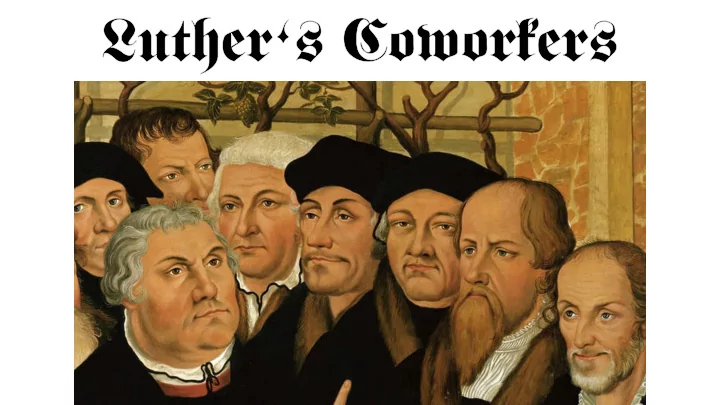
SLIDE 1
SLIDE 2
Philip Melanchthon: Luther’s Right-Hand Man
SLIDE 3 Youth
- Family name was Schwartzerd (“Black Earth”)
- Child prodigy
➢ Began university at the age of 12 ➢BA at 14 from University of Heidelberg ➢MA at age 17 from University of Tubingen ➢Went to teach at Wittenberg in 1518, taught theology after 1519
- Humanist – classics, rehetoric, education
SLIDE 4 Melanchthon and Luther
- Taught Luther Greek
- Assisted Luther at the Leipzig
Debate (1519)
- Helped translate the Bible
- Participated at the Marburg
Colloquy (1529)
- Represented Luther at the Diet
- f Augsburg (1530)
SLIDE 5 As a Reformer
- Irenic, great concern to maintain the unity of the church
Luther: “Philip also stabs, but only with awls and needles. Such stabs are hard to heal, and they hurt. I, on the other hand, stab with boar spears.” “But regarding the pope, I hold that, if he would allow the Gospel, we could agree to his superiority over the bishops, which he has
- therwise taken by human right. This would be for the sake of peace
and the general unity of those Christians who are also under him and may be under him hereafter.”
SLIDE 6
Teaching ability
Melanchthon took Luther’s theology and gave it precise and clear definitions that could be grasped by students and pastors. Emphasized system and order to instruct people in God’s Word. Luther: “I cannot combine conciseness and clearness as does Philip.”
SLIDE 7 Loci Communes (Common Topics) 1521
- First Lutheran dogmatics
- Revised by Melanchthon many
times
- Final 1559 edition was four
times the length of the original
- The basis of Lutheran theological
instruction for generations
SLIDE 8
Purpose:
“There is benefit in having firm and clear testimonies regarding individual articles of Christian doctrine set forth in definite order, as if they were put on a table. Then when our minds are confused or in distress, certain clear statements can be kept in mind which will remove our anxieties, direct our minds, and strengthen and confirm them”
SLIDE 9
Basis of theology
Scripture alone. Philosophy and reason have no place as a source of theology: “The first thing we must know is this, that to seek the will of God without the Word of God or in opposition to it is utterly wrong, for God does not wish us to know Him, neither can we know Him, except through the Word which He has given us, as Scripture everywhere teaches.”
SLIDE 10 Topics treated
Human Powers (especially free will) Sin Law the Gospel Grace Justification and Faith The Distinction between the Old and New Testament and the Abrogation of the Law Signs (the Sacraments) Love Magistrates Scandal
“Just as there are some subjects among these that are completely incomprehensible, so there are some that Christ wants every Christian to know most intimately….whoever is ignorant of the
- ther topics—the power of sin, the Law,
grace—I do not know how I can call him a
- Christian. For through these topics Christ
is properly known…to know Christ is to know his benefits….This, finally, is Christian knowledge—to know what the Law demands, where to find the power to fulfill the Law, where to claim grace for sins, how to strengthen a wavering soul against the devil, the flesh, and the world, and how to console the afflicted conscience.”
SLIDE 11 First Lutheran writing on biblical interpretation
- Scripture interprets Scripture
- The intended meaning of Scripture is based on the grammar. This is
the basis of any interpretation
- Scripture is united in what it teaches, summarized under the
distinction between Law and Gospel
- Scripture is clear
- Scripture alone is the source and norm of all Christian teaching and
the power in the Christian’s life
SLIDE 12 Melanchthon & the Lutheran Confessions
- Two-fifths of the Book of Concord comes from Melanchthon’s pen:
Augsburg Confession (1530) Apology of the Augsburg Confession (1531) Treatise on the Power and Primacy of the Pope (1537)
- More pages than Luther’s writings
- Three of the six authors of the Formula of Concord were
Melanchthon’s students (Martin Chemnitz, Nicholas Selnecker, and David Chytraeus)
SLIDE 13 Augsburg Confession X
1530
Our churches teach that the body and blood of Christ are truly present and distributed to those who eat the Lord’s Supper. They reject those who teach otherwise.
1540 (Variata)
Concerning the Supper of the Lord, they [our churches] teach that with the bread and wine the body and blood of Christ are
- ffered to those who eat in the
Lord’s Supper.
SLIDE 14
Johannes Bugenhagen: Luther’s Pastor
SLIDE 15 Early Life
- Born in Pomerania (modern Poland)
- Attended University of Greifswald
- Rector of Latin School, ordained a priest
- Read Luther’s earliest published writings, became convinced that
Luther was right
- Went to Wittenberg, studied at the University and became a doctor of
theology and served on the faculty
SLIDE 16 In Wittenberg
- Pastor of St. Mary’s from 1523 until his
death
- First reformer to marry (1522)
- Popularizer of the Reformation: could
take difficult ideas and make them clear and understandable for lay people
- Emphasis on good works as the fruit of
faith – education and care for the poor
SLIDE 17 Reformer of the North
Took Luther’s theology and brought it into the forms and structures of congregational life in Saxony and beyond to much of northern Europe
- Worship life
- Education
- Care for the poor
SLIDE 18
SLIDE 19 Bugenhagen and Luther
- Luther’s pastor
- Luther considered him one of
the most capable theologians he knew
- Ardent defender of Luther’s
theology
- Preached Luther’s funeral
sermon
SLIDE 20 Johannes Brenz: Reformer and Defender
SLIDE 21 Early life
- Father was a baker
- Born near Stuttgart
- Studied at Heidelberg
- Heard Luther at the Heidelberg
Disputation of 1518
SLIDE 22 As a Reformer
- Pastor in Schwäbisch-Hall, introduced the Reformation gradually
- Firm supporter of Luther’s theology of the Lord’s Supper against the
Reformed
- Christian education
- Catechism
- Sermons
- Commentaries
- Numerous church orders in Southern Germany