Physical and Statistical Models for Optical Imaging of Food Quality - PowerPoint PPT Presentation
Physical and Statistical Models for Optical Imaging of Food Quality National Food Institute Day 20 May 2016 Jeppe Revall Frisvad Associate Professor DTU Compute Why inspect food quality? Consumers expect Large diversity of food
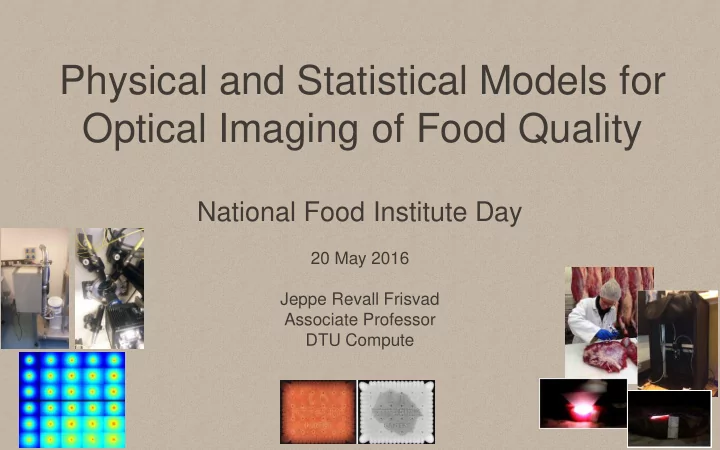
Physical and Statistical Models for Optical Imaging of Food Quality National Food Institute Day 20 May 2016 Jeppe Revall Frisvad Associate Professor DTU Compute
Why inspect food quality? • Consumers expect – Large diversity of food products – Uniformly high quality http://niemagazine.com/consumers-dictate-natural-sensory-qualities/ – Fulfillment of both culinary and nutritional demands – Highest food safety standards • We need efficient quality assessment and inline process control.
Why optical imaging? • Food appearance carries information on – Size, shape, and color (obviously) – Organoleptic parameters (flavor, taste) – Texture, stability, and mouthfeel – Moisture content and storability – Ingredients: amounts of constituents • Computer vision sensors enable noninvasive inline monitoring of food appearance.
Optical imaging methods • Multispectral imaging example Transmission filters Controled illumination VidemeterLab • Hyperspectral imaging example Static Light Scattering (SLS) instrument Pushbroom Acousto-Optic Tuneable Filter (AOTF)
Optical imaging methods • Grating-based X-ray imaging
Multispectral imaging ultraviolet near-infrared (UV) (NIR) nm 200 300 400 500 600 700 800 900 1000 N images obtained at N specific wavelengths
Example: biscuit quality a. Biscuit with water drop in the centre (sRGB) b. Spectrally extracted water absorption map a. c. b. c. Predicted %Moisture from 8 spectral image features versus the %Moisture from evaporation device.
Example: biscuit quality • Normalized canonical discriminant analysis for measuring yellow/red – higher browning – browning index bluish – conforming – glazing vs. non-glazing darker gray – glazing lighter gray – non-glazing
Example: meat study with DMRI Minolta colorimeter VideometerLab Meat Raw samples Cooked
Example: meat study with DMRI • Both instruments discriminate between raw and cooked meat. • Problems in using a colorimeter: – Integrates over large surface patch (misses variations). – Light penetration depth too large (not good for bright red meat at early days of display). – No spectroscopy. • Computer vision systems colorimeter projector solve these problems.
Example: Salami study with DuPont • Salami fermentation process after production. Days: 2 3 9 Segmentation of background and of meat from fat 42 Days: 14 21
Example: Salami study with DuPont • Statistical meat color scale – Darker blue is fresh meat – Yellow and orange represent fermented meat Significant color Days: 2 42 difference between chilled and non-chilled.
Hyperspectral imaging sample image lab setup in situ setup (log transformed, false colours) Milk (1.5% ), at 900 nm
Example: milk fermentation • Spectroscopy for measuring scattering and absorption properties. infer optical properties reduced scattering [1/cm] absorption [1/cm] extract profile yogurt spectroscopy milk oblique incidence wavelength [nm] wavelength [nm] reflectometry
Example: milk fermentation Statistical profile analysis Physical model for particle sizing for estimating viscosity based on optical properties
Grating-based X-ray imaging • When we need to investigate subsurface features. • Three contrast mechanisms are used in grating-based imaging:
Example: heated meat products • Evaluating heat induced changes of micro- structure and cooking loss. Beef Meat emulsion Raw Boiled Lard Sunflower oil
Example: detecting foreign objects Combined multimodal intensity and texture features give best detection results. Normal food model 1 2 3 4 5 6 7 8 Absorption Phase contrast Dark field 1 2 3 4 5 6 7 8 Detection rates
Conclusion • Optical imaging is very useful when moving toward more and better automation in food quality control. • Choice of instrument is important: – VideometerLab is good for detecting spectroscopic differences between different sample regions. – Static light scattering (SLS) is good for detecting emulsion differences in seemingly similar substances. – Grating-based X-ray imaging is good for detecting foreign objects or subsurface/volumetric features.
Credits • Camilla Himmelstrup Trinderup (postdoc, DTU Compute) • Otto Højager Attermann Abildgaard (PhD, DTU Compute Alumnus) • Hildur Einarsdóttir (PhD student, DTU Compute) • Jens Michael Carstensen (Associate Professor, DTU Compute) • Line Harder Clemmensen (Associate Professor, DTU Compute) • Jacob Lercke Skytte (postdoc, DTU Food) • Sara Sharifzadeh (PhD, DTU Compute Alumna) • Knut Conradsen (Professor, DTU Compute) • Anders Bjorholm Dahl (Head of Image Section, DTU Compute) • Bjarne Ersbøll (Head of Statistics Section, DTU Compute) • Rasmus Larsen (Head of Department, DTU Compute) • Research projects: CIFQ and NEXIM
Thank you for your attention • Computing milk appearance using light scattering by fat and protein particles. water vitamin B2 casein milk fat skimmed reduced fat whole products constituents
Recommend
More recommend
Explore More Topics
Stay informed with curated content and fresh updates.