
SLIDE 1
www.dunsky.com
(514) 504-9030 | info@dunsky.com
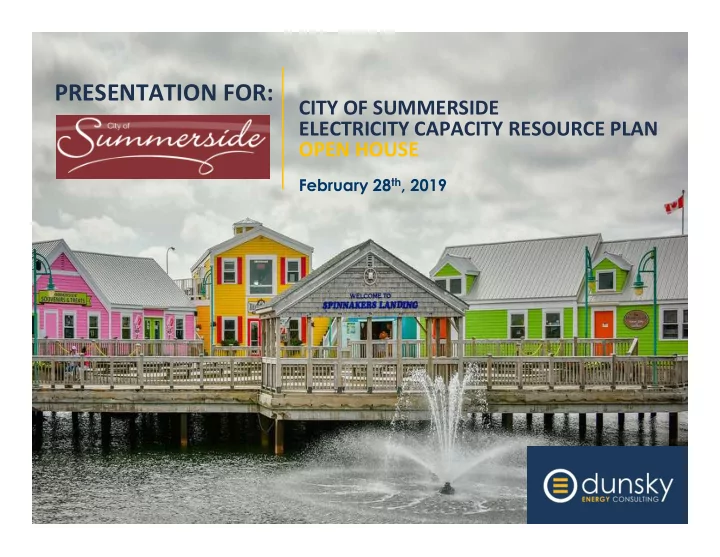
CITY OF SUMMERSIDE ELECTRICITY CAPACITY RESOURCE PLAN OPEN HOUSE
February 28th, 2019
PRESENTATION FOR:
PRESENTATION FOR: CITY OF SUMMERSIDE ELECTRICITY CAPACITY RESOURCE - - PowerPoint PPT Presentation
PRESENTATION FOR: CITY OF SUMMERSIDE ELECTRICITY CAPACITY RESOURCE PLAN OPEN HOUSE February 28 th , 2019 www. dunsky.com (514) 504-9030 | info@dunsky.com DUNSKY OVERVIEW EXPERTISE SERVICES ASSESS DESIGN EVALUATE EFFICIENCY RENEWABLES
www.dunsky.com
(514) 504-9030 | info@dunsky.com
CITY OF SUMMERSIDE ELECTRICITY CAPACITY RESOURCE PLAN OPEN HOUSE
February 28th, 2019
PRESENTATION FOR:
2
SERVICES EXPERTISE
ASSESS
DESIGN
strategies
EVALUATE
performance
EFFICIENCY RENEWABLES MOBILITY
CLIENTELE*
Governments ▪ Utilities ▪ ▪ Private firms ▪ Non-profits
* selection of clients
3
INTRODUCTION TO CAPACITY PLANNING INTRODUCTION TO CAPACITY PLANNING CAPACITY OPTIONS CAPACITY OPTIONS QUESTIONS & DISCUSSION QUESTIONS & DISCUSSION CONTEXT OF THE STUDY CONTEXT OF THE STUDY NEXT STEPS NEXT STEPS RECOMMENDATION RECOMMENDATION
4
PROJECT OVERVIEW
The City of Summerside hired Dunsky to study options and make recommendations on how to deal with Summerside Electric’s capacity needs 15 years into the future.
Understanding Summerside’s System Compile Capacity Planning Requirements Confirm the Peak Load Forecast Initial Stakeholder Input to Inform Analysis Comparative Analysis of Capacity Resource Characteristics and Costs Draft Recommendations and Presentation Refine Recommendations
5
CAPACITY AND ITS ROLE
6
INTRODUCTION TO CAPACITY PLANNING
Forecasting what is needed to meet customers’ demands for electricity at all times given foreseeable emergencies and contingencies.
North American Electric Reliability Corporation (NERC) reliability standards.
7
INTRODUCTION TO CAPACITY PLANNING
More efficient/cost-effective for general, everyday purposes such as driving to work
With capacity planning, we need to plan for those days when we need the extra space. The rationale for buying a car for regular, everyday use represents energy planning: How much energy do we need over the course of the year, and how do we provide it in a cost-effective and sustainable way?
Required for family outings and events, when everyone needs to fit
The rationale for buying a van (or ensuring that one is available) for those times when we need more space represents capacity planning: How much energy do we need at those few times when demand for energy (or space, in the case of our analogy) is highest?
8
INTRODUCTION TO CAPACITY PLANNING
Image from: https://consequential-lca.org/clca/the-functional-unit/determining-market-boundaries/example-temporal-markets-electricity/
9
INTRODUCTION TO CAPACITY PLANNING
10
WHAT WE’RE DOING AND WHY WE’RE DOING IT
11
PROJECT OVERVIEW
10 15 20 25 30 35 40 45 50 2019 2020 2021 2022 2023 2024 2025 2026 2027 2028 2029 2030 2031 2032 2033 2034 2035
Capacity (MW)
Diesel Wind Imports Demand-Side Capacity Requirements (MW)
42 MW Deficit Existing Plan and Commitments Gap to be Addressed by Capacity Planning Study
12
13
CAPACITY OPTIONS
Petrodiesel
Biodiesel
Storage
Supply-Side Options to Pursue
Storage
Storage
Supply-Side Options Not to Pursue
(HFLN)
Program Demand-Side Options Identifying Capacity Options Qualitative Evaluation Quantitative Assessment Recommended Capacity Option
14
CAPACITY OPTIONS
Identifying Capacity Options Qualitative Evaluation Quantitative Assessment Recommended Capacity Option
Type of Objective Attribute Definition/Description Policy Approvable Acceptable to policy makers and citizenry Low Cost Does not significantly increase electric rates GHG Intensity Qualitative assessment of level of GHG emissions in comparison to
Renewable Resources that are replenished on a human timescale Technical Black Start Provides the ability to restore an electrical system’s operations without relying on an external transmission network to recover from a shutdown (known as “black start” capability) Reliable Available to serve winter peak load; meets NERC requirements Resilient Available during long-duration outage events Policy & Technical Secure Located on-Island Diversity Contributes to greater fuel and/or technology diversity on the system Modular & Scalable Can be installed in smaller increments over time instead of in one large investment
15
CAPACITY OPTIONS
Identifying Capacity Options Qualitative Evaluation Quantitative Assessment Recommended Capacity Option Meets Technical Objectives Meets Policy Objectives
Municipal Solid Waste Biomass Wind Grid-Scale Battery Storage Biodiesel Generator Heat-For-Less-Now Program Expansion Diesel Generator Behind-the-Meter Batteries New Brunswick Power Imports Interruptible Load Program Expansion
16
CAPACITY OPTIONS
Identifying Capacity Options Qualitative Evaluation
Quantitative Assessment Recommended Capacity Option
Selected for Quantitative Analysis:
17
18
ANALYSIS RESULTS
Demand-side options have the most advantageous business case to Summerside Based on projected cost assumptions for imports, every assessed option has a positive economic case relative to imports either immediately or in the medium term (2025) All analyzed capacity options result in a reduction in revenue requirements No single capacity option except for imports is capable of covering all of Summerside’s future capacity deficit
19
ANALYSIS RESULTS
Options Levelized Unit Cost ($/kW/year) Net Present Value (NPV) Average Revenue Requirement Impacts (% over lifetime) % of Capacity Resources On- Island (by 2035) Relative GHG Emissions (qualitative) Imports (Baseline against which alternatives are compared) Diesel 2020 $ 96 $ 0.2 M
49% High 2025 $ 96 $ 3.2 M
49% High Heat for Less Now $ 72 $ 7.0 M
36% Low Interruptible Load $ 12 $ 3.4 M
28% Medium Battery Storage 2020 $ 249 ($ 4.2 M) + 1.4% 31% Low 2025 $ 166 $ 1.7 M
31% Low 2030 $ 120 $ 4.4 M
31% Low Biodiesel 2020 $ 97 ($ 0.8 M)
49% Medium 2025 $ 97 $ 2.4 M
49% Medium Most desirable Least desirable
20
21
RECOMMENDATION
2020
3.3 MW Interruptible Load 2.3 MW of HFLN migrated to direct-control 4.6 MW of new HFLN capacity
2023 - 2025
5 MW battery at cost- effectiveness
2025 2028
2030
Additional 5 MW of storage capacity
2034
12 MW
9 MW West Cape Wind
A staged approach that “stacks” multiple capacity sources rather than relying on one option only may allow Summerside to meet its goal of supplying a greater share of its capacity needs with on- Island resources.
22
RECOMMENDATION
23
RECOMMENDATION
Capacity Options Levelized Cost
($/kW/year) Net Present Value Average Revenue Requirements Impacts Over Lifetime % of Capacity Resources on- Island by 2035 Recommendation $52 $18.9M
100%
Recommendation results in positive NPV and net-positive cash-flow beginning in 2020. Results in a decline in Summerside’s revenue requirement as a result of the avoided energy and capacity import costs.
24
RECOMMENDATION
Secure, reliable and diverse resource mix Maintains flexibility moving forward, despite fast-paced technological and policy changes
Avoids technology lock-in (e.g. investing in an option that may become too outdated in comparison to other emerging opportunities) Hedges against technology innovation (e.g., emerging technologies or significant cost reductions in newer options) Allows Summerside to adapt its system to changing conditions (e.g. electrification of heating and transportation) Enables adaptation to changing policy directions and considerations related to increasing demand for renewable energy Allows additional analysis prior to any particular option being implemented (for example, the ability to decommission existing diesel generators earlier or adding imports for diversity purposes)
25
RECOMMENDATION
While imports are not included in the presented analysis, they can be a beneficial part of Summerside’s electric system:
Enhances ability to monitor technology advancements
less effective
Increases diversity of supply
Enables demand-side opportunities analysis
Role of imports
No single option should exceed 50% of the portfolio Performance of resources should not be closely correlated Stagger lifetimes of resources
26
27
SCHEDULE & NEXT STEPS
Receive and engage with stakeholder input
Understand Summerside’s System Compile Capacity Planning Requirements Confirm the Peak Load Forecast Initial Stakeholder Input to Inform Analysis Comparative Analysis of Capacity Resource Characteristics and Costs Draft Recommendations and Presentation Refine Recommendations
Revise report as necessary Submit final report to City
28
dunsky.com
LEARN MORE CONTACT
Julie-Ann Vincent
Senior Consultant julie-ann.vincent@dunsky.com (902) 222-7533