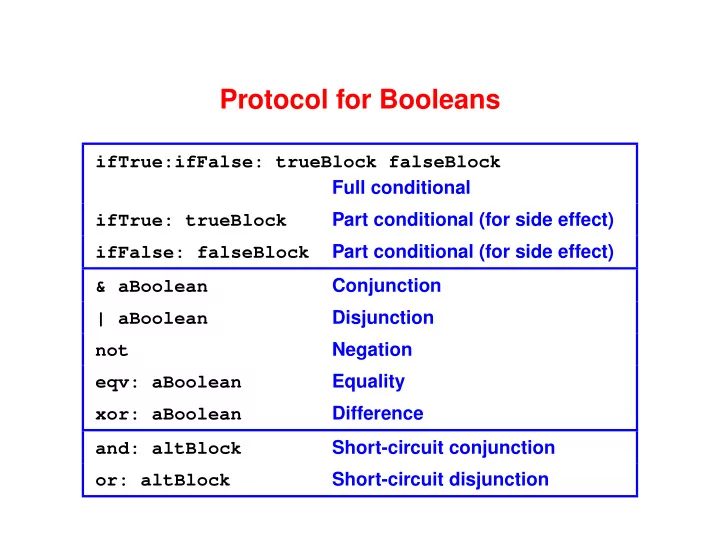
SLIDE 1 Protocol for Booleans
ifTrue:ifFalse: trueBlock falseBlock Full conditional ifTrue: trueBlock Part conditional (for side effect) ifFalse: falseBlock Part conditional (for side effect) & aBoolean Conjunction | aBoolean Disjunction not Negation eqv: aBoolean Equality xor: aBoolean Difference and: altBlock Short-circuit conjunction
Short-circuit disjunction
SLIDE 2
Classes True and False
(class True Boolean [] (method ifTrue:ifFalse: (trueBlock falseBlock) (value trueBlock)) ) (class False Boolean [] (method ifTrue:ifFalse: (trueBlock falseBlock) (value falseBlock)) )
What happens if ifTrue: is sent to true?
SLIDE 3
ifTrue: message dispatched to class Boolean
(class Boolean Object [] (method ifTrue:ifFalse: (trueBlock falseBlock) (subclassResponsibility self)) (method ifTrue: (trueBlock) (ifTrue:ifFalse: self trueBlock {})) ... )
Message sent to self starts over (with class of receiver)
SLIDE 4
Dispatching to True
(class True Boolean [] (method ifTrue:ifFalse: (trueBlock falseBlock) (value trueBlock)) ; all other methods are inherited )
SLIDE 5 Your turn: not
What should not look like?
- Implemented on what class?
- With what method definition?
SLIDE 6
Implementing not
(class Boolean Object [] (method ifTrue:ifFalse: (trueBlock falseBlock) (subclassResponsibility self)) (method ifTrue: (trueBlock) (ifTrue:ifFalse: self trueBlock {})) (method not () (ifTrue:ifFalse: self {false} {true})) ... )
SLIDE 7 Inheritance for Booleans
Boolean True False Boolean is abstract class
- Instances of True and False only
Method ifTrue:ifFalse: defined on True and False All others defined on Boolean
SLIDE 8 Each class has one of two roles
Abstract class
- Meant to be inherited from
- Some (
> 0) subclassResponsibility methods
- Examples: Boolean, Shape, Collection
Regular (“concrete”) class
- Meant to be instantiated
- No subclassResponsibility methods
- Examples: True, Triangle, List
SLIDE 9 Syntax comparison: Impcore to Smalltalk
Exp = LITERAL of rep | VAR
| SET
| IF
| WHILE
| BEGIN
| APPLY
| SEND
| BLOCK
SLIDE 10
“Number hierarchy”
Object Magnitude Number Fraction Float Integer
SLIDE 11
“Extended Number hierarchy”
Object Magnitude Natural Number Fraction Float Integer SmallInteger LargeInteger LargePositiveInteger LargeNegativeInteger
SLIDE 12 Instance protocol for Magnitude
= aMagnitude equality (like Magnitudes) < aMagnitude comparison (ditto) > aMagnitude comparison (ditto) <= aMagnitude comparison (ditto) >= aMagnitude comparison (ditto) min: aMagnitude minimum (ditto) max: aMagnitude maximum (ditto) Subclasses: Date, Natural
- Compare Date with Date, Natural w/Natural, . . .
SLIDE 13 Your turn: object-oriented design
= aMagnitude equality < aMagnitude comparison > aMagnitude comparison <= aMagnitude comparison >= aMagnitude comparison min: aMagnitude minimum max: aMagnitude maximum Questions:
- Which methods “subclass responsibility”?
- Which methods on Magnitude?
SLIDE 14
Implementation of Magnitude
(class Magnitude Object [] ; abstract class (method = (x) (subclassResponsibility self)) ; may not inherit = from Object (method < (x) (subclassResponsibility self)) (method > (y) (< y self)) (method <= (x) (not (> self x))) (method >= (x) (not (< self x))) (method min: (aMagnitude) (if (< self aMagnitude) {self} {aMagnitude})) (method max: (aMagnitude) (if (> self aMagnitude) {self} {aMagnitude})) )
SLIDE 15 Instance protocol for Number
negated reciprocal abs absolute value + aNumber addition
subtraction * aNumber multiplication / aNumber division (converted!) negative sign check nonnegative sign check strictlyPositive sign check
SLIDE 16
More instance protocol for Number
coerce: aNumber class of receiver, value of argument asInteger conversion asFraction conversion asFloat conversion
SLIDE 17 Your turn: Object-oriented design
Given Magnitude, minimal set of these methods: negated * coerce: reciprocal / asInteger abs negative asFraction + nonnegative asFloat
SLIDE 18
Number methods
(method - (y) (+ self (negated y))) (method abs () (ifTrue:IfFalse (negative self) {(negated self)} {self})) (method / (y) (* self (reciprocal y))) (method negative () (< self (coerce: self 0))) (method nonnegative () (>= self (coerce: self 0))) (method strictlyPositive () (> self (coerce: self 0)))
SLIDE 19
“Collection hierarchy”
Collection Set KeyedCollection Dictionary SequenceableCollection List Array
SLIDE 20 Collection mutators
add: newObject Add argument addAll: aCollection Add every element of arg remove: oldObject Remove arg, error if absent remove:ifAbsent: oldObject exnBlock Remove the argument, evaluate exnBlock if absent removeAll: aCollection Remove every element
SLIDE 21 Collection observers
isEmpty Is it empty? size How many elements? includes: anObject Does receiver contain arg?
- ccurrencesOf: anObject How many times?
detect: aBlock Find and answer element satisfying aBlock (cf
Scheme exists?)
detect:ifNone: aBlock exnBlock Detect, recover if none asSet Set of receiver’s elements
SLIDE 22
Collection iterators
do: aBlock For each element x, evaluate (value aBlock x). inject:into: thisValue binaryBlock Essentially
Scheme foldl
select: aBlock Essentially
Scheme filter
reject: aBlock Filter for not satisfying aBlock collect: aBlock Essentially
Scheme map
SLIDE 23
Implementing collections
(class Collection Object [] ; abstract (method do: (aBlock) (subclassResponsibility self)) (method add: (newObject) (subclassResponsibility self)) (method remove:ifAbsent (oldObj exnBlock) (subclassResponsibility self)) (method species () (subclassResponsibility self))
hother methods of class Collectioni
)
SLIDE 24
Reusable methods
hother methods of class Collectioni=
(method addAll: (aCollection) (do: aCollection [block(x) (add: self x)]) aCollection) (method size () [locals temp] (set temp 0) (do: self [block(_) (set temp (+ temp 1))]) temp) These methods always work Subclasses can override (redefine) with more efficient versions
SLIDE 25
species method
Create “collection like the reciever” Example: filtering
hother methods of class Collectioni=
(method select: (aBlock) [locals temp] (set temp (new (species self))) (do: self [block (x) (ifTrue: (value aBlock x) {(add: temp x)})]) temp)