
SLIDE 1
1
RaySense Fiber Optic Distributed Acoustic Sensing for Pipeline - - PowerPoint PPT Presentation
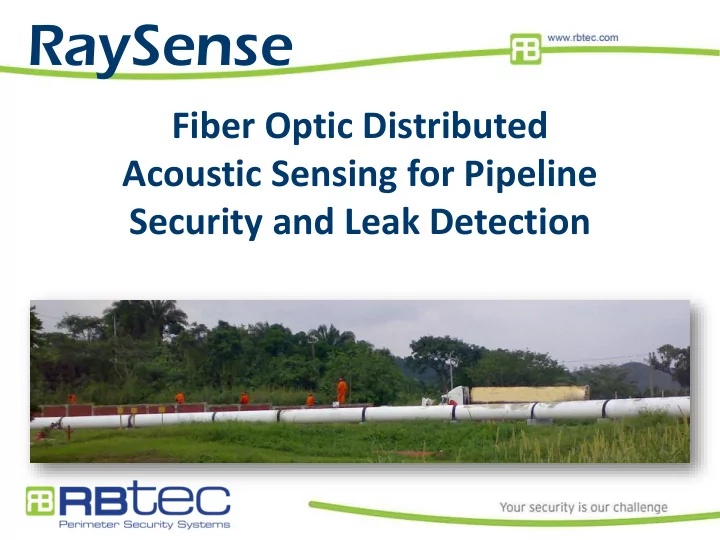
RaySense Fiber Optic Distributed Acoustic Sensing for Pipeline Security and Leak Detection 1 P IPELINE M ONITORING AND S ECURITY The oil & gas industry is currently facing a serious challenge in assuring spill and accident free operations
1
2
The oil & gas industry is currently facing a serious challenge in assuring spill and accident free operations of pipelines and associated infrastructure. To help meet the challenge of a zero incident target, the oil & gas industry must improve its technologies and ability to monitor their systems for safety in real time – permanently and distributed along the length of the pipeline network. RaySense Fiber optic pipeline monitoring and security products are designed to provide a complete monitoring with no gaps, automated, real-time pipeline solution for prevention and corrective control of the most undesirable and dangerous events that can occur to pipelines, such as leaks and third party interference (TPI). These systems are designed to protect oil/gas/liquid pipelines and utility right of way corridors against TPI, including illegal tapping and unauthorized excavation, by providing an early warning of these TPI activities – it is a preventative solution. The ability to detect small leaks is a further advantage offered by fiber optics.
3
4
5
RBtec has a unique Distributed Vibration Sensor (DVS) system that is practical and effective in the prevention of oil or gas spills due to its unique ability to detect, locate and classify vibrations caused by physical activity (such as third party interference), while simultaneously monitoring for early-stage leaks, along the entire length of the pipeline, in real-time.
In comparison with other competing technologies, RaySense is distinguished by the following main operational capabilities:
extremely broad frequency range (3Hz to 500kHz) and is the world’s first and only distributed ultrasonic detector. As a result, it can detect and locate early-stage leaks, directly and much earlier than other cable-based systems.
environmental/traffic noises from potentially dangerous operational events/threats. By reducing nuisance alarms, it alarms for events of true concern with an increased degree of confidence and thus allows for automatic response mechanisms with a practical degree of responsibility.
6
The features of the RaySense system are:
associated with TPI events and the very high range (ultrasonics) associated with early leak detection (nearest competitor has 20kHz).
more robust, lower power consumption) - not based on commercial computers, no cooling required.
significantly reduces amount of data produced (KB/MB vs GB/TB) and enables more events to be simultaneously processed – reducing computing power and post-processing requirements.
telecoms, SCADA, CCTC transmission, PIDS integration, etc.
7
8 *Not to scale
Surface activities are detected by the highly sensitive buried sensor cable
9
Buried Pipeline Location of cable is variable. Three optional locations shown. Only one cable is required. Typical Depth 30-100 Centimeters 12/ 40 Inches
*Not to scale
10
10
11
RBtec has a unique Distributed Vibration Sensor (DVS) system that is effective in the prevention of oil or gas spills due to its unique ability to detect, locate and classify vibrations caused by physical activity (such as third party interference), while simultaneously monitoring for early-stage leaks, along the entire length of the pipeline in real time. This unique technology acts as a continuous microphone, up to 50km in length, designed to “monitor” over an unprecedented quasi-DC to 500kHz bandwidth, to very distinctive frequencies generated by acoustic TPI and ultrasonic leak events, while discriminating between normal and ambient conditions. This is by far the widest frequency bandwidth available for any distributed fiber optic sensing technology, and is the world’s first distributed fiber
ultrasonic
frequency bandwidth of conventional DAS systems, which are typically <2kHz for a 40km reach. Another significant differentiating advantage of this transmissive, hybrid interferometer technology is that its frequency response and location resolution/accuracy are not degraded with increasing distance, unlike conventional DAS systems.
12
Fiber optic splicing pits with passive terminations RaySense APU’s
For long-haul pipeline applications, additional APU’s can be placed every 100km of cable, usually coinciding with compression or pump stations along the pipeline.
50km 50km 50km 50km
Distance between powered locations is 100km of cable
13
14
“monitor” over a quasi-DC to 500kHz bandwidth, to very distinctive frequencies generated by TPI and leak events, while discriminating between normal and ambient conditions.
pipelines, when the leak is small (pin-hole leak). As the hole increases in size, the frequency lowers to a point where audible sound is made and physical vibrations can be felt.
range, which makes it impossible to detect early, small leaks of pipelines.
detection (prior to audible sounds and physical vibrations being generated).
15
RAYSENSE WIDE-BANDWIDTH CAPABILITY
Feature of RaySense
16 Early Leak Detection TPI & Large Leak Detection
Ultrasonic Region >20kHz Acoustic Region <20kHz
TPI <10Hz Region DTS and Geotechnical Applications DTS/DSS Technologies DAS Technologies – at 40km – typical maximum frequency bandwidth of <2kHz DAS Technologies – at 1km – typical maximum frequency bandwidth of 10kHz Other transmissive Technologies – at 40km – maximum frequency bandwidth of 20kHz
RaySense – at 50km – frequency bandwidth of 3Hz to 500kHz
TPI Events
E N
Environmental Noise Acoustics and Ultrasonics of Leaks
17 RaySense LR Technology C-OTDR
Principal of signal to detect LR uses hybrid transmissive signal, so signal is large. Back Scatter signal is used, so signal is very small. Resolution Resolution is 6-20M/20’-65’ depend on soil condition through
so area of disturbance itself covers a larger space. More and more distance, resolution goes down.1 meter resolution up to 5KM, and then 10-20 Meters on 40 KM distance. Sensitivity Double sensitivity. Cable can put in conduit, even losing 20% sensitivity, it is still 160% compared with other sensors. Sensitivity will alter depend on longer distance. Sensing speed will slow down since system has to emit photonic signal and wait for return. Multi platform monitoring The LR can monitor pipeline, fences, walls and buried applications with the same processor. The system can monitor only one application. Handy-cap to handle huge data No - LR has no handy-cap with data size. So much big data analysis and algorism can be built.
Yes - C-OTDR has to handle huge data, so cannot make big data analysis unless hardware will be powerful. Massive data storage is vital.
Cost of hardware Very low cost for high performance. Very high cost. Bandwidth Entire Length of 50KM, 500K HZ bandwidth. Only technology to offer to detect up to Ultrasonic region. Change bandwidth depend on length. It will goes down to 2K Hz in case of 40KM. Responding speed No change depend on length Much longer, slower to complete calculations. Cable LR requires 3 normal single mode fibers in a cable. Specially designed fiber cable changes sensitivity for different soil conditions. Single cable, no special cable solution to improve sensing capability.
LR HAS HIGH PERFORMANCE OVER COMPETITIVE TECHNOLOGIES
18
All images are for illustration only
This document has been written and produced by RBtec to provide the reader with as much technical and other information as possible about RBtec its products and its services. Copying any of its contents without prior permission from RBtec is strictly prohibited. This information is provided for the purpose of initial evaluation of RBtec's products and services. In keeping with RBtec's policy of continuous development, RBtec Ltd. reserves the right to alter these specifications without notice.
Email: Info@rbtec.com www.rbtec.com