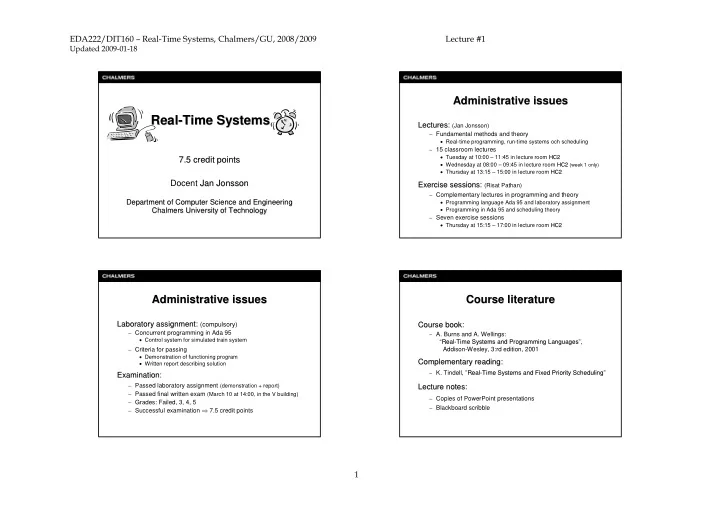
Real Real- -Time Systems Time Systems Lectures: (Jan Jonsson) - - PowerPoint PPT Presentation

real real time systems time systems
SMART_READER_LITE
LIVE PREVIEW

Real Real- -Time Systems Time Systems Lectures: (Jan Jonsson) - - PowerPoint PPT Presentation

EDA222/DIT160 Real-Time Systems, Chalmers/GU, 2008/2009 Lecture #1 Updated 2009-01-18 Administrative issues Administrative issues Real Real- -Time Systems Time Systems Lectures: (Jan Jonsson) Lectures Fundamental methods and theory


slide-1
SLIDE 1

EDA222/DIT160 – Real-Time Systems, Chalmers/GU, 2008/2009 Lecture #1

Updated 2009-01-18

1

Real Real-

  • Time Systems

Time Systems

7.5 credit points 7.5 credit points Docent Jan Jonsson Jan Jonsson

Department of Computer Science and Engineering Department of Computer Science and Engineering Chalmers University of Technology Chalmers University of Technology

Administrative issues Administrative issues

Lectures Lectures: (Jan Jonsson)

– Fundamental methods and theory

  • Real-time programming, run-time systems och scheduling

– 15 classroom lectures

  • Tuesday at 10:00 – 11:45 in lecture room HC2

HC2

  • Wednesday at 08:00 – 09:45 in lecture room HC2

HC2 (week 1 only)

  • Thursday at 13:15 – 15:00 in lecture room HC2

HC2

Exercise sessions Exercise sessions: (Risat Pathan)

– Complementary lectures in programming and theory

  • Programming language Ada 95 and laboratory assignment
  • Programming in Ada 95 and scheduling theory

– Seven exercise sessions

  • Thursday at 15:15 – 17:00 in lecture room HC2

HC2

Administrative issues Administrative issues

Laboratory assignment Laboratory assignment: (compulsory)

– Concurrent programming in Ada 95

  • Control system for simulated train system

– Criteria for passing

  • Demonstration of functioning program
  • Written report describing solution

Examination Examination:

– Passed laboratory assignment (demonstration + report) – Passed final written exam (March 10 at 14:00, in the V building) – Grades: Failed, 3, 4, 5 – Successful examination ⇒ 7.5 credit points

Course literature Course literature

Course book Course book:

– A. Burns and A. Wellings: “Real Real-

  • Time Systems and Programming Languages

Time Systems and Programming Languages”, Addison-Wesley, 3:rd edition, 2001

Complementary reading Complementary reading:

– K. Tindell, ”Real Real-

  • Time Systems and Fixed Priority Scheduling

Time Systems and Fixed Priority Scheduling”

Lecture notes Lecture notes:

– Copies of PowerPoint presentations – Blackboard scribble

slide-2
SLIDE 2

EDA222/DIT160 – Real-Time Systems, Chalmers/GU, 2008/2009 Lecture #1

Updated 2009-01-18

2

Information Information

Student reception Student reception:

– Wednesdays at 13:15 – 13:45 – Room 4479 (floor 4), EDIT building, Rännvägen 6 B

Student portal Student portal:

– Administration of laboratory assignment (form groups, booking) – Results from the grading of written exam and lab report

Information board Information board:

URL: http://www.cse.chalmers.se/edu/course/EDA222/ Lecture notes will be available on the information board no later than 48 hours before the corresponding lecture.

Course Course aim aim

After the After the course course, the student , the student should should be be able able to: to:

  • Construct concurrently executing software for real-time

applications that interface to input/output units such as sensors and actuators.

  • Describe the principles and mechanisms used for designing

real-time kernels and run-time systems.

  • Describe the mechanisms used for time-critical scheduling
  • f tasks.
  • Apply the basic analysis methods used for verifying the

temporal correctness of a set of executing tasks.

Course contents Course contents

What this course is all about: What this course is all about:

1. Construction methods for real-time systems

– Specification, implementation, verification – Application constraints: origin and implications

2. Programming of concurrent real-time programs

– Task and communication models (Ada95) – Low-level (I/O and interrupt) programming (Ada95)

3. Verification of system’s temporal correctness

– Fundamental scheduling theory – Derivation of worst-case task execution times

Course contents Course contents

What this course is What this course is not not about: about:

– Design of high-performance computer systems – Design of logically correct programs – Distributed computations in multiprocessor systems – Complexity theory for scheduling algorithms – Scheduling in overloaded systems – ... Presented in advanced course EDA421

slide-3
SLIDE 3

EDA222/DIT160 – Real-Time Systems, Chalmers/GU, 2008/2009 Lecture #1

Updated 2009-01-18

3

What is a real What is a real-

  • time system?

time system?

  • J. Stankovic, “Misconceptions of Real-Time Computing”, 1988

“A real-time system is one in which the correctness of the system depends not only on the logical result of computation, but also on the time at which the results are generated”

What is a real What is a real-

  • time system?

time system?

Real Real-

  • time systems

time systems must meet must meet timing constraints timing constraints High High-

  • performance computing

performance computing maximizes average maximizes average throughput throughput

Average performance says nothing about correctness! Average performance says nothing about correctness!

“ “A statistician drowned while crossing a stream A statistician drowned while crossing a stream that was, on average, 6 inches deep that was, on average, 6 inches deep” ” Real Real-

  • time system are instead usually optimized with respect to

time system are instead usually optimized with respect to perceived perceived ” ”robustness robustness” ” (control systems) or (control systems) or ” ”comfort comfort” ” (multimedia) (multimedia)

It is It is not only not only about high about high-

  • performance computing!

performance computing!

What is a real What is a real-

  • time system?

time system?

Properties of a real Properties of a real-

  • time system:

time system:

  • Strict timing constraints

– Responsiveness (deadlines), periodicity (sampling rate) – Constraints can (ought to) be verified

  • Application-specific design

– Embedded systems – Carefully specified system properties – Well-known operating environment

  • High reliability

– Thoroughly-tested components – Works even in presence of component faults (fault tolerance)

What is a real What is a real-

  • time system?

time system?

Examples of real Examples of real-

  • time systems:

time systems:

  • Control systems

– Manufacturing systems; process industry – Cars, aero planes, submarines, space shuttles

  • Transaction systems

– E-commerce; ticket booking; teller machines; stock exchange – Wireless phones; telephone switches

  • Multimedia

– Computer games; video-on-demand – Virtual reality

slide-4
SLIDE 4

EDA222/DIT160 – Real-Time Systems, Chalmers/GU, 2008/2009 Lecture #1

Updated 2009-01-18

4

Real Real-

  • time system components

time system components

P1 P2 P3 P4

Application software Target environment

N1

Processor architecture

N2 N3

Run-time system

S S S A A Operator panel Operator display Administrates scheduling and communication between executing tasks Application is organized as concurrent tasks tasks

Designing a real Designing a real-

  • time system

time system

Verification Implementation Specification

How should it be done? What should be done & When should it be done? Can it be done with the given implementation? New design!

Specification Specification

Reliability Sampling rate Response time Resources

Requirements Requirements: Constraints Constraints:

Replication Periodicity Deadline Locality

Specification Specification Implementation Implementation

Specification Specification

Examples of application constraints: Examples of application constraints:

  • Timing constraints

– A task must complete its execution within given time frames (example: task periodicity or deadline)

  • Exclusion constraints

– A task must execute a code region without being interrupted (example: a task needs exclusive access to a shared resource)

  • Precedence constraints

– A task must complete its execution before another task can start (example: a data exchange must take place between the tasks)

slide-5
SLIDE 5

EDA222/DIT160 – Real-Time Systems, Chalmers/GU, 2008/2009 Lecture #1

Updated 2009-01-18

5

Specification Specification

Where do the timing constraints come from? Where do the timing constraints come from?

  • Laws of nature

– Bodies in motion: arm movements in a robotic system – Inertia of the eye: minimal frame rate in film

  • Mathematical theory

– Control theory: recommended sampling rate

  • Component limitations

– Sensors and actuators: minimal time between operations

  • Artificial derivation

– Observable events: certain (global) timing constraints are given, but individual (local) timing constraints are needed

Specification Specification

If the system fails to fulfill a timing constraint, the computational results is useless. Non Non-

  • critical:

critical: system can still function with reduced performance

  • Navigational functions; diagnostics

Critical: Critical: system cannot continue to function

  • Flight control system; control loop

Safety Safety-

  • critical:

critical: can cause serious damage or even loss of life

  • Braking systems (ABS); defense system (missiles, robots)

Correctness must be verified before system is put in mission! Correctness must be verified before system is put in mission!

How critical are the constraints? How critical are the constraints?

Hard Hard constraints constraints: :

Specification Specification

Single failures to fulfill a timing constraint is acceptable, but the usefulness of the computational result is reduced (often to what can be considered useless).

  • Reservation systems: seat booking for aircraft; teller machine
  • E-commerce: stock trading, eBay
  • Multimedia: video-on-demand, computer games, Virtual Reality

Statistical guarantees often suffice for these systems! Statistical guarantees often suffice for these systems!

How critical are the constraints? How critical are the constraints?

Soft constraints Soft constraints: :

Implementation Implementation

Critical choices to be made at design time: Critical choices to be made at design time:

  • Programming paradigm:

– Sequential programming

  • Program is structured as one single “loop”
  • Ignores that the application has inherent concurrency

– Concurrent programming

  • Program is structured as multiple sequential tasks
  • Models the execution of multiple sequential task simultaneously

single-processor system: only pseudo-parallel execution possible multiprocessor system: true parallel execution possible

slide-6
SLIDE 6

EDA222/DIT160 – Real-Time Systems, Chalmers/GU, 2008/2009 Lecture #1

Updated 2009-01-18

6

Implementation Implementation

Critical choices to be made at design time: Critical choices to be made at design time:

  • Hardware architecture:

– Single or multiprocessor architecture

  • Determines degree of true parallelism that can be exploited

– Microprocessor family

  • RISC processor (pipelines, caches, support for multiprocessors)
  • Micro-controller (I/O ports, A/D-converters, no pipeline/cache)
  • Determines cost, performance, and difficulty in worst-case execution

time (WCET WCET) analysis

– Network topology

  • Shared media interconnection network
  • Point-to-point interconnection network

Implementation Implementation

Critical choices to be made at design time: Critical choices to be made at design time:

  • Run-time system:

– System services

  • Operating system (real-time kernel with system calls)
  • Stand-alone system (linked library with subroutine calls)

– Execution model

  • Time vs. priority-driven dispatching
  • Preemptive vs. non-preemptive execution

– Communication model

  • Time vs. token vs. priority-driven message passing

Verification Verification

Ad hoc testing: Ad hoc testing:

Run the system for ”a while” and let the absence of failures ”prove” the correctness

  • fast method that indicates that ”everything seems to work”
  • pathological cases can be overlooked during testing
  • too frequently used as the only method in industrial design

How do we verify the system? How do we verify the system?

Exhaustive testing: Exhaustive testing:

Verify all combinations of input data, time and faults

  • considers all possible cases
  • requires an unreasonable amount of time for testing

Verification Verification

Formal analysis of the implementation Formal analysis of the implementation: : How do we verify the system? How do we verify the system?

Verify temporal correctness using schedulability analysis

  • necessary for verifying hard-real-time systems
  • requires WCET for each task
  • requires support in programming language and run-time system

Verify logical correctness using ”proof machine”

  • requires dedicated description language
  • abstraction level very high (often implementation independent)

Results from the verification phase are only valid if all Results from the verification phase are only valid if all assumptions actually apply at run assumptions actually apply at run-

  • time!

time!

slide-7
SLIDE 7

EDA222/DIT160 – Real-Time Systems, Chalmers/GU, 2008/2009 Lecture #1

Updated 2009-01-18

7

Verification Verification

What sources of uncertainty exist in formal verification? What sources of uncertainty exist in formal verification?

  • Non-determinism in tasks’ WCET (undisturbed execution)

– Input data and internal state controls execution paths – Memory access patterns control delays in processor architecture (pipelines and cache memories)

  • Non-determinism in tasks’ execution interference

(pseudo-parallel execution)

– Run-time execution model controls interference pattern

  • Conflicts in tasks’ demands for shared resources

– (Pseudo-)parallel task execution may give rise to uncontrolled blocking of shared hardware and software resources

Verification Verification

How do we make formal verification possible? How do we make formal verification possible?

Aid #1: Avoid the worst difficulties Aid #1: Avoid the worst difficulties

– Use sequential programming

  • eliminates interference and conflicts between tasks

– Avoid programming using dynamic objects and complicated termination conditions for loops

  • simplifies the derivation of WCET

– Use a micro-controller, or a RISC processor but do not use performance enhancing mechanisms (pipeline and cache)

  • ”restricted” architecture that simplified derivations of WCET

Verification Verification

How do we make formal verification possible? How do we make formal verification possible?

Aid #2: Introduce support in the implementation Aid #2: Introduce support in the implementation

– Add rules for execution interference that introduces analyzable determinism

  • static or dynamic task priorities
  • preemptive task execution

– Add protocols for access to shared resources so that deadlock and uncontrolled blocking is eliminated

  • dynamic adjustments of task priorities
  • non-preemptive code sections (”critical regions”)