Real-Time Performance of Linux Among others: A Measurement-Based - - PDF document

real time performance of linux
SMART_READER_LITE
LIVE PREVIEW

Real-Time Performance of Linux Among others: A Measurement-Based - - PDF document

CPSC-663: Real-Time Systems Linux, Preemption, and Real-Time Real-Time Performance of Linux Among others: A Measurement-Based Analysis of the Real-Time Performance of Linux (L. Abeni , A. Goel, C. Krasic, J. Snow, J. Walpole) [RTAS

slide-1
SLIDE 1

CPSC-663: Real-Time Systems Linux, Preemption, and Real-Time 1

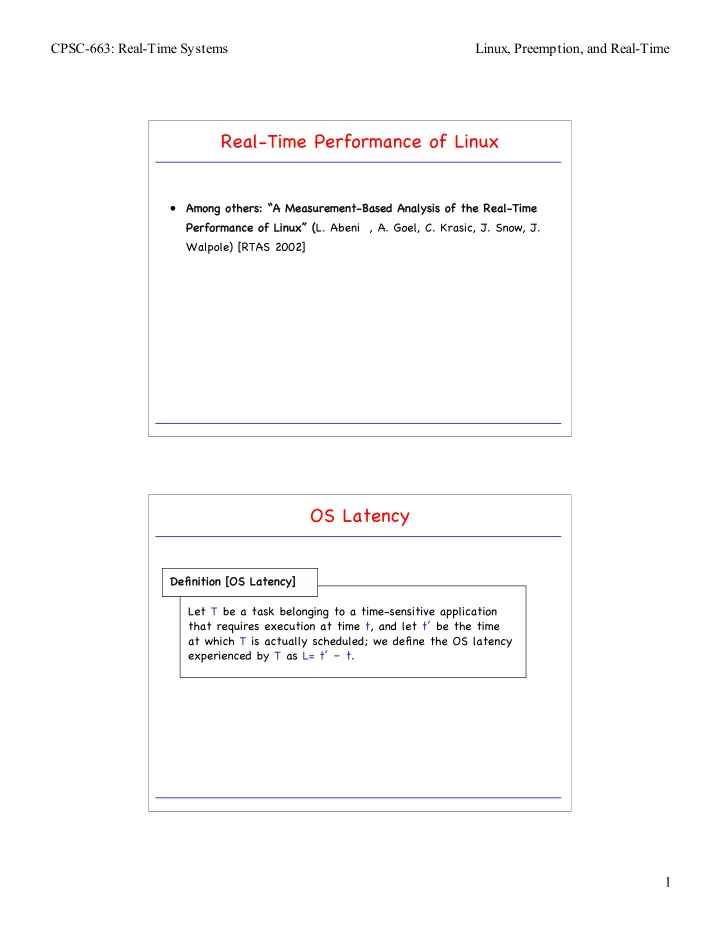
Real-Time Performance of Linux

  • Among others: “A Measurement-Based Analysis of the Real-Time

Performance of Linux” (L. Abeni , A. Goel, C. Krasic, J. Snow, J. Walpole) [RTAS 2002]

OS Latency

Defi finition [OS Latency] Let T be a task belonging to a time-sensitive application that requires execution at time t, and let t’ be the time at which T is actually scheduled; we define the OS latency experienced by T as L= t’ – t.

slide-2
SLIDE 2

CPSC-663: Real-Time Systems Linux, Preemption, and Real-Time 2

Sources of OS Latency

  • Timer Resolution (Ltimer)

– Timer are generally implemented using a periodic tick

  • interrupt. A task that sleeps for an arbitrary amount of time

can experience some timer resolution latency if its expected activation time is not on a tick boundary.

  • Scheduling Jitter (LSJ)

– Task is not highest in scheduling queue.

  • Non-Preemptable Portions (LNP)

– Latency can be caused by non-preemptable sections in kernel and in drivers. (e.g. ISRs, bottom halves, tasklets).

Timer Resolution

  • Standard Linux timers are triggered by a periodic tick interrupt.
  • On x86 machines it is generated by the Programmable Interval

Timer (PIT) with period Ttick = 10ms.

  • How about decreasing Ttick?
  • High-resolution timers using aperiodic interrupt capabilities in

modern APICs (Advanced Programmable Interrupt Controller).

  • Timer resolution possible in range of 4-6musec.
slide-3
SLIDE 3

CPSC-663: Real-Time Systems Linux, Preemption, and Real-Time 3

Non-Preemptable Section Latency

  • Standard Linux:

– monolithic structure of kernel. – Allows execution of at most one thread in kernel. This is achieved by disabling preemption when an execution flow enters the kernel, i.e., when an interrupt fires or when a system call is invoked. – Latency can be as large as 28ms.

  • Low-Latency Linux

– Insert explicit preemption points (re-scheduling points) inside the kernel. – Implemented in RED Linux and Andrew Morton’s low-latency patch.

  • Preemptable Linux

– To support full kernel preemptability, kernel data must be explicitly protected using mutexes or spinlocks. – Linux preemptable-kernel patch disables preemption only when spinlock is held. – Latency determined by max. amound of time for which a spinlock is held plus maximum time taken by ISRs, bottom halves, and tasklets.

  • Preemptable Lock-Breaking Linux

– Spinlocks are broken by releasing spinlocks at strategic points.

Preemptable Lock Breaking: Example

  • This function reclaims cached dentry structures in

fs/dchache.c

  • High-latency point.
  • Why count iteratins at all?
slide-4
SLIDE 4

CPSC-663: Real-Time Systems Linux, Preemption, and Real-Time 4

Test Programs

  • Measuring Ltimer:

– Run test task on lightly loaded system, to avoid Lnp. – Set up a periodic signal (using itimer())

  • Measuring Lnp:

– Run test task against background tasks – Test Task:

  • Read current time t1
  • Sleep for a time T
  • Read time t2, and compute Lnp = t2 - (t1 + T)

– How to read t1 and t2 ? ( gettimeofday() ?)

Measuring Lnp

  • Memory Stress:

– Page fault handler invoked repeatedly.

  • Console-Switch Stress:

– Console driver contains long non-preemptable paths.

  • I/O Stress:

– Systems calls that move large amounts of data between user and kernel space, or from kernel memory to hardware peripherals.

  • Procfs Stress:

– Concurrent access to /proc file system must be protected by non- preemptable sections.

  • Fork Stress:

– New processes created inside non-preemptable section and requires copying of large amounts of data. – Overhead of scheduler increases as number of active processes increases.

slide-5
SLIDE 5

CPSC-663: Real-Time Systems Linux, Preemption, and Real-Time 5

Timer Latency OS Non-Preemptable Section Latency

slide-6
SLIDE 6

CPSC-663: Real-Time Systems Linux, Preemption, and Real-Time 6

Background Load Tests

Standard Linux

Background Load Tests

Low-Latency Kernel

slide-7
SLIDE 7

CPSC-663: Real-Time Systems Linux, Preemption, and Real-Time 7

Background Load Tests

Preemptable Kernel

Background Load Tests

Lock-Breaking Preemptable Kernel

slide-8
SLIDE 8

CPSC-663: Real-Time Systems Linux, Preemption, and Real-Time 8

OS Non-Preemptable Portion Latency Non-Preemptable Portion Latency

slide-9
SLIDE 9

CPSC-663: Real-Time Systems Linux, Preemption, and Real-Time 9

Latencies Inter Frame Times