Retrospective on 10 Years of Modelling Human Dynamics: Never be - - PDF document

retrospective on 10 years of modelling human dynamics
SMART_READER_LITE
LIVE PREVIEW

Retrospective on 10 Years of Modelling Human Dynamics: Never be - - PDF document

Retrospective on 10 Years of Modelling Human Dynamics: Never be your own lawyer - Never model yourself Norman Lee Johnson Chief Scientist Referentia System Inc. Honolulu Hawaii norman@SantaFe.edu http:// CollectiveScience.com (Please see


slide-1
SLIDE 1

1

Norman Lee Johnson

Chief Scientist Referentia System Inc. Honolulu Hawaii

norman@SantaFe.edu http:// CollectiveScience.com (Please see the notes for descriptions of each slide)

Retrospective on 10 Years of Modelling Human Dynamics:

Never be your own lawyer - Never model yourself

Human Systems Dynamics - CSIRO Complex Systems Science Workshop April 2009

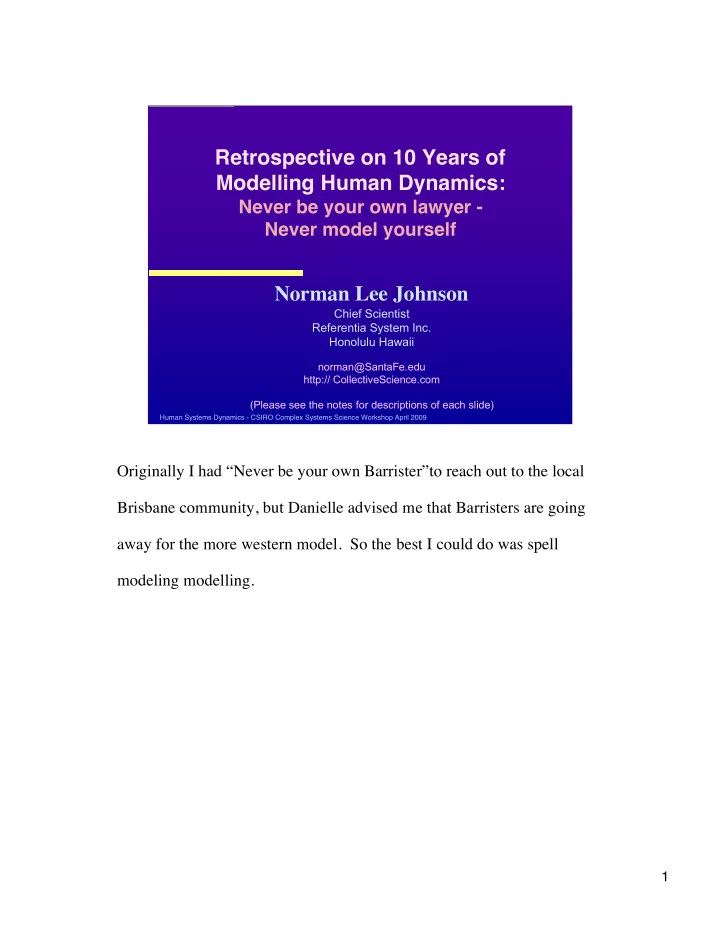
Originally I had “Never be your own Barrister”to reach out to the local Brisbane community, but Danielle advised me that Barristers are going away for the more western model. So the best I could do was spell modeling modelling.

slide-2
SLIDE 2

2

Diversity

Expert Performance in Modelling

Where Experts Have Value Simple Complex Domain Complexity Value of Experts

Michael Mauboussin - Legg Mason Capital Management

Value of Collectives

Complexity Barrier

I’ve reached my complexity barrier in individual modeling - Therefore the best I can do in this talk is to enable the “wisdom of this crowd” by:

  • provide awareness of our biases - making us more open to innovation
  • Setting up a common “world view: for exchange of ideas - so synergy

can happen

  • Identifying areas of opportunity
slide-3
SLIDE 3

3

Diversity

 Are you using “human dynamic” models?  Academic? Government? Company?  Are you a developer?  Is habitual behavior included?  Does the behavior change with need?  Does the behavior change with stress?  Is leadership included?  Does the model include emergent behavior?  Uniquely innovative behavior?  Are you satisfied with your model? Is it working for

your application?

 Is your model validated?  Do your agents behave like you? Are you unnaturally

attached to them?

Questions (with Plausible Deniability)

The point of these questions is to find out who you are, and to get you to listen and thinking about how the material applies to you. But also to highlight where I think there are some missing pieces in the work the community has done - for example addressing threshold changes of behavior. Interestingly there were mostly academics - say 90%, and the rest

  • government. And not companies represented.
slide-4
SLIDE 4

4

Diversity

 Star Wars  Novel fusion device  Novel diesel engine  Hydrogen fuel program  P&G  Biological Threat

Reduction & Homeland Security

Future of the internet

Self-organizing collectives

Diversity and emergent problem solving – Finance applications

Effects of rapid change – Finance applications

Group identity dynamics – Coexistence applications

Leadership models

Social software research

My Background

This illustrates how we even capture diversity in our jobs. On the left is what I did officially for 25 years at Los Alamos National Labs. At the is about. That said, there was a convergence at the end when I worked on Epidemiological simulations - which bought social behavior into the core science side on the left. right was what I did in my spare time and passion - which is what this talk

slide-5
SLIDE 5

5 Study of Human Dynamics: Three Components

Analysis perspectives

  • Optimization vs. robustness
  • Developmental perspective
  • Study of system thresholds
  • Interplay of structure and options
  • Emergent behavior via multi-level

analysis

Behavioral-social model features

  • Descriptive vs. predictive models
  • Individual threshold transitions
  • Collective performance
  • Group identity

Packaging results for decision makers

  • Focus on system threshold changes first
  • Validation requirements
  • Cost-benefit assessment using a transparent

method with uncertainty quantification

  • New social consensus tools

THis is the table of contents for the talk. I spent quite a bit of time trying to figure out how to organize the different topics and how to show where the challenges and opportunities are. This is what I came up with. The Analysis Perspectives are aspects of complex systems. The Behavioral-Social Models is self-explanatory. The Packaging for Decision Makers is how I think we have to package the results of the two boxes at the top. It is not enough to understand or model the

  • systems. You also have to package them in useful forms.
slide-6
SLIDE 6

6

  • Prediction of collective behavior is generally easier at

extremes of diversity or variation

Diversity and Collective Prediction

Low Diversity High Diversity Locally and Globally Predictable Globally Predictable Unpredictable The major “ah-ah” I had about social behavior was seen through the perspective of diversity: which can be technically viewed as distributions and how these enable prediction - with respect to diversity or heterogeneity of the

  • system. The above is one view of this perspective. Turns
  • ut that a little or a lot of diversity (that is well sampled) is

good for prediction. The qualifier “well-sampled” diversity is required because some systems have lots of diversity that is poorly interconnected (or rigidly connected) and therefore the diversity really doesn’t really get sampled, which has a major efgect on the dynamics or robustness of the system - a prime example is a senescent ecosystem: lots of diversity but very restrained interactions. Same is true for old economies.

slide-7
SLIDE 7

7

  • How does this translate to distribution functions?

Diversity and Collective Prediction

Low Diversity High Diversity Locally and Globally Predictable Globally Predictable Unpredictable

Problem distributions:

  • Discrete distributions
  • Multi-modal distributions
  • Long-tailed distributions

(e.g., power law, instead of Gaussian statistics)

p(ø) 1 p()

  • 1

So what causes distributions to be not “nice”? One list is given above. You can read lots on this looking at the work by Tsallis (more on this in a bit).

slide-8
SLIDE 8

8

Predictability is challenging when:

  • The complexity barrier was passed - strategies may not

lead to desired outcomes

  • Subjective or emotional evaluation dominates rather than
  • bjective evaluation (often a consequence of complexity)
  • The system has “calcified” - internal or external structures

lead to lack of robustness if change present.

  • New structures (e.g., technology changes) introduce new
  • ptions
  • New environment causes system to explore uncharted

responses

This is just an empirical list of how predictability breaks down. Some of the items show how distribution as limited or changed by structure are a useful viewpoint into prediction.

slide-9
SLIDE 9

9

Evolvability is challenged when:

  • The system has “calcified” - internal or external structures

lead to lack of robustness.

  • The complexity barrier was passed - strategies may not

lead to desired outcomes

  • Subjective evaluation dominates rather than objective

evaluation (often a consequence of complexity)

  • Habitual or peer-copying behavior dominates rational

choices

  • Low diversity limits exploration
  • Limited synergy between existing diversity limits

innovation

The other side of the coin of prediction is evolvability.

slide-10
SLIDE 10

10

Origin of “The Theory”

Theory of averages and outliers

Data generation Discovery

Analysis - Increasing levels of discovery:

  • Statistical characterization
  • Dimensionless functionality (correlations)
  • Scaling - self-similarity
  • Descriptive-predictive “Laws”
  • Functional relationships
  • Static
  • Dynamic (governing equations of change)
  • Higher moments (variation within)
  • Error generation - uncertainty quantification

This viewgraph illustrates the context and role of scaling or power laws in science (and business). Observations:

  • Most businesses stop at correlations in dealing with large

amounts of data. The challenge and big payoffs are from driving further down in the list. My view is that this is why we are all here today.

  • The last two items are rarely touched even in well developed

sciences, but are proving to be the real resources needed for decision makers in dealing with complex systems with potentially severe unintended consequences of decisions. Much of this can be captured under the rubric of UNCERTAINTY MANAGEMENT.

  • Higher moments refer to the variation of the data around the

mean

  • Error generation refers to the tracking of uncertainty in

systems or of the noise in a system. (search on “infodynamics” on the web for background) (See Doyne Farmerʼs chapter on Power-Law distributions for more details on this viewpoint)

slide-11
SLIDE 11

11 Study of Human Dynamics: Three Components

Analysis perspectives

  • Optimization vs. robustness
  • Developmental perspective
  • Study of system thresholds
  • Interplay of structure and options
  • Emergent behavior via multi-level

analysis

Behavioral-social model features

  • Descriptive vs. predictive models
  • Individual threshold transitions
  • Collective performance
  • Group identity

Packaging results for decision makers

  • Focus on system threshold changes first
  • Validation requirements
  • Cost-benefit assessment using a transparent

method with uncertainty quantification

  • New social consensus tools

The last slides targeted prediction vs. description. Letʼs push these over to system behavior.

slide-12
SLIDE 12

12

Diversity

Simple Ant Foraging Model Simple Ant Foraging Model

Key concepts: Emergence, Productivity, Diversity, Structure

Using NetLogo

Collective information Evaporation Diffusion Agent internal state: Current direction Have food? Three rules of action: Carry food Drop food Search ■ Productive collective ■ “Salaried men” ■ Individual/Innovator ■ Collective structure Nest Food supply

Contact me for movies a paper that describes these simulations, movies for these slides, and the NetLogo program that is used to generate the movies and results.

slide-13
SLIDE 13

13

Diversity

Quantified Environmental Change Quantified Environmental Change

Moves at a fixed radius and constant angular velocity

Most studies examine steady-state systems. But most real systems are undergoing change and now as drastically different rate of change. So we must understand how to model variable rates of environmental change and what type

  • f behavior is exhibited. This is just a simple example.

Contact Norman for a paper that describes this study in detail.

slide-14
SLIDE 14

14

Diversity

Slowly changing environment Slowly changing environment

Productivity is only slightly less than an unchanging source Herd effect allows for quick utilization

  • f new resource

location Innovators become important (again) by sustaining optimal performance of the collective

slide-15
SLIDE 15

15

0.00 0.20 0.40 0.60 0.80 1.00 1.20 1 2 3 4 5 6 7 8 Rate of environmental change (tenth of degree/time unit) Production rate (food units/time units) Collective Individual

Formative Co-Operational Condensed

Food Production Rate

Effect of Rate of Change on System Development

slide-16
SLIDE 16

16

Diversity

Structural Efficiency - Boom and Bust Structural Efficiency - Boom and Bust

  • 0.6
  • 0.4
  • 0.2

0.2 0.4 0.6 Rate = 0.3 Structural efficiency

  • 0.6
  • 0.4
  • 0.2

0.2 0.4 0.6 1000 2000 3000 4000 5000 Structural efficiency Time (time unit) Rate = 0.0 Rate = 0.8

Lower average production -> crash avoidance Bust is proceeded by increased production Greater minimums and maximum when compared to extreme rates!

The structural efficiency is defined as how much the pheromone cloud contributes to the foraging supply. It can be positive or negative.

slide-17
SLIDE 17

17

Diversity

Collective Response to Environmental Change Collective Response to Environmental Change

Condensed Condensed

(optimization of (optimization of collective) collective) Change faster Change faster than individual than individual response response Change faster Change faster than collective than collective response response Change slower Change slower than collective than collective response response Stable Stable “ “no change no change” ”

Featureless Formative Formative

(creation of (creation of individual features) individual features)

Co-Operational

(synergism from individuals) Potential system-wide failure Collective actions lead to inefficiencies Innovators are essential Unimpeded development

Rate of Environmental Change Stages in Development

This is a summary of how this simple problem goes through different stages of development. And how increases in the rate of change forces the system to more immature states of

  • development. Contact Norman for papers on this discussion,

particularly how it related to the different process of selection and synergy in collective performance.

slide-18
SLIDE 18

18 Study of Human Dynamics: Three Components

Analysis perspectives

  • Optimization vs. robustness
  • Developmental perspective
  • Study of system thresholds
  • Interplay of structure and options
  • Emergent behavior via multi-level

analysis

Behavioral-social model features

  • Descriptive vs. predictive models
  • Individual threshold transitions
  • Collective performance
  • Group identity

Packaging results for decision makers

  • Focus on system threshold changes first
  • Validation requirements
  • Cost-benefit assessment using a transparent

method with uncertainty quantification

  • New social consensus tools

This summarizes what we just saw. We saw that looking at diversity leads to an understanding of optimization versus

  • robustness. Looking at the system processes introduce a

useful perspective that system develop and arenʼt just random - even for evolutionary system that are considered to be driven by random processes. Because a development perspective leads to transitions in different processes, system threshold are observed and become an essential consideration for decision makers. And excellent example is the threshold changes we are seeing with CO2 levels at “350” - our climate appear fairly stable until this threshold was

  • reached. Now changes are happening rapidly.
slide-19
SLIDE 19

19

Diversity

Total production (units of food) Time (time units)

For the slowest rate of change

500 1000 1500 2000 2500 500 1000 1500 2000 2500 3000

transient structure sustained structure

Combination of Sustained Structure and Change

How does the retention of structure change the collective response?

Suggests that fixed evolutionary adaptations lead to inefficiencies in the presence of even small rates of change What would be the effect

  • f a faster ant?

What would be the effect

  • f mass communication?

The previous foraging example was an illustration of a transient pheromone structure. What would happen in the simulations if the pheromones persisted above a threshold concentration? The above figure shows the result for even the slowest rate of change. This illustrate how structures can strongly inhibit adaptation in a system - and results in the need for creative destruction (Google this phrase and Fosterʼs book by the same name).

slide-20
SLIDE 20

20 Structure in a system increases over time for decentralized, self-organizing collectives Structure

(the rules required to “run” the system)

Time

Structure declines because the number of new rules are limited by past rules. Structure increases first by components developing structure Structure increases rapidly as components build structure together

Hereʼs a summary of an evolution of a system and how structure first creates options and then limits adaptivity. With a sweet spot in between.

slide-21
SLIDE 21

21

Options around Structure also change

Structure

(the rules required to “run” the system)

Time

Because there is little initial structure, there are few options (“tall giraffes need tall trees”) Options are greatest when structure connects the components

These ideas are captured by researchers studying “infodynamics”

Options are the free choices both created and limited by the structure (example: the rules of chess create an “environment” where many

  • ptions are possible- while also limiting what choices are available)

Options

Options are reduced as more and more structure restricts all options

The best way to understand how structure affects a systems is by how it changes options during the evolution. Google

  • infodynamics. And ask Norman for a paper on this topic.
slide-22
SLIDE 22

22

Effect of Complexity in Stable Systems

Structure

(the rules required to “run” the system)

time

System goes to

  • ptimization via

“expert” route “Complexity Barrier” requires Collective Solutions

X

System goes to

  • ptimization via

“collective” route

This illustrates how in systems with lower complexity, the synergistic state can be bypassed - as is often the case when a “expert” or most fit performer is present. Hence the utility of the collective in the low in the second slide until the complexity increases sufficiently to confound the “expert”.

slide-23
SLIDE 23

23

Diversity

Why Care about Structure-Options?

Studies of thresholds in structure: How structure controls change, innovation and evolution

– Prigogine’s Laws of Stasis, Change and Evolution – Joseph Schumpeter’s Creative Destruction – Foster and Kaplan "Creative Destruction: Why Companies that are Built to Last Underperform the Market - And how to Successfully Transform Them”, 2001 – John Padgett life’s work on innovation in the Florentine (and world) finance system – Johnson and Watkins - on the study of selection vs. synergy - particularly for information systems

 Dynamic “structural” thresholds do the same

Contact Norman for the Johnson/Watkins paper.

slide-24
SLIDE 24

24

Prigogineʼs Laws of stasis, change and evolution:

  • System near equilibrium cannot evolve spontaneously

to generate spatial−t emporal (dissipative) structures

  • As the system is driven far from equilibrium, it may

become unstable and generate spatial−t emporal structures

  • Near-equilibrium temporal evolution typically destroys

structure

  • Far from equilibrium, beyond the limit of stability of the

near-equilibrium behavior, nonlinear kinetic processes associated with flows of matter and energy can generate structure

slide-25
SLIDE 25

25

Diversity

The Structure of The Structure of Structures Structures

Description

Determines evolutionary path directly Retained

  • nce

expressed Always expressed Origins: Random, Direct, Emergent Experiential or transient features

Learning – Ant position

R Shallow surface features Coloring – Collective solution X R Deep surface structures (frozen ``accidents’’) Specific DNA coding X X D,E,R Deep system structures (frozen organization) Digital coding, nucleus formation X X X D,E Features reflecting fundamental laws Hydrogen bonding X X X D

Structures direct the evolution of the system by creating and limiting potential options Their definition depends on the time constant of exogenous/endogenous change.

This is a challenging slide but very important - shows how there are different structures, defined by different properties

  • r origins. Contact Norman for this unpublished work. The

properties are the ones used in Wonderful Life (Stephen Jay Gould), when the “tape” is played again.

slide-26
SLIDE 26

26 Study of Human Dynamics: Three Components

Analysis perspectives

  • Optimization vs. robustness
  • Developmental perspective
  • Study of system thresholds
  • Interplay of structure and options
  • Emergent behavior via multi-level

analysis

Behavioral-social model features

  • Descriptive vs. predictive models
  • Individual threshold transitions
  • Collective performance
  • Group identity

Packaging results for decision makers

  • Focus on system threshold changes first
  • Validation requirements
  • Cost-benefit assessment using a transparent

method with uncertainty quantification

  • New social consensus tools

The interplay for structures and options is often missed in the analysis of systems and are critical to prediction.

slide-27
SLIDE 27

27  Habitual repetition:

 Classical conditioning theory (Pavlov), Operant conditioning theory

(Skinner)

 Individual optimization of decision:

 Theory of reasoned action (Fishbein & Ajzen), Theory of planned

behavior (Ajzen)

 Socially aware:

 Social comparison theory (Festinger), Group comparisons

(Faucheux & Mascovici)

 Social imitation:

 Social learning theory (Bandura), Social impact theory (Latané),

Theory of normative conduct (Cialdini, Kalgren & Reno) CONSUMAT model -- Marco Janssen & Wander Jager – Netherlands

Individual preference + Social drives + Options + Rationality = ?

Letʼs return to social and behavioral models. This is a quick summary of the most complete model in my judgment - Google CONSUMAT. The developers asked the question how can we integrate the validated and accepted models into

  • ne consumer behavior model, listed above.
slide-28
SLIDE 28

28

What drives the changes?

Comparer Imitator Deliberator Repeater Satisfied Dissatisfied Uncertain Certain

Historical comparison Increased stress

They observed that the critical integration step was to introduce two drivers for behavior change - as above. When either of these drivers are small, there behavior is habitual - you do what you did before. This is an often ignored state of

  • behavior. And this approach captures how the different

models can be integrated into a single model. Threshold transition are essential!!

slide-29
SLIDE 29

29

Individual Behavior + Network = Global Dynamics

1000 Consumers with the same behavioral tendency buying 10 products on a small-world network The following example is available in a publication online. And shows how different states of individual behavior lead to very different global behavior - for a specified network. Note that the network changes transition points, but realistic networks all have the same global states.

slide-30
SLIDE 30

30

Population of “Repeaters” - satisfied and certain

0.1 0.2 0.3 0.4 0.5 0.6 10 20 30 40 50 60 70 80 90 100

time steps market shares of products

Few products of equal distribution - highly stable

Repeater

Closest to “Rest state”

slide-31
SLIDE 31

31

Population of “Imitators” - satisfied but uncertain

0.1 0.2 0.3 0.4 0.5 0.6 10 20 30 40 50 60 70 80 90 100 time steps

Few products of unequal distribution - highly stable Imitator

Transitional individual => social state

slide-32
SLIDE 32

32

Population of “Deliberators” - dissatisfied but certain

0.1 0.2 0.3 0.4 0.5 0.6 10 20 30 40 50 60 70 80 90 100 time steps

High volatility on all products Deliberator

Closest to Homo Economicus High rationality, low social

slide-33
SLIDE 33

33

Population of “Comparers” - dissatisfied & uncertain

0.1 0.2 0.3 0.4 0.5 0.6 10 20 30 40 50 60 70 80 90 100

time steps market shares of products

Volatility over long times on few products But difficult to maintain - high energy state Comparers

Social and Rational

slide-34
SLIDE 34

34 “habitual” agent Highly stable with sustained diversity Homo Economicus High volatility Social and Rational Longer time volatility

  • difficult to sustain

Socially driven Highly stable - decreased diversity

Comparer Imitator Deliberator Repeater THis summarizes the last results and how individual behavior leads to different global dynamics or states.

slide-35
SLIDE 35

35 Study of Human Dynamics: Three Components

Analysis perspectives

  • Optimization vs. robustness
  • Developmental perspective
  • Study of system thresholds
  • Interplay of structure and options
  • Emergent behavior via multi-level

analysis

Behavioral-social model features

  • Descriptive vs. predictive models
  • Individual threshold transitions
  • Habitual behavior
  • Behavior transitions
  • Collective performance
  • Group identity

Packaging results for decision makers

  • Focus on system threshold changes first
  • Validation requirements
  • Cost-benefit assessment using a transparent

method with uncertainty quantification

  • New social consensus tools

We now show how individual states can effect global states and systems change change abruptly when thresholds are

  • passes. We saw this ealier in the ant foraging. Now we also

see it for realistic human behavior models.

slide-36
SLIDE 36

36

Diversity

Expert Performance in Finance

Why can’t financial experts outperform the S&P 500 “collective” – good + bad – consistently?

  • Professional money managers fail to beat the S&P 500 at

an average rate of 70% per year.

  • 90% trail the S&P over a 10-year period.
  • Over decades are only a few – Soros, Miller, ….

“These are the people who have more knowledge and more training than the vast majority of investors. And yet, neither the superior knowledge nor the superior experience helps them in the long run.”

Bill Mann, TMFOtter

Now let us turn to collective decision making. Here’s a realistic example.

slide-37
SLIDE 37

37

From a workshop on Complex Science for the Physicianʼs Alliance

Hereʼs another. For the full text and slides of this talk Google the workshop above.

slide-38
SLIDE 38

38 Collective Error = Average Individual error minus Prediction Diversity

“The Difference: How the Power of Diversity Creates Better Groups, Firms, Schools, and Societies”

This rearrangement of the common standard deviation definition explains much of what weʼve observe in collective systems.

slide-39
SLIDE 39

39

Diversity

Expert Performance

Where Experts Have Value Simple Complex Domain Value of Experts

Michael Mauboussin - Legg Mason Capital Management

Value of Collectives

Applying the theorem: When the individual error starts to get large because the complexity of the system is too great for the individual to understand, the collective performance drops, independent of high

  • diversity. See the CollectiveScience.com website for the paper on this

topic in greater detail or contact Norman.

slide-40
SLIDE 40

40 The ant colony (and individuals) finds the shortest path

Nest Food Nest Food

How does it work?

Ants Solving “HARD” problems

This is a well known example. But one major ʻah-ha” is that if the ants have no diversity to begin with they wonʼt every find a shorter

  • path. This is NOT the same as Darwinian diversity leading to

better performance - because synergy of diversity is required, not selection from diversity: when the shortest path is found by the collective there is no one ant (in a complex system) that is actually taking the shortest path!!

slide-41
SLIDE 41

41

Start End

In “Learning” the maze, individuals create a diversity of experience.

A Model for Solving Hard Problems

How can groups > solve hard problems, > without coordination, > without cooperation, > without selection? The Maze has many solutions > non-optimal and optimal. Individuals > Solve a maze > Independently > Same capability When individuals solve the maze again, they eliminate “extra” loops But because a global perspective is missing, they cannot shorten their path. This is were diversity helps.

To view this slide, you must use the presentation mode. Letʼs look at the idealized simulations that I did. (Ask Norman for the paper or see CollectiveScience.com) I asked the question: How can groups solve problems better - without coordination, cooperation or selection? What I did was to have many individuals solve a maze - independently and with the identical capability. And they solved it without having a global perspective of the

  • problem. For example, at the beginning an individual has

two choices - not knowing where the goal is, they randomly pick one path. Then at the next junction, they pick from 3 paths, and so on. Until they find the goal. This is an example of a path of an individual. Note that in repeating the solution, the individual will cut off extra loops - remember the last time you went to a new restaurant again, you did not randomly drive like you did the first time - you

  • ptimized your solution, based on your learned information.

We see that the individual could improve their solution even more, but because they donʼt have a global perspective, they cannot see how to make a shorter path. One individual cannot know everything. Filling this gap is one way how diversity can help.

slide-42
SLIDE 42

42 How collectives find the Shortest path

Paths of three ants Collective path

Unlike in natural selection, no one individual is the fittest!

No global perspective, but results in short path - a global property. Therefore, and emergent property of the problem.

slide-43
SLIDE 43

43

Ensemble (Averaged) Behavior . Individuals in Collective Decision Normalized number of steps 5 10 15 20 0.9 1.0 1.1 1.2 1.3 0.8 Average Individual Using novice information, with two different collections Using established information Performance correlates with high unique diversity

slide-44
SLIDE 44

44 Study of Human Dynamics: Three Components

Analysis perspectives

  • Optimization vs. robustness
  • Developmental perspective
  • Study of system thresholds
  • Interplay of structure and options
  • Emergent behavior via multi-level

analysis

Behavioral-social model features

  • Descriptive vs. predictive models
  • Individual threshold transitions
  • Habitual behavior
  • Behavior transitions
  • Collective performance
  • Group identity

Packaging results for decision makers

  • Focus on system threshold changes first
  • Validation requirements
  • Cost-benefit assessment using a transparent

method with uncertainty quantification

  • New social consensus tools

These observation of emergent collective performance (sometimes called collective intelligence or swarm intelligence or wisdom of the crowds), has lead to new social collaboration and consensus tools. Contact Jen Watkins for a summary paper on these tools.

slide-45
SLIDE 45

45

Diversity - source of conflict or synergy?

Diversity can lead to synergy when collectives have:

  • Common goals
  • Common group identity
  • Common worldview (agreement on options), but with

different preferences or goals

Otherwise, diversity can lead to competition and conflict

More restrictive

A major question that arises is when does diversity lead to conflict (which was what was observed in most selective systems) versus synergy and ultimately cooperation. This is my view on the topic. Ask Norman for papers for more discussion.

slide-46
SLIDE 46

46

Diversity

Options in infrastructure, societal structure, economies, etc.

Collectives in complex environments

begin         end

  • In complex domains:
  • People beginning points differ
  • Their final goals may differ
  • But local paths can overlay and find synergy

This is just an illustration how in a complex world, you donʼt have to have the same beginning point or goals to have synergy in diversity - you just have to have “paths” that overlap.

slide-47
SLIDE 47

47 Study of Human Dynamics: Three Components

Analysis perspectives

  • Optimization vs. robustness
  • Developmental perspective
  • Study of system thresholds
  • Interplay of structure and options
  • Emergent behavior via multi-level

analysis

Behavioral-social model features

  • Descriptive vs. predictive models
  • Individual threshold transitions
  • Habitual behavior
  • Behavior transitions
  • Collective performance
  • Group identity

Packaging results for decision makers

  • Focus on system threshold changes first
  • Validation requirements
  • Cost-benefit assessment using a transparent

method with uncertainty quantification

  • New social consensus tools

We now see that global emergent behavior is the key perspective to understand collective performance. What about the dark side of Collective systems - as observed in groups with a common identity?

slide-48
SLIDE 48

48

Diversity

Why Care about Group Identity?

Social organisms have a strong drive to form group identity:

“... experiments show that competition is not necessary for group

identification and even the most minimal group assignment can affect

  • behavior. ʻGroupsʼ form by nothing more than random assignment of

subjects to labels, such as even or odd.”

Group Identity can be the dominant factor of behavior:

“Subjects are more likely to give rewards to those with the same label than to those with other labels, even when choices are anonymous and have no impact on their own payoffs. Subjects also have higher

  • pinions of members of their own group.”

Akerlof, G. A. and R. E. Kranton (2000). “Economics and Identity.” Quarterly Journal of Economics 115(3): 715-753.

Ethnicity question on IQ tests

slide-49
SLIDE 49

49

Rat Studies of Maximum Carrying Capacity

Social order system can carry 8 times the optimal capacity before going over the threshold.

NIMH psychologist John B. Calhoun, 1971

Control group - no “rules” => Your worst nightmare One “social” rule => Cooperative social structure Both systems loaded to 2 1/2 times the optimal capacity.

This experiment shows how a simple change (requiring two rats to get a drink of water) cause major changes in global societal stability. But the real story was when one of the control rats on the left go loose in the “ideal” system: One of the ideal rats tried to help the control rat get water, which the control rat took as aggression and attacked and hurt the helping rat. The helping rat continue to try to help even though attacked - until it died. Contact Norman for the Calhoun paper on this topic. THis illustrates that even “simple” social organism can exhibit complex behavior of individual suicide for not logical reason, except sustaining group identity.

slide-50
SLIDE 50

50

Diversity

Levels of Social complexity

humans humans “ “high high” ” apes apes “ “low low” ” apes apes social social mammals mammals “ “high high” ” social social insects insects “ “low low” ” social social insects insects slime slime molds molds

Identity, diverse, decentralized, collective survival and problem solving Collectively adaptable, self-organizing, emergent properties Individual Self-awareness & Consciousness Collective memory, Intelligence, Deception Individual intelligence & emotions

From a workshop on “The Evolution of Social Behavior” which covered a wide range of social

  • rganisms

Example: All social

  • rganism when stressed

are “programmed” to copy the behavior of others in the “organism”

The different qualities associated with different social

  • rganism are just a guess by Norman - But this viewpoint

appears to be supported by researchers in the field. It is a major reason to be optimistic about modeling human behavior is a useful way. The lesson is that we tend to focus

  • n whatʼs unique in humans, but the most successful models
  • like CONSUMAT - focus on what common to all social
  • rganism!!
slide-51
SLIDE 51

51

Group Identity as the missing piece

Suicide bombers – War heroes – Defensive mothers All about sacrifice of self to the “greater self”

What can we say about group identity and behavior and system dynamics. Note that this type of social behavior was not specifically captured in the CONSUMAT model.

slide-52
SLIDE 52

52

Identity: Assertions and Definitions

Identity

Group Identity == Mechanism of Group Immunity Common definition: if someone does something to a person in your identity group, it is the same as if they did it to you. Working definition: Identity is the individual behavioral bond/process that creates a “group self” that has all of properties of an individual self. Assert: Group identity in higher social organisms can be an abstraction that detaches from the origin of the identity group.

Despite the long-standing recognition of the importance of identity in social systems, most studies of identity are observations of identity's influence on individual and group behavior, rather than understanding the processes by which identity forms and modifies behaviors.

An example of abstraction of identity is the Muslim fundamentalist groups that now behave is a manner that is in direct conflict with their religion.

slide-53
SLIDE 53

53 Questions from an Identity Perspective Identity What are the characteristics of identity groups? What are their dynamics? Formation, stability, coalescence,

expression, polarization, influence, dissolution

How does group identity affect the acceptance, adaptation, spread and exploitation of an idea? Does the rapid spread of an infectious idea (e.g., a fad) require a common group identity? What are the conditions that cause identity groups to become destructive to other groups or to factions within a group? How does a ”leaderless group” group use identity to self-organize? How does insurgent news/press of “violence on self” polarize the “self”? How does diversity affect identity formation? Performance? Stability? As diversity decreases, will tolerance decrease? What are the conditions necessary for coexistence to emerge between identity groups? How does one really build a democratic nation from fractionalized groups?

Answers, or at least a beginning of an understanding, of questions like these will help to inform policy regarding intra and international negotiations and other actions designed to bring about the resolution of conflict. It will aid them in identifying unintended consequences of hasty actions, such as the use of extreme

  • force. Or, how to prevent violent conflict and grow the conditions for peace.

An example of abstraction of identity is the Muslim fundamentalist groups that now behave is a manner that is in direct conflict with their religion.

slide-54
SLIDE 54

54

Characteristics of Identity Groups

Identity Groups (IDGs) express a common worldview – an understanding of how the world works: what are options and what is forbidden IDGs have a shared, unspoken knowledge that is typically unknowable outside the IDG IDGs often have symbols of association such as dress or language differences, often unobserved by others IDGs – when in larger and sustained groups – develop culture and civilizations While most of us are born or develop within existing IDGs, we also form many identity groups during our lives.

slide-55
SLIDE 55

55

Identity Groups under Stress

Stress – a heightened state of anxiety about oneʼs current state that might

  • riginate from outside the IDG (e.g., oppression) or from within (e.g.,

internal dissension) – can cause the IDG to act as a single organism (“circling up the wagons”) Stressed Identity Groups: Are more likely to reject ideas coming from outside the IDG Oppress, reduce, or prohibit expression of diverse ideas within the IDG Make irrational actions that are potentially self-destructive Can “dehumanize” individuals and groups that represent opposition IDGs Are in a state that can lead to polarization, particularly if “outside” IDGs are well defined, are in opposition and are creating the stress Can be strongly influenced by a leader (or idea!) that represents the IDG, particularly potential “martyrs” that have received the brunt of the

  • ppression or violence from the opposing IDGs.
slide-56
SLIDE 56

56

Diversity and Identity

Self-Organizing Decentralized IDGs (SODIDs) can have sophisticated information gathering, complex problem solving, collectively organized action, and high performance, predictability and system-wide stability. SODIDs with high expressed diversity typically exhibit these desirable collective attributes – Identity is the mechanism that provides coordination of diversity in social organisms. SODIDs with low expressed diversity often exhibit negative attributes of oscillating performance (boom and bust cycles), failures due to an excessive dominance of one component of the system and unpredictability. The tendency of Identity Groups under stress to repress diversity can results in negative global outcomes. Identity can both enable the quick adaptation of a life-preserving idea or reinforcement of a destructive idea that leads to failure of the system as a whole – which path is taken is dependent on diversity

  • f the group.
slide-57
SLIDE 57

57

Application - Tipping Point

Law of the Few

Identity largely determines the social network Identity coherence determines the success of trendsetters to represent the the group and the sticky idea Trendsetters often span multiple identity groups

Stickiness Factor

The “stickiness” strongly correlates with the resonance with identity Ability to jump across multiple identity groups determines widespread propagation An idea that is sticky to an opposing identity group will be aborted and demonized.

What we conclude is that many researcher have made conclusions about the herd effect in collectives, but they have not identified that this only happens in identity groups. Therefore a study of identity groups is essential to understanding group behavior.

slide-58
SLIDE 58

58

Diversity

Why Care about Group Identity?

Studies on group identity as the missing link: – Mary Douglas Grid-Group Theory of culture ** – Akrtlog & Kranton modify the “rational choice utility model” to include identity * – Sun-Ki Chai’s Coherence model for predictable cultural change

* Akerlof, G. A. and R. E. Kranton (2000). “Economics and Identity.” Quarterly Journal of Economics 115(3): 715-753. ** Douglas 1970, 1978; Douglas and Wildavsky 1982; Wildavsky et al. 1990. Adapted for choice- theoretic models in Chai and Wildavsky 1993; Chai and Swedlow 1998.

slide-59
SLIDE 59

59 Study of Human Dynamics: Three Components

Analysis perspectives

  • Optimization vs. robustness
  • Developmental perspective
  • Study of system thresholds
  • Interplay of structure and options
  • Emergent behavior via multi-level

analysis

Behavioral-social model features

  • Descriptive vs. predictive models
  • Individual threshold transitions
  • Habitual behavior
  • Behavior transitions
  • Collective performance
  • Group identity

Packaging results for decision makers

  • Focus on system threshold changes first
  • Validation requirements
  • Cost-benefit assessment using a transparent

method with uncertainty quantification

  • New social consensus tools

Hereʼs as summary of all the points weʼve covered. I did not cover validation or tools used for cost-benefit analysis - which must be essential components of any application of behavioral models.

slide-60
SLIDE 60

60

Diversity

Norman L. Johnson norman@santafe.edu http://CollectiveScience.com

slide-61
SLIDE 61

61

References

Shalizi, Cosma R., “METHODS AND TECHNIQUES OF COMPLEX SYSTEMS SCIENCE: AN OVERVIEW”, Chapter 1 (pp. 33-114) in Thomas S. Deisboeck and J. Yasha Kresh (eds.), Complex Systems Science in Biomedicine (New York:Springer, 2006) http://arxiv.org/abs/nlin/0307015 Farmer, J. Doyne & John Geanakoplos, “Power laws in economics and elsewhere”, DRAFT April 4, 2005 (chapter from a preliminary draft of a book called “Beyond equilibrium and efficiency”) - Contact the authors for a copy. Farmer, J. Doyne, “Power laws”, Santa Fe Institute Summer School June 29, 2005. Contact the author for a copy. Holbrook, Morris B.. 2003. "Adventures in Complexity: An Essay on Dynamic Open Complex Adaptive Systems, Butterfly Effects, Self-Organizing Order, Co-evolution, the Ecological Perspective, Fitness Landscapes, Market Spaces, Emergent Beauty at the Edge of Chaos, and All That Jazz http://www.amsreview.org/articles/holbrook06-2003.pdf White, Douglas R., “Civilizations as dynamic networks: Cities, hinterlands, populations, industries, trade and conflict”, European Conference on Complex Systems Paris, 14-18 November 2005. http://eclectic.ss.uci.edu/~drwhite/ ppt/CivilizationsasDynamicNetworksParis.ppt For exceptional talks on Complexity in financial systems, see the Thought Leaders Forums:

  • http://www.leggmason.com/thoughtleaderforum/2006/index.asp for 2003-2006
  • http://www.capatcolumbia.com/CSFB%20Thought%20Leader%20Forum.htm for 2000-2003

Here are additional references relative to dynamics of complex systems. Contact Norman for additional references.