Review: Why We Use Caches Caches Review Mechanism for transparent - - PowerPoint PPT Presentation

review why we use caches caches review mechanism for
SMART_READER_LITE
LIVE PREVIEW

Review: Why We Use Caches Caches Review Mechanism for transparent - - PowerPoint PPT Presentation

Review: Why We Use Caches Caches Review Mechanism for transparent movement of Proc 1000 CPU data among levels of a storage hierarchy 60%/yr. Moores Law Performance set of address/value bindings address index to


slide-1
SLIDE 1

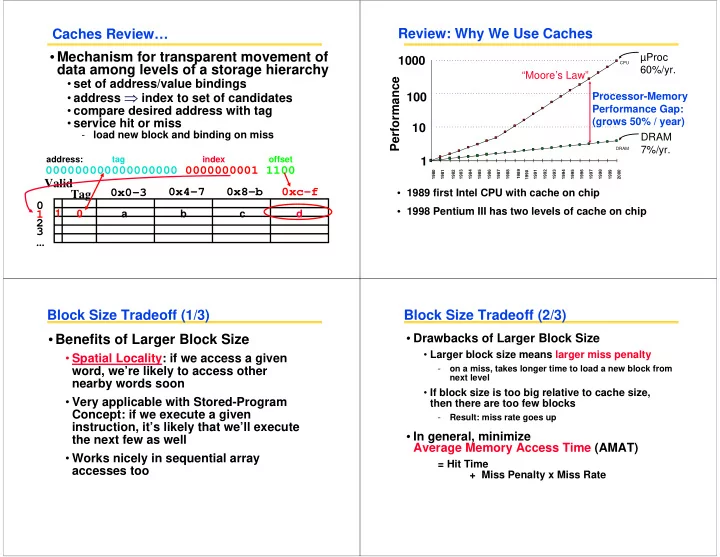
Caches Review…

  • Mechanism for transparent movement of

data among levels of a storage hierarchy

  • set of address/value bindings
  • address ⇒ index to set of candidates
  • compare desired address with tag
  • service hit or miss
  • load new block and binding on miss

Valid Tag 0x0-3 0x4-7 0x8-b 0xc-f 1 2 3

... 1 a b c d

000000000000000000 0000000001 1100

address: tag index offset

Review: Why We Use Caches

µProc 60%/yr. DRAM 7%/yr.

1 10 100 1000

1980 1981 1983 1984 1985 1986 1987 1988 1989 1990 1991 1992 1993 1994 1995 1996 1997 1998 1999 2000 DRAM CPU 1982

Processor-Memory Performance Gap: (grows 50% / year)

Performance

“Moore’s Law”

  • 1989 first Intel CPU with cache on chip
  • 1998 Pentium III has two levels of cache on chip

Block Size Tradeoff (1/3)

  • Benefits of Larger Block Size
  • Spatial Locality: if we access a given

word, we’re likely to access other nearby words soon

  • Very applicable with Stored-Program

Concept: if we execute a given instruction, it’s likely that we’ll execute the next few as well

  • Works nicely in sequential array

accesses too

Block Size Tradeoff (2/3)

  • Drawbacks of Larger Block Size
  • Larger block size means larger miss penalty
  • n a miss, takes longer time to load a new block from

next level

  • If block size is too big relative to cache size,

then there are too few blocks

  • Result: miss rate goes up
  • In general, minimize

Average Memory Access Time (AMAT)

= Hit Time + Miss Penalty x Miss Rate

slide-2
SLIDE 2

Block Size Tradeoff (3/3)

  • Hit Time = time to find and retrieve

data from current level cache

  • Miss Penalty = average time to retrieve

data on a current level miss (includes the possibility of misses on successive levels of memory hierarchy)

  • Hit Rate = % of requests that are found

in current level cache

  • Miss Rate = 1 - Hit Rate

Extreme Example: One Big Block

  • Cache Size = 4 bytes

Block Size = 4 bytes

  • Only ONE entry in the cache!
  • If item accessed, likely accessed again soon
  • But unlikely will be accessed again immediately!
  • The next access will likely to be a miss again
  • Continually loading data into the cache but

discard data (force out) before use it again

  • Nightmare for cache designer: Ping Pong Effect

Cache Data Valid Bit B 0 B 1 B 3 Tag B 2

Block Size Tradeoff Conclusions

Miss Penalty Block Size Increased Miss Penalty & Miss Rate Average Memory Access Time Block Size Exploits Spatial Locality Fewer blocks: compromises temporal locality Miss Rate Block Size

Types of Cache Misses (1/2)

  • “Three Cs” Model of Misses
  • 1st C: Compulsory Misses
  • occur when a program is first started
  • cache does not contain any of that

program’s data yet, so misses are bound to occur

  • can’t be avoided easily, so won’t focus
  • n these in this course
slide-3
SLIDE 3

Types of Cache Misses (2/2)

  • 2nd C: Conflict Misses
  • miss that occurs because two distinct memory

addresses map to the same cache location

  • two blocks (which happen to map to the same

location) can keep overwriting each other

  • big problem in direct-mapped caches
  • how do we lessen the effect of these?
  • Dealing with Conflict Misses
  • Solution 1: Make the cache size bigger
  • Fails at some point
  • Solution 2: Multiple distinct blocks can fit in the

same cache Index?

Fully Associative Cache (1/3)

  • Memory address fields:
  • Tag: same as before
  • Offset: same as before
  • Index: non-existant
  • What does this mean?
  • no “rows”: any block can go anywhere in

the cache

  • must compare with all tags in entire cache

to see if data is there

Fully Associative Cache (2/3)

  • Fully Associative Cache (e.g., 32 B block)
  • compare tags in parallel

Byte Offset : Cache Data B 0 4 31 : Cache Tag (27 bits long) Valid : B 1 B 31 : Cache Tag

= = = = = :

Fully Associative Cache (3/3)

  • Benefit of Fully Assoc Cache
  • No Conflict Misses (since data can go

anywhere)

  • Drawbacks of Fully Assoc Cache
  • Need hardware comparator for every

single entry: if we have a 64KB of data in cache with 4B entries, we need 16K comparators: infeasible

slide-4
SLIDE 4

Third Type of Cache Miss

  • Capacity Misses
  • miss that occurs because the cache has

a limited size

  • miss that would not occur if we increase

the size of the cache

  • sketchy definition, so just get the general

idea

  • This is the primary type of miss for

Fully Associative caches. N-Way Set Associative Cache (1/4)

  • Memory address fields:
  • Tag: same as before
  • Offset: same as before
  • Index: points us to the correct “row”

(called a set in this case)

  • So what’s the difference?
  • each set contains multiple blocks
  • once we’ve found correct set, must

compare with all tags in that set to find

  • ur data

N-Way Set Associative Cache (2/4)

  • Summary:
  • cache is direct-mapped w/respect to sets
  • each set is fully associative
  • basically N direct-mapped caches

working in parallel: each has its own valid bit and data

N-Way Set Associative Cache (3/4)

  • Given memory address:
  • Find correct set using Index value.
  • Compare Tag with all Tag values in the

determined set.

  • If a match occurs, hit!, otherwise a miss.
  • Finally, use the offset field as usual to

find the desired data within the block.

slide-5
SLIDE 5

N-Way Set Associative Cache (4/4)

  • What’s so great about this?
  • even a 2-way set assoc cache avoids a

lot of conflict misses

  • hardware cost isn’t that bad: only need N

comparators

  • In fact, for a cache with M blocks,
  • it’s Direct-Mapped if it’s 1-way set assoc
  • it’s Fully Assoc if it’s M-way set assoc
  • so these two are just special cases of the

more general set associative design

Associative Cache Example

  • Recall this is how a

simple direct mapped cache looked.

  • This is also a 1-way set-

associative cache!

Memory

Memory Address

1 2 3 4 5 6 7 8 9 A B C D E F 4 Byte Direct Mapped Cache Cache Index 1 2 3

Associative Cache Example

  • Here’s a simple 2 way set

associative cache.

Memory

Memory Address

1 2 3 4 5 6 7 8 9 A B C D E F Cache Index 1 1

Block Replacement Policy (1/2)

  • Direct-Mapped Cache: index completely

specifies which position a block can go in on a miss

  • N-Way Set Assoc: index specifies a set,

but block can occupy any position within the set on a miss

  • Fully Associative: block can be written

into any position

  • Question: if we have the choice, where

should we write an incoming block?

slide-6
SLIDE 6

Block Replacement Policy (2/2)

  • If there are any locations with valid bit
  • ff (empty), then usually write the new

block into the first one.

  • If all possible locations already have a

valid block, we must pick a replacement policy: rule by which we determine which block gets “cached

  • ut” on a miss.

Block Replacement Policy: LRU

  • LRU (Least Recently Used)
  • Idea: cache out block which has been

accessed (read or write) least recently

  • Pro: temporal locality ⇒ recent past use

implies likely future use: in fact, this is a very effective policy

  • Con: with 2-way set assoc, easy to keep

track (one LRU bit); with 4-way or greater, requires complicated hardware and much time to keep track of this

Block Replacement Example

  • We have a 2-way set associative cache

with a four word total capacity and one word blocks. We perform the following word accesses (ignore bytes for this problem): 0, 2, 0, 1, 4, 0, 2, 3, 5, 4 How many hits and how many misses will there be for the LRU block replacement policy? Block Replacement Example: LRU

  • Addresses 0, 2, 0, 1, 4, 0, ...

0 lru 2 1 lru

loc 0 loc 1 set 0 set 1

2

lru set 0 set 1

0: miss, bring into set 0 (loc 0) 2: miss, bring into set 0 (loc 1) 0: hit 1: miss, bring into set 1 (loc 0) 4: miss, bring into set 0 (loc 1, replace 2) 0: hit

set 0 set 1 lru lru

2

set 0 set 1 lru lru set 0 set 1

1

lru

lru2

4

lru set 0 set 1

4 1

lru

lru lru

slide-7
SLIDE 7

Administrivia

  • Do your reading! VM is coming up,

and it’s shown to be hard for students!

  • Any other announcements?

Big Idea

  • How to choose between associativity,

block size, replacement policy?

  • Design against a performance model
  • Minimize: Average Memory Access Time

= Hit Time + Miss Penalty x Miss Rate

  • influenced by technology & program

behavior

  • Note: Hit Time encompasses Hit Rate!!!
  • Create the illusion of a memory that is

large, cheap, and fast - on average Example

  • Assume
  • Hit Time = 1 cycle
  • Miss rate = 5%
  • Miss penalty = 20 cycles
  • Calculate AMAT…
  • Avg mem access time

= 1 + 0.05 x 20 = 1 + 1 cycles = 2 cycles

Ways to reduce miss rate

  • Larger cache
  • limited by cost and technology
  • hit time of first level cache < cycle time
  • More places in the cache to put each

block of memory – associativity

  • fully-associative
  • any block any line
  • N-way set associated
  • N places for each block
  • direct map: N=1
slide-8
SLIDE 8

Improving Miss Penalty

  • When caches first became popular, Miss

Penalty ~ 10 processor clock cycles

  • Today 2400 MHz Processor (0.4 ns per

clock cycle) and 80 ns to go to DRAM ⇒ 200 processor clock cycles!

Proc $2 DRAM $ MEM

Solution: another cache between memory and the processor cache: Second Level (L2) Cache

Analyzing Multi-level cache hierarchy

Proc $2 DRAM $

L1 hit time L1 Miss Rate L1 Miss Penalty

Avg Mem Access Time = L1 Hit Time + L1 Miss Rate * L1 Miss Penalty L1 Miss Penalty = L2 Hit Time + L2 Miss Rate * L2 Miss Penalty Avg Mem Access Time = L1 Hit Time + L1 Miss Rate * (L2 Hit Time + L2 Miss Rate * L2 Miss Penalty)

L2 hit time L2 Miss Rate L2 Miss Penalty

Typical Scale

  • L1
  • size: tens of KB
  • hit time: complete in one clock cycle
  • miss rates: 1-5%
  • L2:
  • size: hundreds of KB
  • hit time: few clock cycles
  • miss rates: 10-20%
  • L2 miss rate is fraction of L1 misses

that also miss in L2

  • why so high?

Example: with L2 cache

  • Assume
  • L1 Hit Time = 1 cycle
  • L1 Miss rate = 5%
  • L2 Hit Time = 5 cycles
  • L2 Miss rate = 15% (% L1 misses that miss)
  • L2 Miss Penalty = 200 cycles
  • L1 miss penalty = 5 + 0.15 * 200 = 35
  • Avg mem access time = 1 + 0.05 x 35

= 2.75 cycles

slide-9
SLIDE 9

Example: without L2 cache

  • Assume
  • L1 Hit Time = 1 cycle
  • L1 Miss rate = 5%
  • L1 Miss Penalty = 200 cycles
  • Avg mem access time = 1 + 0.05 x 200

= 11 cycles

  • 4x faster with L2 cache! (2.75 vs. 11)

What to do on a write hit?

  • Write-through
  • update the word in cache block and

corresponding word in memory

  • Write-back
  • update word in cache block
  • allow memory word to be “stale”

⇒ add ‘dirty’ bit to each block indicating

that memory needs to be updated when block is replaced

⇒ OS flushes cache before I/O…

  • Performance trade-offs?

Peer Instructions

1. In the last 10 years, the gap between the access time of DRAMs & the cycle time of processors has decreased. (I.e., is closing) 2. A 2-way set-associative cache can be

  • utperformed by a direct-mapped cache.

3. Larger block size ⇒ lower miss rate ABC 1: FFF 2: FFT 3: FTF 4: FTT 5: TFF 6: TFT 7: TTF 8: TTT

Peer Instructions Answer

1. In the last 10 years, the gap between the access time of DRAMs & the cycle time of processors has decreased. (I.e., is closing) 2. A 2-way set-associative cache can be

  • utperformed by a direct-mapped cache.

3. Larger block size ⇒ lower miss rate ABC 1: FFF 2: FFT 3: FTF 4: FTT 5: TFF 6: TFT 7: TTF 8: TTT 1. That was was one of the motivation for caches in the first place -- that the memory gap is big and widening. 2. Sure, consider the caches from the previous slides with the following workload: 0, 2, 0, 4, 2 2-way: 0m, 2m, 0h, 4m, 2m; DM: 0m, 2m, 0h, 4m, 2h 3. Larger block size ⇒ lower miss rate, true until a certain point, and then the ping-pong effect takes over

slide-10
SLIDE 10

Generalized Caching

  • We’ve discussed memory caching in
  • detail. Caching in general shows up
  • ver and over in computer systems
  • Filesystem cache
  • Web page cache
  • Game Theory databases / tablebases
  • Software memoization
  • Others?
  • Big idea: if something is expensive but

we want to do it repeatedly, do it once and cache the result. An actual CPU -- Early PowerPC

  • Cache
  • 32 KiByte Instructions

and 32 KiByte Data L1 caches

  • External L2 Cache

interface with integrated controller and cache tags, supports up to 1 MiByte external L2 cache

  • Dual Memory

Management Units (MMU) with Translation Lookaside Buffers (TLB)

  • Pipelining
  • Superscalar (3

inst/cycle)

  • 6 execution units (2

integer and 1 double precision IEEE floating point)

Cache Things to Remember

  • Caches are NOT mandatory:
  • Processor performs arithmetic, memory stores data
  • Caches simply make data transfers go faster
  • Each Memory Hiererarchy level subset of next higher level
  • Caches speed up due to temporal locality:

store data used recently

  • Block size > 1 wd spatial locality speedup:

Store words next to the ones used recently

  • Cache design choices:
  • size of cache: speed v. capacity
  • direct-mapped v. associative
  • choice of N for N-way set assoc
  • block replacement policy
  • 2nd level cache? 3rd level cache?
  • Write through v. write back?
  • Use performance model to pick between choices,

depending on programs, technology, budget, ...

An Actual CPU – Pentium M

slide-11
SLIDE 11

Peer Instruction

1. Increased associativity (1->2->4->8-way) ⇒ decreased or steady miss rate. 2. Increased associativity ⇒ increased cost & slower access time. 3. The ratio of costs of a “miss” vs. a “hit” are within an order of magnitude between VM & cache ABC 1: FFF 2: FFT 3: FTF 4: FTT 5: TFF 6: TFT 7: TTF 8: TTT