Single cell protein from grape pomace: Sustainability in the winery - - PowerPoint PPT Presentation

single cell protein from grape pomace
SMART_READER_LITE
LIVE PREVIEW

Single cell protein from grape pomace: Sustainability in the winery - - PowerPoint PPT Presentation

Single cell protein from grape pomace: Sustainability in the winery to value-added food- Review Sotiropoulou E.I. 1* , Liouni M. 1 , Calokerinos A.C., 2 Nerantzis E.T 3 1 Laboratory of Industrial Chemistry, Dept. of Chemistry, National &


slide-1
SLIDE 1

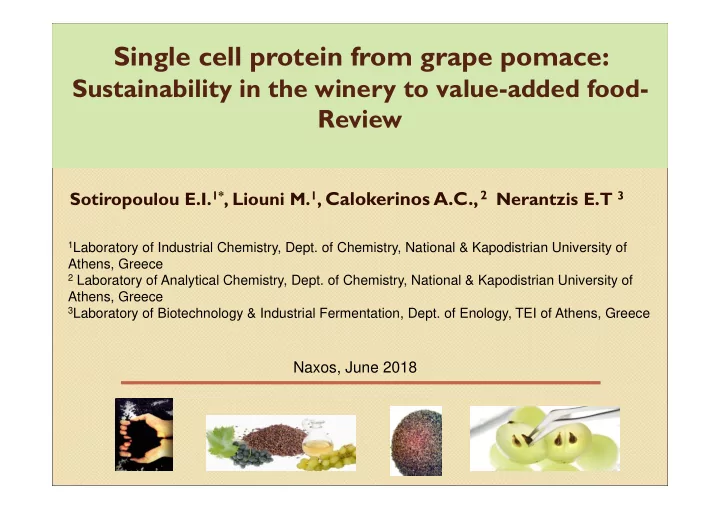
Single cell protein from grape pomace:

Sustainability in the winery to value-added food- Review

Sotiropoulou E.I.1*, Liouni M.1, Calokerinos A.C.,2 Nerantzis E.T 3

1Laboratory of Industrial Chemistry, Dept. of Chemistry, National & Kapodistrian University of

Athens, Greece

2 Laboratory of Analytical Chemistry, Dept. of Chemistry, National & Kapodistrian University of

Athens, Greece

3Laboratory of Biotechnology & Industrial Fermentation, Dept. of Enology, TEI of Athens, Greece

Naxos, June 2018

slide-2
SLIDE 2

Introduction

 During the red and the white vinification, a large number of by products

is produced

 In Greece, it is estimated that the annual production is about 525,000

tons of grapes which leads to 142,000 tons of winery waste

 100 kg fresh marc are constituted from 30 kg of fresh pulp, 25 kg

  • f fresh seeds and 20 kg stalks

 Recent studies showed that winery by-products may negatively affect

the environment by presenting toxicity to crops and wetlands

 Researches focused on wastewater of wineries were considered to be

responsible for the contamination of groundwater resources

slide-3
SLIDE 3

Sustainability in the wineries Encourage wineries to apply value adding technologies in

  • rder to:

 Reduce their waste generation and disposal  Provide further alternatives to diminish the

environmental impact of the winery activity

 Introduce additional sources of income

slide-4
SLIDE 4

Grape skin & grape seed

 They are the main by-products  Used: produce another product (grape seed oil)

compost for the production of alcohol create a new type of human food

(grape seed powder)

slide-5
SLIDE 5

Grape pomace

  • Definition

 The solid remains of pressed grapes  It is equivalent to about 20% of the grapes used  Result after pressing grapes for juice or oil  It contains:

Seeds (3-6)% & Stalks (2,5-7,5%) Pulp (10-12%)

Skins

slide-6
SLIDE 6

Conventional applications

Animal Feeding Fertilizer Grape Seed Oil

slide-7
SLIDE 7

 Pulp can be composted after mixing with other minerals and used

as fertilizer

 Grape pomace: fermented with special crops and produce high

added value and purity substances such as polysaccharide

  • r produce alcohol

 Using grape pomace with the composting process; substrate for

plants & substrate for cultivation of mushrooms

 Fermentation with different microorganisms & different treatment

(hydrolysis or not) the extraction of tannins & polyphenols

More applications

slide-8
SLIDE 8

Microbial protein Definition

 It refers to dead, dry cells of micro-

  • rganisms such as yeast, bacteria, fungi and

algae which grow on different carbon sources.

 The name "single cell protein" was used

to give a better image than "microbial protein.

 Also known as " Novel Food " or " Mini

Food "

slide-9
SLIDE 9

Microbial protein: Advantages

Utilization of grape by- products in the production

  • f microbial protein will

help in controlling pollution

Help solving waste disposable problem to some extent Satisfy the world shortage of protein rich food High protein content (about 60-82% of dry cell weight), fats, carbohydrates, nucleic acids, vitamins and minerals

Rich in certain essential amino acids like lysine, methionine which are limiting in most plant and animal foods

slide-10
SLIDE 10

Microbial protein: Usages

Additive to the main diet instead of sources known very expensive (soya bean and fish) Grape pomace with good nutrient content can be converted into food enriched with protein and feed and by properly utilizing them, will bring an end to the protein deficiency around the world Good nutritious food can be supplied with least expenditure of cost

slide-11
SLIDE 11

Where microbial protein is used?

 Animal nutrition

fattening calves, poultry, pigs and fish breading

 Foodstuffs area

aroma carriers, vitamin carrier, emulsifying aids and to improve the nutritive value of baked products, in soups, in ready-to-serve meals, in diet recipes

 T

echnical field paper processing, leather processing and as foam stabilizers

slide-12
SLIDE 12

Production process of microbial protein

Production of microbial protein

Filtration & Drying Fermentor (bacteria, yeasts, fungi, algae) Substrate (wood, carbohydrate, methanol)

slide-13
SLIDE 13

Fermentation process (I)

 Grape and wine by-products are a good source of carbon and have

been used to generate various high-value products

 Major components of grape biomass waste are cellulose pectins and

lignins (including tannins)

 Fungi belonging to the division Ascomycota, such as Trichoderma spp.,

Aspergillus spp. , Penicillium spp., are known for their biomass degrading ability and should prove useful in grape biomass degradation

 Protein rich products can be used as feedstock for animals.  The protein content of grape marc has been managed to be increased

from 7% to up to 27% in five days using solid state fermentation process, certain fungal strains and specific conditions like temperature and moisture content

slide-14
SLIDE 14

Fermentation process (II)

 Pleurotus ostreatus is the third most important edible

mushroom cultivated worldwide

 It can easily decompose lignocellulose without chemical or

biological pretreatment as it possesses an enzymatic complex system that includes phenol oxidases and peroxidases

 Therefore, they can be utilized and recycled by solid state

fermentation (SSF) using various strains of mushroom

 The bioconversion of vineyard prunings and grape pomace

by Pleurotus spp. with SSF was evaluated by measuring the fruiting body as alternative attempt for recycling of winery agroindustrial wastes

slide-15
SLIDE 15

Grame Pomace + Microbial Protein Sustainability in the winery

 Environmental concern is leading consumers to demand for products which

take environment issues into account, such as organic food, carbon neutral products or water-friendly products

 Sustainability is not referred only in the vineyard but it refers also to energy

conservation, solar and other renewable sources, efficient and recycled construction and winery’s overall carbon footprint

 Consumers are willing to pay more and to support wines produced from

green production practices that leads to sustainably produced wines

 More importance to the issues of natural resources that to the water savings

in wine production and that can be related to the fact that consumers are less familiar with the issue of water consumption in food production

 One more useful strategy for wineries aiming towards reducing environmental

contamination and as an alternative to reduce the carbon footprint in the wine production process (sustainability in the winery) as part of the Sustainable Development Goals (SDGs)
slide-16
SLIDE 16

Ongoing research work

 A series of experiments are planned to be performed to obtain

an optimized protocol for degrading winery biomass waste.

 Both submerged fermentation and SSF processes will be assessed

using different fungus

 The fermentation process will be held in a solid state

fermentation bioreactor, designed specifically for the needs of this research where conditions like temperature and pH were measured on a regular basis.

 Various analyses (temperature, pH, ash, total nitrogen) will be

performed on both, the substrate and the fermented product.

slide-17
SLIDE 17

Conclusion

 Introduction of grape pomace as a new vehicle to produce

microbial protein

 One of our goals is to prove that grape pomace have compounds

with beneficial effects when correctly used as a substrate allowing the valorization of winery by- products and produce value-added products.

slide-18
SLIDE 18

Thank you for your attention!

Contact info: Evangelia Sotiropoulou, evasot@chem.uoa.gr Oenologist, MSc, PhD Cand.