Skylight to enhance outdoor scenes 02564 Real-Time Graphics - - PowerPoint PPT Presentation

skylight to enhance outdoor scenes 02564 real time
SMART_READER_LITE
LIVE PREVIEW

Skylight to enhance outdoor scenes 02564 Real-Time Graphics - - PowerPoint PPT Presentation

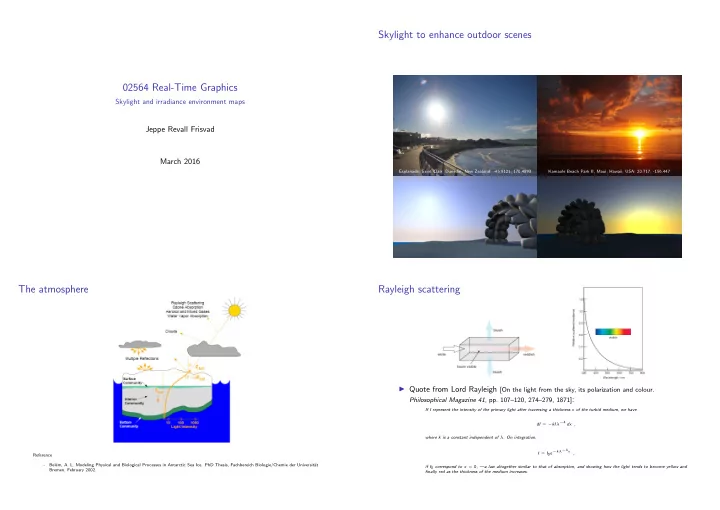
Skylight to enhance outdoor scenes 02564 Real-Time Graphics Skylight and irradiance environment maps Jeppe Revall Frisvad March 2016 Esplanade, Saint Clair, Dunedin, New Zealand: -45.9121, 170.4893 Kamaole Beach Park II, Maui, Hawaii, USA:


slide-1
SLIDE 1

02564 Real-Time Graphics

Skylight and irradiance environment maps

Jeppe Revall Frisvad March 2016

Skylight to enhance outdoor scenes

Esplanade, Saint Clair, Dunedin, New Zealand: -45.9121, 170.4893 Kamaole Beach Park II, Maui, Hawaii, USA: 20.717, -156.447

The atmosphere

Reference

  • Bel´

em, A. L. Modeling Physical and Biological Processes in Antarctic Sea Ice. PhD Thesis, Fachbereich Biologie/Chemie der Universit¨ at Bremen, February 2002.

Rayleigh scattering

◮ Quote from Lord Rayleigh [On the light from the sky, its polarization and colour.

Philosophical Magazine 41, pp. 107–120, 274–279, 1871]:

If I represent the intensity of the primary light after traversing a thickness x of the turbid medium, we have dI = −kIλ−4 dx , where k is a constant independent of λ. On integration, I = I0e−kλ−4x , if I0 correspond to x = 0, —a law altogether similar to that of absorption, and showing how the light tends to become yellow and finally red as the thickness of the medium increases.

slide-2
SLIDE 2

Solar radiation

[Source: http://en.wikipedia.org/wiki/Sunlight]

Colorimetry

CIE color matching functions The chromaticity diagram

  • -

XYZ gamut — RGB gamut — CRT/LCD monitor gamut

R =

  • V

C(λ)¯ r(λ) dλ G =

  • V

C(λ)¯ g(λ) dλ B =

  • V

C(λ)¯ b(λ) dλ ,

where V is the interval of visible wavelengths and C(λ) is the spectrum that we want to transform to RGB.

Gamut mapping

◮ Gamut mapping is mapping one tristimulus color space to another. ◮ Gamut mapping is a linear transformation. Example:   X Y Z   =   0.4124 0.3576 0.1805 0.2126 0.7152 0.0722 0.0193 0.1192 0.9505     R G B   .   R G B   =   3.2405 −1.5371 −0.4985 −0.9693 1.8760 0.0416 0.0556 −0.2040 1.0572     X Y Z   ◮ Y in the XYZ color space is called luminance. ◮ Luminance is a measure of how bright a scene appears. ◮ From the linear transformation above, we have Y = 0.2126 R + 0.7152 G + 0.0722 B .

Dynamic range

◮ Ambient luminance levels for some common lighting environments: Condition Illumination (cd/m2) Starlight 10−3 Moonlight 10−1 Indoor lighting 102 Sunlight 105 Maximum intensity of common monitors 102

Reference

  • Reinhard, E., Ward, G., Pattanaik, S., Debevec, P., Heidrich, W., and Myszkowski, K. High Dynamic Range Imaging: Acquisition, Display

and Image-Based Lighting, second edition, Morgan Kaufmann/Elsevier, 2010.

slide-3
SLIDE 3

Tone mapping

◮ Simplistic tone mapping: scale and gamma correct: (R′, G ′, B′) =

  • (sR)1/γ, (sG)1/γ, (sB)1/γ

, where s and γ are user-defined parameters. ◮ The framework uses s = 0.025 (and γ = 1) for the sun and sky. ◮ Another tone mapping operator (Ferschin’s exponential mapping): (R′, G ′, B′) =

  • (1 − e−R)1/γ, (1 − e−G)1/γ, (1 − e−B)1/γ

. ◮ This is useful for avoiding overexposed pixels. ◮ Other tone mapping operators use sigmoid functions based on the luminance levels in the scene [Reinhard et al. 2010].

Analytical sky models [Preetham et al. 1999] (input parameters)

◮ Solar declination angle: δ = 0.4093 sin 2π(J − 81) 368

  • .

◮ Solar position: θs = π 2 − arcsin

  • sin ℓ sin δ − cos ℓ cos δ cos πt

12

  • ,

φs = arctan

  • − cos δ sin πt

12

cos ℓ sin δ − sin ℓ cos δ cos πt

12

  • ,

where J ∈ [1, 365] is Julian day, t is solar time, and ℓ is latitude.

Direct sunlight

◮ Assume the Sun is a diffuse emitter of total power Φ = 3.91 · 1026 W and surface area A = 6.07 · 1018 m2. ◮ Radiance from the Sun to the Earth: L =

Φ πA ≈ 2.05 · 107 W m2 sr.

◮ Assume the Sun is in zenith and at a distance to the Earth of r = 1.5 · 1011 m. ◮ The solid angle subtended by the Sun as seen from Earth: ω = As

r2 = A 4r2 ≈ 6.74 · 10−5 sr.

◮ Energy received in a 1 × 1 m2 patch of Earth atmosphere: E = Lω ≈ 1383 W

m2 .

◮ A directional source with its color set to the solar irradiance at Earth will deliver the same energy in a square meter.

Skylight

◮ Environment mapping: Map an omnidirectional image onto everything surrounding the scene. ◮ Cube mapping: Use a direction to perform look-ups into an omnidirectional image consisting of six texture images (square resolution, 90◦ field of view). ◮ We use Preetham’s analytical model to precompute a sky cube map. ◮ Look-ups then return the radiance Lsky( ω) received from the sky when looking in the direction ω.

slide-4
SLIDE 4

Precomputing a cube map

We precompute by storing Lsky( vijk) in the texel at index i, j of face k.

  • vijk =

ak+ uk

  • 2 i

res − 1

  • +

bk

  • 2 j

res − 1

  • ,

where the faces are numbered from 0 to 5 and ordered as follows: left, right, top, bottom, front, back ◮ ak is the major axis direction of face k, ◮ uk is the up direction of face k, and ◮ bk is the right direction of face k.

  • x

+x

  • y

+y +z

  • z

Folded Front Left R ight Top Bottom Back Unfolded

+z

  • y

+x +z +x

  • y

+x

  • z
  • z
  • y
  • x
  • y

Environment mapping

◮ Reflective environment mapping:

  • i =

pe pe ,

  • r =

i − 2

  • n ·

i

  • n .

◮ We need world space directions when looking up in a cube map.

  • rw =
  • V −1

3×3

r, where V is the view matrix and A3×3 takes the upper left 3 × 3 part of A.

Environment mapping - filling the background

Object World Eye Normalized device Clip Window Model View Projection W divide Viewport

◮ Given window space pixel coordinates xp, yp find the direction from the eye to the corresponding point on the image plane.

  • iw =

   

  • V −1

3×3

    P−1 pn , pn =     2 xp

W − 1

2 yp

H − 1

1     . ◮ Note that depth is unimportant as iw is the direction of an eye ray.

The Rendering Equation

◮ When rendering surfaces, the equation we try to evaluate is [Kajiya 1986] Lo(x, ω) = Le(x, ω) +

fr(x, ω′, ω)Li(x, ω′) cos θ dω′ , ◮ where

Lo is outgoing radiance, Le is emitted radiance, Li is incoming radiance, x is a surface position,

  • ω is the direction of the light,
  • ω′ is the direction toward the light source,

fr is the bidirectional reflectance distribution function (BRDF), dω′ is an element of solid angle, θ is the angle between ω′ and the surface normal n at x, such that cos θ = ω′ · n.

References

  • Kajiya, J. The Rendering Equation. Computer Graphics (Proceedings of ACM SIGGRAPH 86) 20(4), pp. 143–150, 1986.
slide-5
SLIDE 5

Splitting the evaluation

◮ Distinguishing between:

◮ Direct illumination Ldirect.

◮ Light reaching a surface directly from the source.

◮ Indirect illumination Lindirect.

◮ Light reaching a surface after at least one bounce.

◮ The rendering equation is then L = Le + Ldirect + Lindirect .

◮ Le is emission. ◮ Ldirect is sampling of lights. ◮ Lindirect is sampling of the BRDF excluding lights.

◮ In a real-time skylight setting:

◮ Ldirect is direct sunlight (using the Phong illumination model without ambient). ◮ Lindirect is integrated skylight and specular reflection of the sky.

Sky irradiance Esky and ambient occlusion A

◮ Excluding direct sunlight from Li, we have Lindirect(x, ωo) =

fr(x, ω′, ω)Li(x, ωi)( n · ωi) dωi = ρd π

V (x, ωi)Lsky( ωi)( n · ωi) dωi + ρsV (x, r )Lsky( rw) , where

◮ Li(x, ωi) = V (x, ωi)Lsky( ωi) is incident skylight, ◮ fr(x, ω′, ω) = ρd/π is the BRDF of perfectly diffuse (Lambertian) materials, ◮ ρd is the diffuse reflectance (diffuse color), and ◮ ρs is the specular reflectance.

◮ The remaining integral is called the irradiance E, and E(x, n) =

V (x, ωi)Lsky( ωi)( n · ωi) dωi ≈ 1 π

V (x, ωi)( n · ωi) dωi

Lsky( ωi)( n · ωi) dωi = A(x)Esky( n) .

Integrating skylight

◮ The sky irradiance integral (neglecting visibility): Esky( n) =

Lsky( ωi)( n · ωi) dωi. ◮ Monte Carlo estimator: Esky,N( n) = 1 N

N

  • j=1

Lsky( ωi,j)( n · ωi,j) pdf( ωi,j) . ◮ A good choice of pdf would be pdf( ωi,j) =

n· ωi,j π .

◮ We sample ωi,j on a cosine-weighted hemisphere using (θi, φi) = (cos−1 1 − ξ1, 2πξ2) , ξ1, ξ2 ∈ [0, 1) (random numbers) (x, y, z) = (cos φi sin θi, sin φi sin θi, cos θi)

  • ωi,j

=  x   1 − n2

x/(1 + nz)

−nxny/(1 + nz) −nx   + y   −nxny/(1 + nz) 1 − n2

y/(1 + nz)

−ny   + z   nx ny nz     .

Irradiance environment map

skylight to sky irradiance ◮ Precompute cube map on the GPU using layered rendering and sampling. ◮ In the geometry shader (integrator.geom):

◮ emit triangle vertices to each cube map face using a loop and gl Layer.

◮ In the fragment shader (integrator.frag):

◮ implement the cosine-weighted sampling of the skylight with n = vijk (use rnd(t) to get a random number).

◮ The framework progressively improves the sky irradiance map using these shaders.

slide-6
SLIDE 6

Illumination model for skylight

Lr = ρd π

  • (

n · l )V Lsun + A Esky( nw)

  • + ρs
  • (

r · l )pV Lsun + Lsky( rw)

  • ,

where ◮ Lsun is the radiance (color) of the directional light, ◮ Lsky is a look-up into the skylight environment map, ◮ Esky is a look-up into the sky irradiance map, ◮ V is the visibility term obtained from shadow mapping, ◮ A is the factor from screen-space ambient occlusion (SSAO), ◮ n is the normal, ◮ l is the direction toward the sun, ◮ r is the reflection of the view vector around the normal, ◮ nw is the normal in world coordinates, ◮ rw is the reflected vector in world coordinates, ◮ ρd is a diffuse reflectance, ◮ ρs is a specular reflectance, and ◮ p is a shininess.