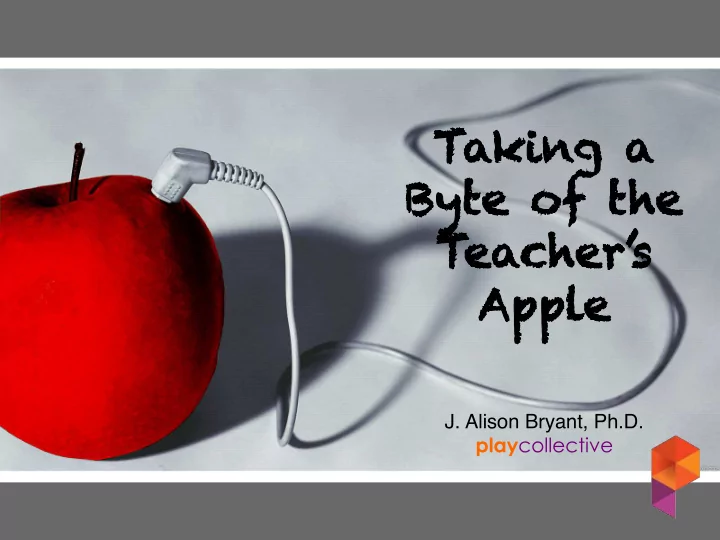
SLIDE 1 Ta Taking a By Byte of t
Teacher’ s s Ap Apple
playcollective
SLIDE 2
SLIDE 3 Transmediated Learning
- Just because you have curriculum
goals across a property doesn’t mean that you should be teaching the same thing on all platforms.
- Ideally transmedia “pushes” kids to
the right content on the right platform, and kids can also “pull” the content they want on the platform they want.
SLIDE 4
Case Study in Transmedia Learning
SLIDE 5
Lesson 2:
The medium does not define the (learning) message
SLIDE 6
There are digital ways to
Learn, Practice, and Play Videos ¡ Music ¡ Interac0ve ¡ Games ¡ Print ¡ Ac0vi0es ¡
SLIDE 7 1-5 scale, 5= Strongly Agree
An ebook can be more than a book…
SLIDE 8
…but it still has to have the core literacy learning features
SLIDE 9
Offline is a medium too
SLIDE 10 Kids as makers
MaKey MaKey
SLIDE 11
Lesson 3:
We don’t need no stinkin’ badges
SLIDE 12 Gamification is not a panacea
Gamification can help with short-term engagement, but is not a long-term solution
Intrinsi sic Mo Motivation Extrinsi sic Mo Motivation
SLIDE 13 But game elements do have their place
- Games are a great way to informally assess without “testing”
- This is a generation who has grown up with “leveling up,” and
the notion of meeting new challenges as you go along
– But this also means that it is a generation that assumes personalization
- Games are great at visually showing progress, and giving instant
feedback
– Giving kids a “learning positioning system” (LPS) as they play helps them orient
SLIDE 14 And there is an expectation of gaming on certain platforms
% of kids who play games on these mobile devices, if the household owns
The iPad has the highest gaming “conversion” rates, with learning tablets a close 2nd.
72% 68% 60% 55% 54%
Source: PlayScience, Global Gaming Generations study – includes U.S., Mexico, Germany, China
SLIDE 15
Lesson 4:
Kids do love to learn, but it needs to be byte-sized
SLIDE 16
Kids are natural learners and explorers
SLIDE 17 We have to keep time spent playing in mind as we develop
About 1/2 of preschoolers spend 11-20 minutes playing per session; 2/5 only spend 5-10 minutes
Source: Cooney Center. (2010). Learning: Is there an app for that?
SLIDE 18
SLIDE 19 Kids make their own play
(no matter what you do)
So empower them to PLAY
“Make it theirs, not yours”
– Lane Merrifield
SLIDE 20 The Closed-Creativity Continuum
Closed Creative
We don’t just want interactive flash cards…. …but how do we assess fully open creative?
SLIDE 21
Lesson 6:
We’ve still got a long way to go with social- emotional learning
SLIDE 22 Communication is a key skill
Being able to chat doesn’t mean that kids are learning communication And as we move to virtual learning, we need to spend time teaching virtual social skills We still tend to develop intra-culturally, not with the global world kids live in digitally in mind
SLIDE 23
Lesson 7:
Parents and kids are different tech generations (and relate to digital learning differently)
SLIDE 24 Parents still place value on non-digital
Parents will pay 33% less for an ebook than a print book, but that is 40% more than what they are willing to pay for apps!
SLIDE 25 Parents want data
…but not too much data!
..but when they get too much data they get
- verwhelmed and “turn
- ff” (or feel guilty).
When parents have data, they become more engaged in the learning process…
SLIDE 26 Lesson 8:
We have to focus
- n the ecosystem
- f learning
SLIDE 27
We know that co-play enhances and reinforces learning
Siblings & Cousins Parents & Kids Grandparents & Kids
SLIDE 28
Provide simple-to-use, multidimensional resources
We have to keep teachers in the loop
SLIDE 29
Lesson 9:
Contextualized learning builds engagement
SLIDE 30
Case Study on Context:
SLIDE 31
Lesson 10:
We have a long way to go in understanding how to teach across platforms
SLIDE 32
We’ve got smaller tech “generations”
SLIDE 33 Platforms for play change by age
Younger ¡kids ¡lean ¡toward ¡tablet ¡use, ¡ whereas ¡older ¡kids ¡are ¡more ¡computer ¡ and ¡gaming ¡system ¡oriented. ¡
Source: PlayScience, Global Gaming Generations study – includes U.S., Mexico, Germany, China
SLIDE 34 Enter the (Research) Matrix
Media/Mechanics Ages
SLIDE 35 Let’s Play!
alison@playcollective.com www.playcollective.com www.playsciencelab.com
Sign up for LabNotes @
playsciencelab.com/ labnotes/