textual economy in generation the SPUD system Magdalena Wolska 9 - - PowerPoint PPT Presentation

textual economy in generation the spud system
SMART_READER_LITE
LIVE PREVIEW

textual economy in generation the SPUD system Magdalena Wolska 9 - - PowerPoint PPT Presentation

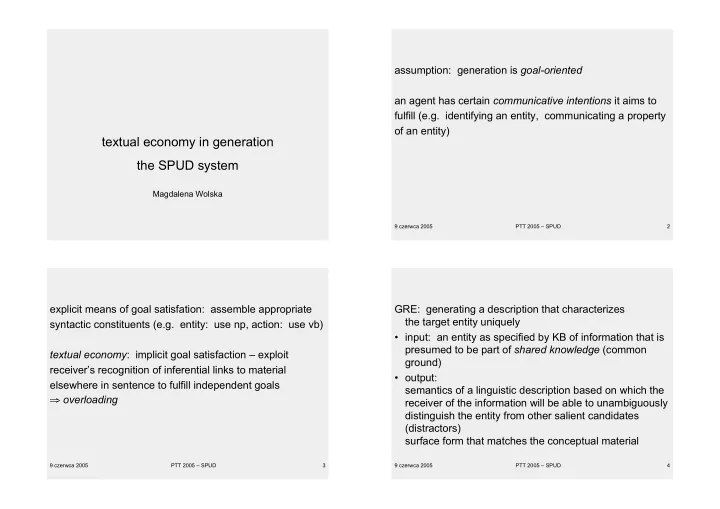
assumption: generation is goal-oriented an agent has certain communicative intentions it aims to fulfill (e.g. identifying an entity, communicating a property of an entity) textual economy in generation the SPUD system Magdalena Wolska 9


slide-1
SLIDE 1

textual economy in generation the SPUD system

Magdalena Wolska

9 czerwca 2005 PTT 2005 – SPUD 2

assumption: generation is goal-oriented an agent has certain communicative intentions it aims to fulfill (e.g. identifying an entity, communicating a property

  • f an entity)

9 czerwca 2005 PTT 2005 – SPUD 3

explicit means of goal satisfation: assemble appropriate syntactic constituents (e.g. entity: use np, action: use vb) textual economy: implicit goal satisfaction – exploit receiver’s recognition of inferential links to material elsewhere in sentence to fulfill independent goals

  • verloading

9 czerwca 2005 PTT 2005 – SPUD 4

GRE: generating a description that characterizes the target entity uniquely

  • input: an entity as specified by KB of information that is

presumed to be part of shared knowledge (common ground)

  • output:

semantics of a linguistic description based on which the receiver of the information will be able to unambiguously distinguish the entity from other salient candidates (distractors) surface form that matches the conceptual material

slide-2
SLIDE 2

9 czerwca 2005 PTT 2005 – SPUD 5

„economy” in GRE : generate a description D to indentify r in context set C just in case KB supports attribution of D to r and motivates D in describing r in C support: there must exist information that r fits the description (else description may not be understood or generated) motivation: there must be a reason to use each of the properties to describe r (else the generator may leave the desriptor out)

9 czerwca 2005 PTT 2005 – SPUD 6

  • cf. full-brevity GRE: use as few properties as possible;

when multiple descriptions apply, f-b: produce a more complex description when shorter don’t refer uniquely r1 : the big black shaggy dog r1 : the affable purebred racing dog the black racing dog

9 czerwca 2005 PTT 2005 – SPUD 7

indredients of a GRE component:

  • context set of entities that are explicit (or implicit) in

discourse

  • formalisation of properties of these entities
  • specification of how to combine the properties into

linguisitc description

  • representation for processing
  • reasoning to online assess how receiver will interpret the

given description resource intensive

9 czerwca 2005 PTT 2005 – SPUD 8

typical GRE scenario:

  • any fact to be communicated must fit into abstract

grammatical structure (including lexical items)

  • any reference to domain entity must be elaborated into a

description that uniquely identifies (cf. incremental descrption)

  • surface form must be found

step-wise process

(assuming e in common ground, 1/ identify set of concepts that together distinguish e from its distractors, 2/ derive syntactic structure that realises these concepts)

slide-3
SLIDE 3

9 czerwca 2005 PTT 2005 – SPUD 9

SPUD: perform syntactic and semantic processes simultaneously

9 czerwca 2005 PTT 2005 – SPUD 10

References

Matthew Stone and Bonnie Webber. Textual Economy through Close Coupling of Syntax and

  • Semantics. Proceedings of INLG 1998, p. 178--187.

Martha E. Pollack. Overloading intentions for efficient practical reasoning. Nous 25(4):513--536. see also other references at: http://www.cs.rutgers.edu/~mdstone/nlg.html you can download SPUD at: http://www.cs.rutgers.edu/~mdstone/class/taglet/ (for instructions on running SPUD, you may contact Magdalena Wolska magda@coli.uni-sb.de)