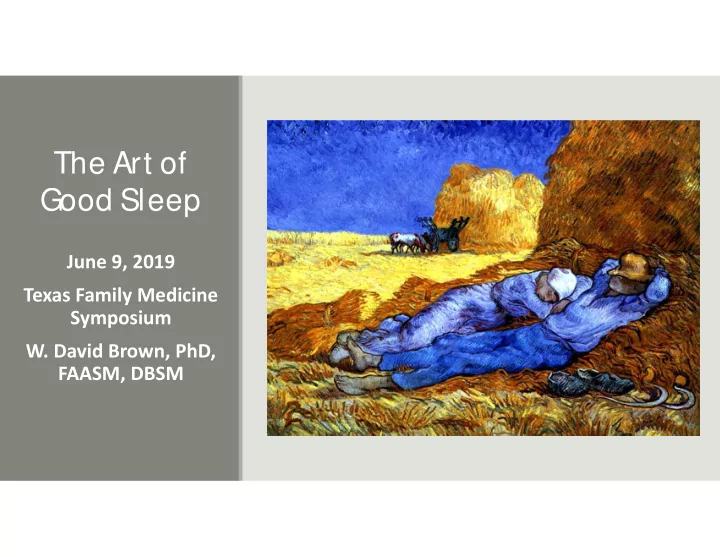
The Art of Good Sleep June 9, 2019 Texas Family Medicine - - PowerPoint PPT Presentation

the art of good sleep
SMART_READER_LITE
LIVE PREVIEW

The Art of Good Sleep June 9, 2019 Texas Family Medicine - - PowerPoint PPT Presentation

The Art of Good Sleep June 9, 2019 Texas Family Medicine Symposium W. David Brown, PhD, FAASM, DBSM Speaker Disclosure Dr. Brown has disclosed that he has no actual or potential conflict of interest in relation to this topic. Learning


slide-1
SLIDE 1

The Art of Good Sleep

June 9, 2019 Texas Family Medicine Symposium

  • W. David Brown, PhD,

FAASM, DBSM

slide-2
SLIDE 2

Speaker Disclosure

  • Dr. Brown has disclosed that he has no actual or

potential conflict of interest in relation to this topic.

slide-3
SLIDE 3

By the end of this educational activity, the learner should be better able to:

  • 1. Evaluate various sleep‐related conditions utilizing evidence‐based

recommendations and guidelines, including ordering appropriate diagnostic testing based on patient history and physical examination.

  • 2. Develop a treatment plan utilizing nonpharmaceutical management of

insomnia such as lifestyle modification, cognitive behavioral therapy and alternative therapies.

  • 3. Review basic theories of insomnia in adults and pediatric patients.

Learning Objectives

slide-4
SLIDE 4

Brief Review

  • Sleep is controlled by two main

factors

  • Homeostasis
  • Circadian Rhythms
  • Sleep is also a behavior
  • There are over 70 diagnosable

sleep disorders

  • Sleep is critically important for all

aspects of human health and well‐being

slide-5
SLIDE 5
slide-6
SLIDE 6

Two Process Model

slide-7
SLIDE 7

Two-Process Model of Sleep Regulation

slide-8
SLIDE 8

Core Temperature and Sleep

From Duffy JF, et al. 1998. Core (rectal) body temperatures for young and older subjects. Solid circles = Older subjects (n =43); open circles = young subjects (n = 97); solid bar, usual sleep episode of older subjects; open bar, usual sleep episode of young subjects. Data are plotted with respect to actual time of day.

slide-9
SLIDE 9

Childhoods E nd

  • Strong Phase Delay

during Adolescence

  • Trend reverses in early

20’s

  • Earlier in women
slide-10
SLIDE 10
  • Insomnia patients are very accurate in estimating how long it takes

them to fall to sleep and how long they slept

  • Most people sleep through the night without waking
  • The older you get, the fewer hours of sleep you need
  • Drinking alcohol will help you sleep
  • You can catch up on your sleep over the weekend
  • Watching TV helps you sleep
  • Never wake up a sleepwalker
  • Eating Turkey will put you to sleep
  • Counting Sheep helps you fall to sleep

Frankel BL, et al. Recorded and reported sleep in primary insomnia. Arch Gen Psychiatry, 1976, 33: 615‐623

Sleep Myths

slide-11
SLIDE 11

Insomnia patients are very accurate in estimating how long it takes them to fall to sleep and how long they slept

  • Very few “Universals in psychology or medicine but this seems to one of them
  • Insomnia patients tend to grossly overestimate how long it takes them to fall to

sleep and how long they actually slept

  • This has clinical implications

Frankel BL, Coursey RD, Buchbinder R, Snyder F. Recorded and reported sleep in chronic primary insomnia. Arch Gen Psychiatry, 1976;33:615‐23.

  • If you hold someone to their

reported time in bed, you will end up sleep depriving them

  • Controlled sleep deprivation will

increase Stage N3 sleep, decrease SOSL, and Decrease number and duration of awakenings

  • Most Severe Example is Sleep State

Misperception

slide-12
SLIDE 12

Sleep State Misperception

  • Complaint is “I don’t sleep
  • May go days with no sleep at all
  • Not manic, not abusing amphetamines
  • Go to bed at the same time
  • Stay in bed all night
  • Get up at the same time
  • Are not sleepy during the day
  • Often report dreams
  • Ask bedpartner if they appear to be asleep
slide-13
SLIDE 13

Counting Sheep Helps Y

  • u Fall to Sleep
slide-14
SLIDE 14

Insomnia

slide-15
SLIDE 15
slide-16
SLIDE 16
slide-17
SLIDE 17

Significance of Insomnia

  • Among the most common health complaints in

medical practice

  • 9‐15% of adult population reports chronic

insomnia

  • 27% report occasional insomnia
  • 50% of Primary Care patients report Intermittent

insomnia and 19% have chronic insomnia

  • Reduced Quality of Life
  • Increased absenteeism
  • Reduced productivity
  • Higher health care costs
  • Increased risk of depression
  • Increased risk of chronic medication use
  • Cognitive Impairments
  • Placement in nursing home

Ancoli‐Israel S and Roth T. Sleep, 1999; 22(Supplement 2), S347‐S353. Ohayon M. Epidemiology of insomnia: what we know and what we still need to learn. Sleep Medicine Reviews, Volume 6, Issue 2, May 2002, Pages 97‐111.

slide-18
SLIDE 18

Behavioral Treatment of Insomnia

  • 70‐80% of patients with insomnia benefit from treatment
  • Only 20‐30% become good sleepers
  • Total Sleep Time is increased by a modest 30‐45 minutes
  • Increased sleep satisfaction
  • Five studies met criteria for analysis. Low to moderate grade

evidence suggests CBT‐I has superior effectiveness to benzodiazepine and non‐benzodiazepine drugs in the long‐term, while very low‐grade evidence suggests benzodiazepines are more effective in the short‐term.

Mitchell M, et al. Comparative effectiveness of cognitive behavioral therapy for insomnia: a systematic review. BMC Family Practice, 2012, 13:40 http://www.biomedcentral.com/1471‐2296/13/40 Trauer JM, et al. Cognitive Behavioral Therapy for Chronic Insomnia: A Systematic Review and Meta‐analysis. 2015 Aug ;163(3):191‐204.

slide-19
SLIDE 19

Initial Assessment

  • What is the complaint – “I can’t sleep” (trouble falling or staying asleep or both)
  • Get sleep phase
  • Differentiate diagnosis – Primary Sleep Disorder, RLS, PLMS, Circadian Rhythm

Disturbance, OSA

  • Daytime functioning – Sleepy, tired, hyperactive, fatigued
  • Substance Use – Prescription and OTC medications, Medications for sleep,

Caffeine, recreational drugs

  • Medical History – Anemia, thyroid, Flu, Chronic pain, Cardiac, Pulmonary, Obesity,

Tonsillar Hypertrophy

  • Psychological History – Depression, Anxiety, Trauma, Bullying, Divorce, Stress
  • Environment – Share room, how dark, electronics, temperature, sound, music,

safe

  • Family History – Depression, sleep disorders
slide-20
SLIDE 20

Determining Circadian Phase

  • Ask about bedtime on

school/work days and weekends

  • Ask about wake time on

School/Workdays and weekends

  • If they have no constraints when

will they awaken spontaneously

  • More difficult in adults but in

children, when do they awaken spontaneously in summer

slide-21
SLIDE 21
slide-22
SLIDE 22

E xample

  • 16‐year‐old male
  • CC: “I have a hard time falling to sleep”

School Days Weekends Summer

Bedtime 10:00 PM 2:00 AM 2‐3:00 AM SOSL 2+ hours < 30 minutes < 30 minutes Wake time 6:30 AM 2:00 PM 11:00 AM TST 6 hours 12 hours 8 – 9 hours Estimated Sleep Phase is 2 AM until 11 AM

slide-23
SLIDE 23

Two-Process Model of Sleep Regulation

slide-24
SLIDE 24

Sleep Diary

slide-25
SLIDE 25

Dangerous Driver Circadian Rhythm Disturbance

slide-26
SLIDE 26

Actigraphy

  • Motion and light recorder
  • Step better than the sleep diary
  • Less data than a sleep study but

you get two weeks of data not just a single night

slide-27
SLIDE 27
  • 4‐year‐old male
  • Mother states “He never

sleeps.”

  • She does not watch him
  • nly hears him at night
  • Melatonin has no effect

No melatonin With Melatonin 1 mg

slide-28
SLIDE 28

Polysomnographic E valuation

  • 8‐year‐old male
  • Difficulty falling to sleep
  • Difficulty staying asleep
  • Bed 8 PM, Asleep 10 PM
  • Sleepwalking 2‐3 AM
  • Restless Sleeper
  • Snoring
  • Dry Mouth
  • Tonsils size: +4 on the right

(impinging on the uvula), +3‐4

  • n the left
  • Mallampatti Grade: 1‐open
  • 121 episodes of impaired

breathing

  • AHI = 19.3 episodes/hr.
  • REM AHI = 92.7 episodes/hr.
  • Low O2 = 74%
  • CO2 >50 mm hg = 1.4% of TST
  • SOSL 21 minutes
  • SE = 71%
slide-29
SLIDE 29

Sleep Hygiene Model

  • Specific kinds of behaviors are conducive

to or incompatible with sleep and by modifying behavior insomnia may be alleviated

  • Sleep hygiene is not necessary or

sufficient for the occurrence of insomnia

  • Patients with insomnia do not

engage in more poor sleep hygiene practices than good sleepers

  • Monotherapy with good sleep

hygiene does not reliably produce benefit

Stepanski EJ an Wyatt JK. Use of sleep hygiene in the treatment of insomnia. Sleep Med Rev. 7 (2003), 215‐225

slide-30
SLIDE 30

Sleep Hygiene

  • Clock in room
  • No Electronics – RHT and Blue Light
  • Less time in bed is better than more
  • Clinician knows sleep hygiene rules and finds

violations

  • If you give a list to patient and say see me in 2

weeks, you will not see them again.

slide-31
SLIDE 31

Physiologic Model of Insomnia

  • Insomnia is considered a disorder of hyperarousal
  • Physiologic arousal and sleep are mutually exclusive
  • Early studies found clear evidence of increased physiological arousal (Increased heart

rate, respiration rate, skin conductance, etc.)

  • Methodological flaws limited value (mixed types of insomnia, control of sleep and

wake states)

  • Some features such as core temperature are higher 24 hours whereas heart rate was
  • nly increased during sleep.
  • Whole body metabolic rate is higher but could be related to physical fitness (Based on
  • xygen consumption)
  • Heart Rate Variability shows increased sympathetic activity
  • 400 mg of caffeine 3 times/day for a week mimics insomnia
  • Evidence of physiologic arousal but does not rise to the level of a test.

Riemann D, et al. The hyperarousal model of insomnia: A review of the concept and its evidence. Sleep Medicine Reviews, Volume 14, Issue 1, February 2010, Pgs 19‐31

slide-32
SLIDE 32

Relaxation-Based Interventions

  • Stress, tension, and anxiety are frequent contributing factors to sleep disturbance
  • Relaxation is the most commonly used nondrug therapy
  • Goal is to reduce arousal at bedtime or during nighttime awakenings
  • Progressive Muscle Relaxation – reduces somatic arousal
  • Imagery training, meditation, thought stopping – target mental arousal in the

form of worries, intrusive thoughts, or a racing mind

  • Biofeedback is designed to train patients to control some physiologic

parameters (e.g., frontalis tension) not used often today

  • Most relaxation techniques are equally effective but not indicated for all patients.
  • Some have a paradoxical response to relaxation
  • Need diligent and daily practice for 2‐4 weeks and keep focus on reducing

arousal rather than inducing sleep

  • More effective for Sleep Onset than it is for Sleep Maintenance

Lichstein KL, et al. Relaxation for insomnia. In Perlis M, Aloia M, and Kuhn B. Behavioral Treatments for Sleep Disorders, 2011, Elsevier, Boston, MA, 45‐54.

slide-33
SLIDE 33

Cognitive Models

  • Assumes arousal is incompatible with sleep but source of arousal is cognitive rumination

and worry

  • Predisposing
  • Tendency to ruminate and worry serves as a predisposing factor in that these people

are more likely to be reactive to life stressors

  • High trait levels of cognitive arousal may require less activation to reach level of arousal

that is incompatible with sleep

  • Chronic insomnia patients score higher on trait levels of worry
  • Precipitating
  • Life stressor triggers both physiologic (Fight or flight) and cognitive activation (problem

solving) both adaptive but at night results in sleeplessness

  • Perpetuating
  • When insomnia becomes chronic person worries about not sleeping and consequences
  • f sleep loss – sets up self perpetuating cycle

Morin CM, et al. Cognitive therapy for dysfunctional beliefs about sleep and insomnia. In Perlis M, Aloia M, and Kuhn B. Behavioral Treatments for Sleep Disorders, 2011, Elsevier, Boston, MA, 107 ‐ 116.

slide-34
SLIDE 34

Cognitive Therapy

  • Insomnia is exacerbated by excessive preoccupation with sleep and by apprehensions and

monitoring of next day consequences

  • Cognitive Restructuring Therapy seeks to alter dysfunctional sleep cognitions (Beliefs,

attitudes, expectations)

  • Basic premise – Appraisal of a given situation (sleeplessness) can trigger negative

emotions (fear, anxiety) that are incompatible with sleep

  • If you can’t sleep at night you may start worrying about how the lack of sleep will

negatively effect your ability to work the next day.

  • Cognitive therapy tries to short circuit the self‐fulfilling nature of the vicious cycle
  • Unrealistic Expectations – I must get 8 hours of sleep to function
  • Faulty attributions – My insomnia is entirely caused by a chemical imbalance
  • Amplification of consequences – Insomnia will cause serious health complaints
  • Ronald Siegel, PsyD – Mindfulness
  • Physiology – Emotional Sleep

Morin CM and Belanger L. Cognitive therapy for Dysfunctional Beliefs about Sleep and Insomnia. In Behavioral Treatments for Sleep Disorders, Academic Press, Burlington Press, 2011, 107‐118. The Science of Mindfulness: A Research‐Based Path to Well‐Being, Ronald Siegel The Great Courses, 2014

slide-35
SLIDE 35

Reticular Activating System

Stahl S.M. New Delhi: Cambridge University Press; 2007. Essential Psychopharmacology: Neuroscientific basis and practical applications.

slide-36
SLIDE 36

Sleep Pathways

Stahl S.M. New Delhi: Cambridge University Press; 2007. Essential Psychopharmacology: Neuroscientific basis and practical applications.

slide-37
SLIDE 37
  • What is the evidence for this idea?
  • What is the evidence against?
  • What makes you think this will happen?
  • What are the chances this will happen?
  • What is the worst that can happen?
  • Are there any alternative ways of seeing the situation?
  • What is the most realistic outcome?

Find Alternatives to Dysfunctional Sleep Cognitions

slide-38
SLIDE 38

Cognitive Therapy for Dysfunctional Beliefs

Situation

(Specify Date and Time of Day)

Automatic Thoughts

(What is going through your mind)

Emotions (Rate

each emotion’s intensity on a scale of 1 – 100%)

Alternative Thoughts (How

can I see this situation Differently?)

Emotions (Rate

each emotion’s intensity on a scale

  • f 1 – 100%)

June 1 – Wide Awake in the middle of the night “Oh no, not again! What type of day will I have tomorrow? I definitely won’t be able to function at work” Anxious – 90% “There is really no point in worrying about this right now… I can’t force sleep anyway… I can usually get some work done after a poor night’s sleep, worrying will only make things worse and keep me awake

  • longer. Even if feeling tired is

unpleasant, I can find ways to

  • cope. I always end up okay in

the end…” Anxious – 15%

slide-39
SLIDE 39

Multifaceted Cognitive Behavioral Therapy – CBTI

  • Combination of several of the

techniques

  • Behavioral Component (Stimulus

Control, Sleep Restriction Therapy)

  • Cognitive Component (cognitive

restructuring therapy)

  • Educational component (Sleep

Hygiene, Control of Sleep)

  • Together called Cognitive Behavioral

Therapy for Insomnia (CBTI)

slide-40
SLIDE 40

Stimulus Control Therapy

  • Indicated for acute or chronic insomnia
  • Particularly effective for sleep onset problems whether they occur at beginning middle or end of the night
  • Contraindicated or Modified for
  • Disabled who cannot get out of bed
  • Individuals who may be prone to falls during the night
  • Demented or cognitively impaired individuals who cannot understand the instructions
  • Rationale
  • Based on learning analysis of sleep – falling asleep is an instrumental act emitted to produce

reinforcement (Sleep)

  • Cues both internal and external to the individual that are associated with falling to sleep become

discriminative stimuli for the occurrence of reinforcement

  • Difficulty falling to sleep may be due to insufficient stimulus control
  • Discriminative Stimuli may have not been developed
  • Sleep incompatible behaviors may form discriminative stimuli
  • Pavlovian factors also important – bed and bedroom can become cues to distress and frustration

Bootsin, R.R. and Nicassio P. Behavioral treatments for insomnia. In Progress in Behavior Modification, Vol 6, Academic Press, New York, NY, 1978, 1‐45.

slide-41
SLIDE 41

SCT Step by Step

  • Introduce the Exercise
  • Detail the stimulus control instructions
  • Make a plan for what to do during the night

Bedtime Bedroom Sex Sleep Good Stimulus Control Poor Stimulus Control Bedtime Bedroom Eating in bed Read Watch TV Sex Sleep Work in Bed Worry Clean Bedroom

Stimulus Control Therapy, Bootzin RR, et al. In Perlis M, Aloia M, and Kuhn B. Behavioral Treatments for Sleep Disorders, 2011, Elsevier, Boston, MA, 21‐30.

slide-42
SLIDE 42

SCT Instructions

  • 1. Go to bed only when sleepy
  • 2. Do not use bed for anything except sleep (and sex)
  • 3. If not asleep within about 10 minutes (no clock) then get out of

bed and go to another room

  • 4. Stay up as long as you wish, then return to the bed
  • 5. If still not asleep repeat step 3 – Do this as often as necessary

throughout the night

  • 6. Get up at the same time every morning whether you slept or not.
  • 7. Do not nap during the day

Stimulus Control Therapy, Bootzin RR, et al. In Perlis M, Aloia M, and Kuhn B. Behavioral Treatments for Sleep Disorders, 2011, Elsevier, Boston, MA, 21‐30.

slide-43
SLIDE 43

Sleep Restriction Therapy

  • Indication
  • Trouble sleeping during beginning, middle and end of the night
  • Best if sleep efficiency is < 80%
  • Contraindication
  • Increases homeostatic sleep drive and therefore increased sleepiness
  • People who need to maintain optimal alertness (i.e., truck driver) should not do SRT
  • Epilepsy, parasomnia, apnea
  • Rationale
  • Sleep Deprivation increases Stage N3 sleep
  • Impose Schedule (Stop Yo‐yo Effect)
  • Controlled sleep deprivation leads to shorter SOSL and decreased number and

duration of awakenings

  • Delaying bedtime moves closer to normal circadian sleep phase
  • Morning wake time more important than a bedtime

Spielman AJ, et al. Treatment of chronic insomnia by restriction of time in bed. Sleep, 10 (1), 1987, 45‐56.

slide-44
SLIDE 44

SRT Step by Step

  • Estimate typical sleep duration, workday wake‐up time, portion of

the night likely to contain the best sleep (Sleep diary and interview)

  • TIB is set for average sleep time but never < 5 hours
  • Wake‐up time never later than average workday wake time on

diary

  • Calculate Sleep Efficiency (Sleep time/time in bed X100)
  • If sleep Efficiency > 85‐90% go to bed 15 – 30 minutes earlier
  • If Sleep efficiency is = 85 – 90% then don’t change
  • If sleep efficiency < 85% then decrease TIB by 15 – 30 minutes
  • There are many modifications of SRT
  • Rarely done as a stand‐alone therapy but is nearly always a part of

CBTI – Educational component (sleep hygiene, sleep control), Behavioral component (Relaxation, stimulus Control, SRT), Cognitive component (Cognitive restructuring)

Spielman AJ, et al. Sleep Restriction Therapy, In Perlis M, Aloia M, and Kuhn B. Behavioral Treatments for Sleep Disorders, 2011, Elsevier, Boston, MA, 9‐19.

slide-45
SLIDE 45

Sleep Problems in Children

slide-46
SLIDE 46

Children vs. Adults

  • Children can be more challenging and complex
  • All behavioral problems are defined by Caregivers
  • Transient problems may be understood in context of

normal stages of development

  • Parental recognition changes from infant/toddlers to

school age children and adolescents

  • Culturally based differences in sleep practices
slide-47
SLIDE 47
  • Most studies are remarkably consistent with 20‐30%
  • f children having bedtime resistance and nighttime

awakenings

  • Nighttime awakenings common in infants (>6 months)

and toddlers with 25‐50% continuing to awaken at night

  • Sleep problems can be much higher in specific

populations such as psychiatric (25‐50%) , autism spectrum disorders (49‐89%) and developmental disorders (34‐86%)

Prevalence of Insomnia in Children

Liu X, et al. Pediatrics. 2005;115;241‐249. Corkum P. et al. Pediatric Clinics of North America, 2011;58:667‐683. Siversten R. et al. Autism, 2012;16 (2):139‐ 150.

slide-48
SLIDE 48

Sleep Onset and Awakenings

slide-49
SLIDE 49

Sleep Onset Association

slide-50
SLIDE 50
  • Sleep‐Onset Association Type: Involves children who won’t sleep

because they need to be with a specific item or person to fall asleep or get back to sleep after awakening.

  • Limit‐Setting Type: Describes children who refuse or stall
  • bedtime. They may scream and cry or ask for hugs kisses or even

drinks of water to avoid sleeping. Parents who struggle enforcing limits such as a scheduled bedtime may encourage this behavior.

  • Combined Type: As the name indicates, is a combination of both

sleep‐onset association and limit‐setting symptoms.

Behavioral Insomnia of Childhood

slide-51
SLIDE 51
  • Difficulties with learning and memory
  • Poor academic performance (e.g., lower grades)
  • Inability to concentrate
  • Irritability and poor emotional control
  • Disruptive behavior (e.g., aggressiveness, impulsivity, hyperactivity)
  • Negative parent‐child relations
  • Increases in accidental injuries
  • Disrupt Family Functioning
  • Metabolic Consequences

Consequences

slide-52
SLIDE 52

Behavioral Interventions

  • Brief Parent Consultation to prevent Infant/Toddler

Sleep Disturbance

  • Unmodified Extinction for Childhood Sleep Disturbance
  • Extinction with Parental Presence (Infants 6‐24

months)

Effective and Recommended

Practice Parameters for Behavioral Treatment of Bedtime Problems and Night Wakings in Infants and Young Children, AASM, SLEEP, Vol. 29, No. 10, 2006.

slide-53
SLIDE 53

Behavioral Interventions

  • Graduated Extinction: Bedtime Problems and Night Wakings in

Young Children (*)

  • Scheduled Awakenings (Waking, Enuresis, Sleepwalking and night

terrors) (*)

  • Bedtime Fading with Response Cost (Multiple Sleep Problems)
  • The Excuse‐Me Drill
  • Day Correction of Pediatric Sleep Problems
  • Insufficient evidence to recommend standard bedtime routine or

positive reinforcement as single therapies

slide-54
SLIDE 54

Behavioral Interventions

  • Graduated Exposure Games to reduce Children’s fear of the

dark

  • Imagery Rehearsal Therapy (nightmares)
  • Moisture Alarm Therapy (enuresis)
  • Light Therapy
  • CPAP Compliance (desensitization)
  • Stimulus Control
  • Sleep Restriction
  • CBT‐I
slide-55
SLIDE 55

Unmodified E xtinction

  • Establish a consistent bedtime routine
  • Reinforcement for inappropriate sleep behaviors should be

completely withdrawn and withheld

  • Both parents must agree to this
  • After put to bed, refrain from talking to child, limited eye contact,

no anger

  • Parental responses (reinforcers) are completely withheld and the

child’s behavior is ignored

Didden R. Unmodified Extinction for Childhood Sleep Disturbance. In Perlis M, et al. Behavioral Treatments For Sleep Disorders. Academic Press, Burlington, MA.

  • 2011. pp. 257 – 263.
  • If parent wants to comfort child after three hours of crying,

provides intermittent reinforcement and this will strengthen the behavior rather than extinguish it.

  • Warn about the extinction burst
  • Does not lead to worsening of the parent child relationship
  • “Spontaneous Recovery” may happen but usually after a

disruption in the schedule, taking a trip, staying with grandparents, etc.

slide-56
SLIDE 56

The Bedtime Pass

  • Approach give older children additional control over the bedtime

routine

  • Goal is to reduce frequency of “curtain calls” and increase the child’s

ability to initiate sleep independently Technique

  • Determine the number of passes child will get (1‐ 3)
  • Have child and parents create the pass
  • She can use the pass to get out of bed, no questions asked
  • However, she must surrender the pass and it cannot be used until the

next night

  • If the pass is not used, it can be traded for a small prize the next day
slide-57
SLIDE 57

The E xcuse Me Drill

  • Temporarily Delay Bedtime
  • Put child to bed but parent must get out of the bed but will stay in the

room

  • After a moment say, “Excuse me. I have to go check on…”
  • Parent leaves the room but almost immediately will return before the

child can get upset or out of the bed.

  • Wait a moment and then say, “Excuse me. I need to go check on….”
  • The parent leaves the room and stays out a bit longer
  • Keep repeating this step with gradually increasing times out of the

room.

  • Try to time it so that parent is out of the room when child falls to sleep

Kuhn, BR. The Excuse Me Drill: A Behavioral Protocol to Promote Independent Sleep Initiation Skills and Reduce Bedtime Problems in Young Children. In Perlis

  • M. et al. Behavioral Treatments for Sleep Disorders. Academic Press, Burlington, MA, 2011. pp. 299 – 309.
slide-58
SLIDE 58

Melatonin

  • Hormone produced by the Pineal gland at night in dark
  • Regulates circadian rhythms in humans
  • Tells Seasonal breeders when to breed
  • Drops with puberty
  • Exogenous melatonin is available OTC in US but prescription in Europe
  • It is the only hormone that is not regulated by FDA
  • Half‐Life of 45 minutes
  • Strong Anti‐oxidant
  • Boosts the immune system
  • Many companies make it but not regulated
  • Some evidence that Melatonin systems are abnormal in Autism
  • Some evidence that Autistic children produce less melatonin

Braam W, et al.(May 2009). "Exogenous melatonin for sleep problems in individuals with intellectual disability: a meta‐analysis". Dev Med Child Neurol (Meta‐analysis) 51 (5): 340–9. Rossignol DA, Frye RE (April 2011). "Melatonin in autism spectrum disorders: a systematic review and meta‐analysis.“ Dev Med Child Neurol (Meta‐analysis) 53 (9): 783–92. Pendergast JS, Allen MJ, Leu RM, Johnson CH, Elsea SH, Malow BA (January 2015). "Genetic variation in melatonin pathway enzymes in children with autism spectrum disorder and comorbid sleep onset delay.". J Autism Dev Disord, 45 (1): 100–10.

slide-59
SLIDE 59

Imagery Rehearsal Therapy

  • Recurrent Nightmares
  • Check for PTSD

Technique

  • While awake, child chooses to focus on a

particular nightmare

  • Recall as much detail as possible and engage

as many senses as possible

  • You can be the boss of your own dream
  • The child then changes the dream for more

positive content or outcome. He may become a powerful person or replace it with another dream.

  • Child rehearses dream with parents many

times and immediately after waking from a bad dream

Krakow B. (2004). Imagery Rehearsal Therapy for Chronic Posttraumatic Nightmares: A Mind's Eye View. In R.I. Rosner, W.J. Lyddon, A. Freeman (Eds), Cognitive Therapy and Dreams. New York, NY: Springer Publishing Company.

slide-60
SLIDE 60

Non-Image Producing Retinohypothalamic Tract (RHT) Using Melanopsin

Hattar S, Liao HW, Takao M, Berson DM, Yau KW. Melanopsin‐containing retinal ganglion cells: architecture, projections, an intrinsic photosensitivity. Science. 2002;295:1065–1071

slide-61
SLIDE 61

Bright Light Therapy for Circadian Rhythm Disorder