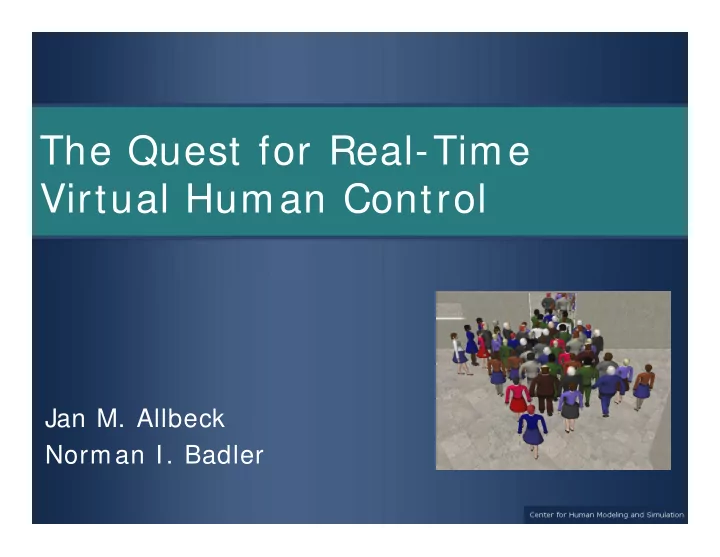
The Quest for Real-Time Virtual Human Control Jan M. Allbeck - - PowerPoint PPT Presentation

the quest for real time virtual human control
SMART_READER_LITE
LIVE PREVIEW

The Quest for Real-Time Virtual Human Control Jan M. Allbeck - - PowerPoint PPT Presentation

The Quest for Real-Time Virtual Human Control Jan M. Allbeck Norman I. Badler Center for Human Modeling and Simulation (HMS) University of Pennsylvania Becoming SIG Center for Computer Graphics Director is Norman I. Badler


slide-1
SLIDE 1

The Quest for Real-Time Virtual Human Control

Jan M. Allbeck Norman I. Badler

slide-2
SLIDE 2

2

Center for Human Modeling and Simulation (HMS)

  • University of Pennsylvania
  • Becoming SIG Center for

Computer Graphics

  • Director is Norman I. Badler
  • Associate Director is Jan M.

Allbeck

  • Claim to fame is Jack.
slide-3
SLIDE 3

3

generic character > hand-crafted character > cultural distinctions > sex and age > personality > psychological-physiological profiles > specific individual Individuality drawing > scripting > interacting > reacting > making decisions > communicating > intending > taking initiative > leading Autonomy

  • ff-line animation > interactive manipulation > real-time motion

playback > parameterized motion synthesis > multiple agents > crowds > coordinated teams (time to create movement at the next frame) Time cartoon > jointed skeleton > joint limits > strength limits > fatigue > hazards > injury > skills > effects of loads and stressors > psychological models > cognitive models > roles > teaming Function 2D drawings > 3D wireframe > 3D polyhedra > curved surfaces > freeform deformations > accurate surfaces > muscles, fat > biomechanics > clothing, equipment > physiological effects (perspiration, irritation, injury) Appearance

Comparative Virtual Humans

slide-4
SLIDE 4

4

Appearance

slide-5
SLIDE 5

5

Functionality

  • Robust walking and reaching are

required by a lot of scenarios.

  • Expressivity builds life.
slide-6
SLIDE 6

6

Locomotion

  • Evolving model based on a

combination of kinematic simulation of leg motions plus motion capture data

  • n pelvis motion.
  • Combined for procedural locomotion
  • n uneven or moving terrain.
  • Can combine with carrying and

pushing.

slide-7
SLIDE 7

7

Real-Time Upper Torso & Arm Reach (Zhao et al., SAE 2005)

  • Interactive wrist reach goal.
  • Real-time collision avoidance
  • Use available strength to

mediate arm poses.

  • Multi-joint dependencies.
  • Torso motion from empirical

data (Delleman/ TNO).

  • Benefits from spatial subdivision

and guidance.

slide-8
SLIDE 8

8

Better Movements: Motion Qualities “Orthogonal” to Gesture Choice

  • A “lively / reluctant” wave
  • A “warm / cool” welcome [ handshake]
  • A “threatening / friendly” gesture
  • Pick up the broken glass “carefully”
  • A “smashing” blow

Need to construct an intermediate representation between motion and “meaningful” states.

slide-9
SLIDE 9

9

EMOTE Motion Quality Model (Chi et al., SIGGRAPH 2000)

  • EMOTE: A real-time motion quality

model.

  • Based on Effort and Shape components
  • f Laban Movement Analysis.
  • Defines movement qualities with 8

parameters.

  • Controls numerous lower level

parameters of an articulated figure.

  • May be used to promote individuality.
slide-10
SLIDE 10

10

Effort Motion Factors

Four factors range from an indulging extreme to a fighting extreme:

Space: Indirect ------------------ Direct Weight: Light --------------------- Strong Time: Sustained ------------- Sudden Flow: Free --------------------- Bound

slide-11
SLIDE 11

11

Hit the ball … forcefully. …softly.

Manner Variants (adverbs): HIT

slide-12
SLIDE 12

12

Autonomy

  • What base functionality can be built
  • n?
  • Makes virtual humans easier to

instruct.

  • Trade off between autonomy and

control.

slide-13
SLIDE 13

13

Autonomy: Scripting for Complex Tasks

WalkFromSit, SitFromWalk, Reach, Carry2Hands, push, attach (camera), …

slide-14
SLIDE 14

14

Following Instructions: A human capability

  • 1. Rotate the handle at the base of the unit.
  • 2. Disconnect the 4 bottom electric

connectors.

  • 3. Disconnect the 5 top electric connectors.
  • 4. Disconnect the 2 coolant lines.
  • 5. Unbolt the 8 bolts retaining the power

supply to the airframe and support it accordingly, and remove it.

slide-15
SLIDE 15

15

Executing Maintenance Instructions

Eye view (Note attention Control)

Actual instructions translated into PARs, which then control actions.

slide-16
SLIDE 16

16

Some movements may greatly increase realism, but shouldn’t require explicit controls.

slide-17
SLIDE 17

17

Eye Movements Modeled from Human Performance Data

Source Eyes fixed ahead Eyes moved by statistical model Full MPEG-4 face

slide-18
SLIDE 18

18

Visual Attention Model (Gu et al., IVA ’06)

  • Model multiple influences:

imperfect cognition

interaction behaviors internal agent state engagement level social context environmental distractions

Reactivity

slide-19
SLIDE 19

19

Gaze and Gesture Application

  • American Sign Language synthesis
  • “Classifier Predicates”: Basically gestural

movements that relate to a virtual space around the signer situating the participants in the discourse, or show the actual movement path of a verb by spatial analogy.

slide-20
SLIDE 20

20

Time

And then there were many…

slide-21
SLIDE 21

21

Crowds Mobs Audiences Aggressive Escape Acquisitive Espressive Casual Intentional Lynchings Terrorizations Riots Panics in unorganized crowds Panics in

  • rganized

crowds Recreational Information- seeking Bourbon Proletariat

Brown (1954) Mass Phenomena

slide-22
SLIDE 22

22

Comparative Virtual Crowds

Individuals, groups, and mass phenomena that evolves Individuality Coordination, cooperation, and competition Autonomy How many characters can be simulated Time Variety of behaviors and movements Function Variety Appearance

slide-23
SLIDE 23

23

Multi-Agent Communication for Evacuation Simulation (MACES)

  • Wayfinding to explore unfamiliar building to find exits.
  • Inter-agent communication to share partial mental maps.
  • Roles for individual agents:
  • Trained leaders: complete knowledge of the

structure.

  • Untrained leaders: sparse knowledge. Help others

and search the environment to construct their mental maps.

  • Untrained follow ers: dependent people who cannot

make own decisions; when they see some other agent they follow it.

100% Untrained followers 100% Untrained leaders 10% Trained leaders

slide-24
SLIDE 24

24

MACES: Results (Pelechano, IEEE CG&A 2006)

  • Significant improvements in

evacuation rates with inter- agent communication.

  • Only a small percentage

(~ 10% ) of trained (knowledgeable) leaders yield evacuation rates comparable to the case where everyone is trained.

Evacuation time for 0, 25, 50, 75 and 100% leadership. Evacuation time for 200 agents with and without communication.

slide-25
SLIDE 25

25

High Density Crowd Simulation (HiDAC); (Pelechano et al., SCA 2007)

  • Simulate individual and group psychosocial

parameters.

slide-26
SLIDE 26

26

Durupinar, et al. Crowds with Personality (AAMAS 2008)

  • Openness
  • Conscientiousness
  • Extroversion
  • Agreeable
  • Neuroticism
slide-27
SLIDE 27

27

Conclusions?

  • Greater minimum investment
  • Higher expectations
  • Adding cognition to animation still implies

animation

  • Control vs. Autonomy
  • Application focused
  • Ease of creation and modification

(adaptability)

  • Mass Phenomena
  • Data driven
slide-28
SLIDE 28

28

Thank you! http: / / hms.upenn.edu

  • NSF
  • US Army (MURI)
  • US Air Force
  • Fulbright

Foundation

  • Autodesk
  • Pixar
  • Bilkent University
  • LMCO
  • NASA
  • Everyone in HMS.

Acknowledgments