
SLIDE 1
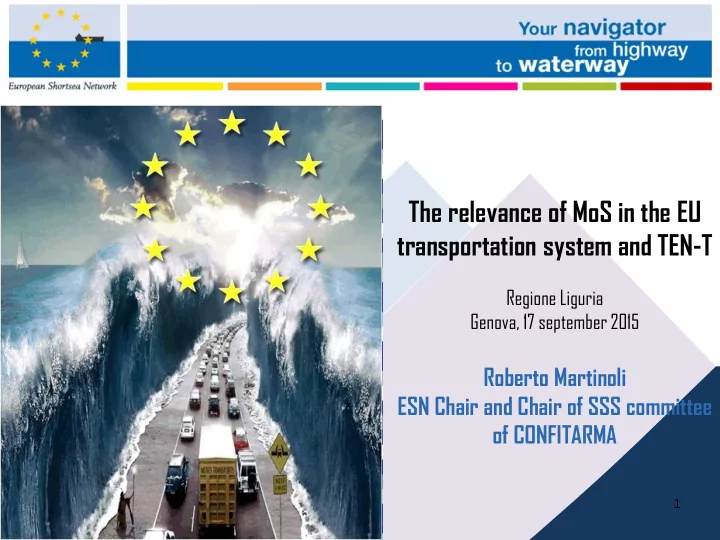
The relevance of MoS in the EU transportation system and TEN-T
Regione Liguria Genova, 17 september 2015
Roberto Martinoli ESN Chair and Chair of SSS committee
- f CONFITARMA
1
The relevance of MoS in the EU transportation system and TEN-T - - PowerPoint PPT Presentation
The relevance of MoS in the EU transportation system and TEN-T Regione Liguria Genova, 17 september 2015 Roberto Martinoli ESN Chair and Chair of SSS committee of CONFITARMA 1 S HORTSEA P ROMOTION C ENTRES 1995-2015 22 SPCs 1. Belgium 8.
Regione Liguria Genova, 17 september 2015
1
Shipowners, Shippers, Road haulers, Forwarders, ports,..
intermodal transport chains
SPC Italy is chairing the ESN from 1° July 2014 till 31 December 2015
1. Belgium 2. Bulgaria 3. Croatia 4. Cyprus 5. Denmark 6. Estonia 7. Finlandia
22 SPCs
8. France 9. Germany
2
WHO WE ARE Since 1999, SPCs are part
measures identified by the Commission to promote the image of SSS
COM 1999(317)
Non profit organisations supporting cluster activities 100% public, mixed or 100% industries’s run structures in straight connection with National Focal Points (FOP) ESN Annual Report 2014 http://www.shortsea.info/
WHAT DO WE DO
SSS, legal, economic and technical
Europea de SSS, Centre Atlantique de Shortsea européen, communication campaigns, ECSA, ESPO, FEPORT
national , EU authorities
the annual Joint meeting with EC and National Focal Points
OUR OBJECTIVES
Intermodality
mobility and flows of traffics
transport
simplify formalities
sustainable transport
3
We have a mission Strengthening the activities of promotion of national SPCs to ensure that SSS is perceived as a viable alternative to road Stimulating the exchange of initiatives between SPCs (best practice) Identifying common problems, needs and bottlenecks arising from the contacts with the users (bottom up approach) and search for solutions We share a vision Shifting the increased road traffic to sea transport, ensuring SSS will be the real alternative to road freight transport (2011 White paper objectives) “30% of road freight over 300km should shift to other modes such as rail or waterborne transport by 2030, and more than 50% by 2050, facilitating by efficient and Green corridors”.
ESN is there to make it happen!
4
Image of MOS (more marketing and interactive communication needed between governing
institutions and potential beneficiaries; MoS application process still complicated )
complex administrative procedures lack of efficiency at ports inconsistency in the application of rules and procedures among EU Members States lack of integration with the intermodal logistics chain
5
Implementation
the 2010/65/EU Directive
reporting formalities which establishes a standard electronic transmission
data by 1st June 2015 =>Member States not ready;
implementation;
National Single Windows systems;
requirements; => National existing systems still in place…
Directive 2015/719 on weight and dimensions of road vehicles participate to the
promotion of intermodal transport
containers or swap bodies of a length of up to 45’Palletwide/eurocontainer 33 pallet (100% intermodal compatible with all modes) => This should be also introduced within the revision of Directive
92/106/EEC on the establishment
a more efficient multimodal logistic chain.
Environmental performance
Directive 2012/33/EU on sulphur limits in marine fuels put at risk the economic sustainability of SSS in the North sea/Baltic areas (risk of modal shift back). Monitoring under way within the European Sustainable Shipping Forum (ESSF) and Regulation 2015/757 on Monitoring, Reporting, Notification (MRV) of Co2 will apply from 1.01.2018 to all ships (over 5 000GT) that use EU ports with additional commercial burden and costs on MoS.
LEGISLATIVE MEASURES
6
Multimodal transport of goods e-Freight The concepts of ‘single window’ and ‘one- stop administrative shop’ aiming at creating and deploying a single transport document in electronic form (electronic waybill) and creating the appropriate framework for the deployment
tracking and tracing technologies is far from being a reality in all EU ports! =>This should be accompanied by a uniform liability regime for intermodal transport in the Eu. OPERATIONAL ACTIONS
Maintaining the efficient operation and guidance of SPCs
=> driven by multimodal business interests, SPCs are delivering, however some still suffer of lack of financing .
Ensuring a vital role of SSS Focal Points
=> Cooperation with FOPs is effective as most SPCs are 100% /50% public structures, however more enhanced interaction is needed.
Statistical information – EU statistics on SSS
trade are not sufficiently detailed => SPCs are a valuable source of data => Ready to contribute.
7
ESN welcomed the positive and forward-looking Athens Declaration (May 2014) and asked for concrete implementation In may 2015, Joint letter co-signed by ECSA, ESPO, FEPORT, INTERFERRY, World Shipping Council, ESN to the EC and Member States to remind their commitments and to highlight 4 areas that should continue to form the basis of EU SSS/MoS in the future:
edge
Centres/Focal Points at national level
8
9
Mil ton
% based on gross weight of goods
10
sea volumes in the main ports of the United Kingdom (UK) came close to 307 million tonnes of cargo in 2013, accounting for 14 % of the total tonnages of short sea shipping in the EU-28 countries. The UK is followed by Italy and the Netherlands, with shares of 12.4 % and 12 % of the EU short sea shipping total, respectively.
same as in 2012. However, the share of SSS in total maritime transport varies considerably between the reporting countries. The predominance
Bulgaria, Denmark, Ireland, Croatia, Cyprus, Latvia, Malta, Poland, Finland and Sweden (above 80 %), as well as in the EEA country Norway.
Eurostat sources:
http://ec.europa.eu/eurostat/statistics-explained/index.php/Maritime_transport_statistics_- _short_sea_shipping_of_goods
11
MOS services from Italy to Med Countries (only Italian operators)
13
14
In accordance with DIRECTIVE 2014/94/EU of 22 October 2014 on the deployment of alternative fuels infrastructure, the Italian Ministry for the Economic Development has activated a national working group for the definition of a Strategic Plan for the use of LNG (road and maritime transport). CONFITARMA has given its contribution participating actively in the sub-group for maritime transport. The Strategic Plan will be adopted in the next months, hopefully allowing Italy to respect the 2016 deadline for the adoption of a policy framework for the development of the market as regards alternative fuels
Art.4.1 of the Directive: Member States shall ensure, by means of their national policy frameworks, that an appropriate number of refuelling points for LNG are put in place at maritime ports, to enable LNG inland waterway vessels or seagoing ships to circulate throughout the TEN-T Core Network by 31 December 2025. Member States shall cooperate with neighbouring Member States where necessary to ensure adequate coverage of the TEN-T Core Network.
16
Since the Transport White Paper of 2001, the development of MoS has been proposed as “a real competitive alternative to land transport” as part of the Trans-European Network - Transport (TEN-T). In 2004, the revised TEN-T Guidelines gave a legal framework for funding the MoS. In 2013, complete revision of the TEN-T Guidelines (2014-2020) and adoption of the financial instrument, so-called “Connecting Europe Facility (CEF)” succeeding the former TEN-T Programme (2007-2013) to help complete the TEN-T Core Network and its Corridors by 2030 with an increased total budget of €24 billion for projects. Since 2014, MoS is a horizontal priority of the Connecting Europe Facility (CEF) that aims to promote green, viable, attractive and efficient sea-based transport links integrated in the entire transport chain. Their implementation should help to rebalance the EU transport system.
17
about a structural change to transport organization: door-to-door integrated transport chains. Three main objectives for MoS: (1) freight flow concentration on sea-based logistical routes; (2) increasing cohesion; (3) reducing road congestion through modal shift. MoS will: help implement the policy initiatives on the European maritime space without barriers and the maritime transport strategy for 2018; positively contribute to greenhouse gas (CO2) reductions which is of paramount importance in the context of climate change.
18
19
20
Connecting Europe Facility-CEF instrument (2014-2020) provides co-fundings (grants) to MoS projects and supports the following MoS-related actions focusing either on establishing maritime-based MoS links or elaborating wider benefit actions:
the Cohesion Fund concerns Bulgaria, Croatia, Cyprus, the Czech Republic, Estonia, Greece, Hungary, Latvia, Lithuania, Malta, Poland, Portugal, Romania, Slovakia and Slovenia).
21
22
MoS portfolio ranks 7th in terms of TEN-T funding allocated to Priority Projects (PPs) (It also corresponds to 6.4% of the total TEN-T budget allocated thus far for the PPs).
Full list of MoS projects (updated December 2014): https://ec.europa.eu/inea/en/connecting-europe- facility/cef-transport/cef-transport-motorways-sea 23
OUTCOME OF CEF Transport CALLs 2014 (Multi Annual call) Objective 3: Horizontal measures Priority 4 : MoS On 19 July 2015, the EU Member States selected 27 MOS projects for a total of 259.4 € million CEF funding that will be implemented from 2015-2019.
24
MED-ATLANTIC Ecobonus 2014-EU-TM-0544- Study-ES, FR, IT, PT- June 2015- September 2017 Conceived as a study to develop a transport policy, the proposed Action aims at creating an incentive scheme (ECOBONUS), to support the demand for Motorways of the Sea (MoS) and modal shift in favour of sea-based routes. It focuses on the Atlantic and West Mediterranean markets. The key elements are: ECOBONUS scheme design, addressing financing, scope, operation, technical, technological and innovation aspects, including regulatory and legal issues; The Action will contribute to the development of new freight transport services and/or the
a modal shift.
25
26
Poseidon Med II - 2014-EU-TM-0673-Study – Cyprus, Greece, Italy The forthcoming 2020 global sulphur cap regulations (0,5%) are going to create a challenge for marine transportation in the EU. The Action focuses on the necessary steps towards adoption of LNG as marine fuel in the East Mediterranean, while making Greece a marine bunkering and distribution hub for LNG in South Eastern Europe. The Action will: facilitate the adoption of regulatory framework for LNG bunkering; design the extension of Revithoussa LNG terminal; design and construct a LNG fuelled specific feeder vessel; implement technical designs and plan approvals for the retrofit/new build of LNG fuelled vessels and for additional ports‘ infrastructure for bunkering operations; examine potential synergies with other uses of LNG. In the long term the Action will improve performance of maritime transport in the Mediterranean Sea.
2014-EU-TM-0698-M- Sustainable LNG Operations for Ports and Shipping – Innovative Pilot Actions (GAINN4MOS)
The Action prepares engineering studies and plans, as well as construction drawings of 4 LNG retrofitted prototype vessels, and 7 LNG bunkering stations at core ports (5 prototype stations in Koper, Genova, La Spezia, Livorno, Venezia, and 2 fully
Nantes-St Nazaire, and Fos- Marseille). The Action is part of the GAINN Global Project. Its activities include: final engineering projects of prototypes and pilots; prototyping; real life trials and pilots; communication and coordination.
27
2014-EU-TM-0531-Study: Fresh Food Corridors
Cyprus, France, Italy, Slovenia
Contributing to the objectives of the Global Project on establishing new cold logistics chain in the Euro-Mediterranean area, the proposed Action aims to design, implement and evaluate a Fresh Food Corridors (FFC) concept between Israel/Jordan and Europe using the core ports of Koper, Marseille and
extension of the concept to the Port of La Spezia and its integration between Cyprus-
definition of requirements; FFCs pilots: design and execution of 3 corridors including an assessment how the FFC can be applied also to Israel/Jordan - port of La Spezia corridor and south of Germany; Establishing a B2B stakeholders platform;
28
29
30