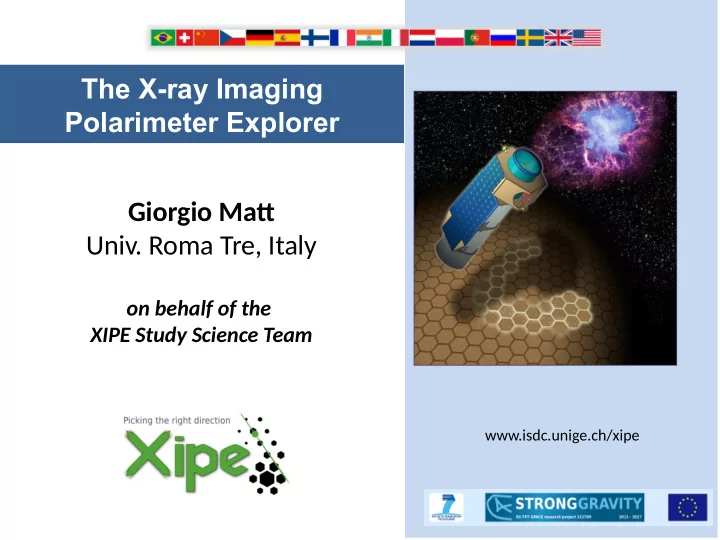
SLIDE 1 The X-ray Imaging Polarimeter Explorer Giorgio Mat
- Univ. Roma Tre, Italy
- n behalf of the
XIPE Study Science Team
www.isdc.unige.ch/xipe
SLIDE 2 Why X-ray polarimetry?
Introductjon
Informatjon on celestjal (extra-solar) sources are mostly provided by electromagnetjc radiatjon. They can be obtained by studying the spatjal, spectral, tjming and polarizatjon propertjes
- f the observed radiatjon.
In partjcular, the polarizatjon propertjes give us informatjon on geometry (in a broad sense: geometry of the emittjng mater but also of magnetjc and gravitatjonal fjelds, of space-tjme, etc.): the polarizatjon degree depends on the level and type of symmetry of the system, the polarizatjon angle indicates its orientatjon. Our knowledge of the emission from a celestjal source in a certain energy band is therefore incomplete without polarimetry. However, polarimetric informatjons of astrophysical sources are basically missing in the X-ray band !
SLIDE 3
Why X-ray polarimetry?
Introductjon
Polarimetry has proved very important in radio, IR and optjcal bands (eg. jet emission in blazars, Unifjcatjon Model of AGN, ...). In X-rays, where non-thermal emission processes and aspherical geometries are likely to be more common than at lower energies, polarimetry is expected to be vital to fully understand emittjng sources. However, only one measurement (P=19% for the Crab Nebula, indicatjng synchrotron emission) has been obtained so far, together with a tjght upper limit to Sco X-1. These measurements have been obtained in the 70s, for the two brightest sources in the X-ray sky. The lack, for many decades, of signifjcant technical improvements implied that no polarimeters were put on board of X-ray satellites.
SLIDE 4 Why X-ray polarimetry?
Why XIPE? The situatjon has changed dramatjcally with the advent of polarimeters based on the photoelectric
- efgect. Such detectors, on the focal plane of a
X-ray telescope, may provide astrophysically interestjng measurements for hundreds of sources (remember that polarimetry is a photon hungry technique...). The brightest specimens of all major classes of X-ray sources are now accessible! Time is ripe for a X-ray polarimetric mission ! Indeed, a X-ray polarimeter was part of the focal plane suite of detectors of XEUS/IXO, but it did not survive the severe descooping towards Athena. A X-ray polarimetric mission, GEMS, was approved by NASA as a SMEX but later cancelled for programmatjc reasons. And fjnally, XIPE has been selected for a phase A study in ESA M4 (together with Ariel, devoted to exoplanets, and Thor, a solar magnetosphere mission; fjnal down-selectjon in Spring 2017). XIPE will perform spectrally-, spatjally- and tjme-resolved polarimetry of hundreds of celestjal sources to provide a breakthrough in astrophysics and fundamental physics
SLIDE 5
Why X-ray polarimetry?
XIPE goals
Astrophysics Acceleratjon phenomena Pulsar wind nebulae SNRs Jets Emission in strong magnetjc fjelds Magnetjc cataclysmic variables Accretjng millisecond pulsars Accretjng X-ray pulsars Magnetars Scatering in aspherical situatjons X-ray binaries Radio-quiet AGN X-ray refmectjon nebulae Fundamental Physics Mater in Extreme Magnetjc Fields: QED efgects Mater in Extreme Gravitatjonal Fields: GR efgects Galactjc black hole system & AGNs Quantum Gravity Search for axion-like partjcles XIPE will observe almost all classes of X-ray sources
A large community involved (as for the proposal): 17 countries 146 scientjsts 68 instjtutes around the world
SLIDE 6 Radio (VLA) Infrared (Keck) Optjcal (Palomar) X-rays (Chandra) Radio polarisatjon IR polarisatjon Optjcal polarisatjon X-ray polarisatjon
?
P=19% integrated over the entjre nebula (Weisskopf et al. 1978)
X-rays probe freshly accelerated electrons and their acceleratjon site.
XIPE scientjfjc goals
Astrophysics: Acceleratjon: PWN - The Crab Pulsar
SLIDE 7 XIPE scientjfjc goals
Astrophysics: Acceleratjon: PWN 20 ks with XIPE
- The OSO-8 observatjon, integrated over the entjre nebula, measured a positjon angle that is tjlted with
respect to the jets and torus axes.
- What is the role of the magnetjc fjeld (turbulent or not?) in acceleratjng partjcles and forming
structures?
- XIPE imaging capabilitjes will allow us to measure the pulsar polarisatjon by separatjng it from the
much brighter nebula emission.
- Other PWN, up to 5 or 6, are accessible for larger exposure tjmes (e.g. Vela or the “Hand of God”).
SLIDE 8
XIPE scientjfjc goals
Astrophysics: Acceleratjon: SNR Map of the magnetjc fjeld Spectral imaging allows to separate the thermalised plasma from the regions where shocks accelerate partjcles. What is the orientatjon of the magnetjc fjeld? How ordered is it? The spectrum cannot tell…
2 Ms observatjon with XIPE 4-6 keV image of Cas A blurred with the PSF of XIPE
SLIDE 9
XIPE scientjfjc goals
Astrophysics: Acceleratjon: Unresolved Jets in Blazars Schematjc view of an AGN
➡
Blazars are those AGN which not only have a jet (like all radiogalaxies), but it is directed towards us. Due to a Special Relatjvity efgect (aberratjon), the jet emission dominates over other emission components
SLIDE 10 Astrophysics: Acceleratjon: Unresolved Jets in Blazars Blazars are extreme accelerators in the Universe, but the emission mechanism is far from being understood. In inverse Compton dominated Blazars, a XIPE observatjon can determine the origin
- f the seed photons:
- Synchrotron-Self Compton (SSC) ?
The polarizatjon angle is the same as for the synchrotron peak.
The polarizatjon angle may be difgerent. The polarizatjon degree determines the electron temperature in the jet.
XIPE band XIPE band XIPE band XIPE band XIPE band
XIPE scientjfjc goals
IC Peak
SLIDE 11 XIPE scientjfjc goals
Astrophysics: Acceleratjon: Unresolved Jets in Blazars
IC Peak
IC Peak XIPE band
In synchrotron-dominated X-ray Blazars, multj-λ polarimetry probes the structure
- f the magnetjc fjeld along the jet.
Models predict a larger and more variable polarisatjon in X-rays than in the
Coordinated multj-wavelength campaigns are crucial for blazars. Such campaigns (including polarimetry) are routjnely organised and it will be easy for XIPE to join them.
IC Peak
IC Peak XIPE band
IC Peak XIPE band
IC Peak
IC Peak XIPE band
IC Peak XIPE band
IC Peak
Blazars are extreme accelerators in the Universe, but the emission mechanism is far from being understood.
SLIDE 12
XIPE scientjfjc goals
Astrophysics: Acceleratjon: Resolved Jets in Radiogalaxies The extended (4’) radio jet in Cen A. In nearby, non-blazar radiogalaxies, the jet may be resolved. XIPE can map the X-ray polarisatjon and thus the magnetjc fjeld of resolved X-ray emittjng jets. MDP for the jet of Centaurus A is 5% in 1 Ms in 5 regions.
SLIDE 13
XIPE scientjfjc goals
Astrophysics: Strong Magnetjc Fields: Cataclysmic variables Accretjon in Magnetjc Cataclysmic Variables occurs in accretjon column. Main emission process is thermal bremsstrahlung, but scatuering may be relevant. Polarizatjon gives informatjons on the accretjon mode (Matu 2004; McNamara et al, 2008) Matu 2004
SLIDE 14
XIPE scientjfjc goals
Astrophysics: Strong Magnetjc Fields: Accretjng Millisecond Pulsars Viironen & Poutanen 2004
Emission due to scatuering in hot spots ⇒ Phase-dependent linear polarizatjon
SLIDE 15 XIPE scientjfjc goals
Astrophysics: Strong Magnetjc Fields: Accretjng X-ray Pulsars Meszaros et al. 1988
Opacity in highly magnetjzed plasma ⇒ k⊥ ≠ k∥
Phase-dependent linear polarizatjon
From the (phase-resolved) swing
- f the polarisatjon angle :
Orientatjon of the rotatjon axis and inclinatjon of the magnetjc fjeld (required for many purposes, e.g. measure of mass/radius relatjon)
SLIDE 16
XIPE scientjfjc goals
Astrophysics: Strong Magnetjc Fields: Accretjng X-ray Pulsars Meszaros et al. 1988
“Fan” vs. “Pencil” beam
SLIDE 17 XIPE scientjfjc goals
Astrophysics: Scatering: Coronae in X-ray binaries & AGN
The geometry is related to the corona
- rigin:
- Slab – high polarisatjon (up to more
than 10%): disc instabilitjes?
- Sphere – very low polarisatjon:
aborted jet? The geometry of the hot corona, considered to be responsible for the (non-disc) X-ray emission in binaries and AGN, is largely unconstrained.
SLIDE 18 XIPE scientjfjc goals
Astrophysics: Scatering: Coronae in X-ray binaries & AGN
The geometry is related to the corona
- rigin:
- Slab – high polarisatjon (up to more
than 10%): disc instabilitjes?
- Sphere – very low polarisatjon:
aborted jet? The geometry of the hot corona, considered to be responsible for the (non-disc) X-ray emission in binaries and AGN, is largely unconstrained.
SLAB SPHERE
Marin & Tamborra 2014
SLIDE 19 XIPE scientjfjc goals
Astrophysics: Scatering: X-ray refmectjon nebulae in the GC
Cold molecular clouds around Sgr A* (i.e. the supermassive black hole at the centre of
- ur own Galaxy) show a neutral iron line and a Compton bump → Refmectjon from an
external source!?! No bright enough sources are in the surroundings. Are they refmectjng X-rays from Sgr A*? so, was it one million tjmes brighter a few hundreds years ago? Polarimetry can tell!
SLIDE 20 XIPE scientjfjc goals
Astrophysics: Scatering: X-ray refmectjon nebulae in the GC
Polarizatjon by scatering from Sgr B complex, Sgr C complex
- The angle of polarisatjon pinpoints the source of X-rays
- The degree of polarizatjon measures the scatuering angle and determines
the true distance of the clouds from Sgr A*.
Marin et al. 2014
SLIDE 21 XIPE scientjfjc goals
Fundamental Physics: Mater in extreme magnetjc fjelds: QED efgects Such an efgect is only visible in the phase dependent polarizatjon degree and angle. Light curve Polarisatjon degree Polarisatjon angle Magnetars are isolated neutron stars with likely a huge magnetjc fjeld (B up to 1015 Gauss).
It heats the star crust and explains why the X-ray luminosity largely exceeds the spin down energy loss. QED foresees vacuum birefringence, an efgect predicted 80 years ago (Eisenberg & Euler 1936), expected in such a strong magnetjc fjeld and never detected yet.
SLIDE 22 XIPE scientjfjc goals
Fundamental Physics: Strong Gravitatjonal Fields: GR efgects in XRB So far, three methods have been used to measure the BH spin in XRBs:
- 1. Relatjvistjc refmectjon (stjll debated, requires accurate spectral decompositjon);
- 2. Contjnuum fjttjng (requires knowledge of the BH mass, distance and inclinatjon);
- 3. QPOs (all three QPOs required to completely determine the parameters,
so far applied only to two sources). Black holes are fully characterized by their mass and angular momentum (spin, indicated with a) (+Q) Knowledge of the spin tells us about the BH birth (in Galactjc black holes) or the BH growth (in galaxies).
SLIDE 23 XIPE scientjfjc goals
Fundamental Physics: Strong Gravitatjonal Fields: GR efgects in XRB Statjc BH Maximally rotatjng BH For a number of XRBs, the three methods do not agree! Example: J1655-40: QPO: a = J/Jmax = 0.290±0.003 Contjnuum: a = J/Jmax = 0.7±0.1 Iron line: a = J/Jmax > 0.95 Energy dependent rotatjon of the X-ray polarisatjon plane
- Two observables: polarisatjon degree & angle
- Two parameters: disc inclinatjon & black hole
spin
SLIDE 24
XIPE scientjfjc goals
Fundamental Physics: Loop QG and search for Axion-like partjcles
Search for energy-dependent birefringence efgects on distant polarized sources (e.g. Blazars) may put tjghter constraint on QG theories (e.g. Loop Quantum Gravity). Variatjons of polarizatjon angle and degree from sources in the background of large regions with signifjcant magnetjc fjeld (eg clusters of galaxies) may indicate the presence of Axion-like partjcles, a candidate to be one of the dark matuer main ingredients. Very challenging measurements, but potentjally very rewarding!!
SLIDE 25
XIPE Science Requirements
The energy band
SLIDE 26
XIPE Science Requirements
The energy band
SLIDE 27
XIPE Science Requirements
General requirements
SLIDE 28
XIPE Science Requirements
Payload and mission requirements
SLIDE 29 XIPE Observing Plan
How many sources? Target Class Ttot (days) Tobs/ source (Ms) MDP (%) Number in 3 years Number available AGN 219 0.3 < 5 73 127 XRBs (low+high mass) 91 0.1 < 3 91 160 SNRe 80 1.0 < 15 % (10 regions) 8 8 PWN 30 0.5 <10 % (more than 5 regions) 6 6 Magnetars 50 0.5 < 10 % (in more than 5 bins) 10 10 Molecular clouds 30 1-2 < 10 % 2 complexes or 5 clouds 2 complexes
Total 500 193 316
SLIDE 30
XIPE Observing Plan
First six months observing plan
SLIDE 31 XIPE Design
Overview
- Three telescopes with 3.5 m focal length to fjt within the Vega fairing:
Long heritage: SAX → XMM → Swifu → eROSITA → XIPE
- Pioneering, yet mature detectors: conventjonal proportjonal counter but with a revolutjonary
readout, already studied by ESA during XEUS/IXO.
- Mild mission requirements: 1 mm alignment, 1 arcmin pointjng.
- Fixed solar panel. No deployable structure. No
- cryogenics. No movable part except for the fjlter
wheels.
- Three years of nominal operatjon. No consumables.
- Optjcs designed by the XIPE consortjum and
procured by ESA; Focal Plane Assembly and Control Electronics procured by the XIPE consortjum.
SLIDE 32
XIPE Design
The Gax Pixel Detector The Gas Pixel Detector (Costa et al. 2001, Bellazzini et al. 2006, 2007) is a polarizatjon-sensitjve instrument capable of imaging, tjming and spectroscopy The directjon of the ejected photoelectron is statjstjcally related to the polarisatjon of the absorbed photon. The Gas Pixel Detector
SLIDE 33 XIPE Design
The Gax Pixel Detector
Image of a real photoelectron track. The use of the gas allows to resolve tracks in the X-ray energy band. Modulatjon factor as a functjon of energy. Real modulatjon curve derived from the measurement
- f the emission directjon of the photoelectron.
Residual modulatjon for unpolarized photons. Muleri et al. 2008, 2010
SLIDE 34 XIPE Design
Imaging capability
- Good spatjal resolutjon: 90 µm HEW
- Imaging capabilitjes on- and ofg-axis measured at the
PANTER X-ray testjng facility of the MPE with a JET-X telescope (Fabiani et al. 2014)
- Angular resolutjon for XIPE: <26 arcsec
SLIDE 35 XIPE in a nutshell
Polarisatjon sensitjvity 1.2% MDP for 2x10⁻¹⁰ erg/s cm2 (10 mCrab) in 300 ks
- r 6.7% MDP for 2x10-11 erg/s cm2 (1 mCrab) in 100 ks
Energy range 2-8 keV Angular resolutjon <26 arcsec (goal: 20 arcsec) Field of View 15x15 arcmin2 Spectral resolutjon 16% @ 5.9 keV Timing Resolution <8 μs Dead time 200 μs Stability >3 yr Spurious polarizatjon <0.5 % (goal: <0.1%) Background 2x10⁻⁶ c/s or 4 nCrab µ: modulatjon factor S: collectjng area T: observing tjme The MDP is the minimum detectable polarisatjon at the 99% confjdence level.
SLIDE 36
XIPE Team
XIPE Science Study Team Soffjta Paolo (Lead Scientjst) (INAF-IAPS, I) Bellazzini Ronaldo (INFN-Pi, I) Courvoisier Thierry (University of Geneva, CH) Goosmann Rene (Obs. Astron. de Strasbourg, F) Mat Giorgio (Univ. Roma Tre, I) Reglero Victor (Univ. of Valencia, E) Santangelo Andrea (IAAT, D) Tagliaferri Gianpiero (INAF-OA Brera, I) Vink Jacco (Univ. of Amsterdam, NL) Zane Silvia (MSSL-UCL, UK)
SLIDE 37 XIPE Team
XIPE Science Working Groups
WG 1. Acceleratjon mechanisms (leaders: G. Tagliaferri, J. Vink) WG1.1. Pulsar Wind Nebulae (chair: M. Weisskopf)
WG1.2. Supernova Remnants (chair: A. Bykov) WG1.3. Blazars (chair: I. Agudo) WG1.4. Microquasars (chair: E. Gallo) WG1.5. Gamma-ray Bursts (chair: C. Mundell) WG1.6. Tidal Disruptjon Events (chair: I. Donnarumma) WG1.7. Actjve Stars (chair: N. Grosso) WG1.8. Clusters of Galaxies (chair: S. Sazonov)
WG 2. Magnetjc Fields in Compact Objects (leaders: A. Santangelo, S. Zane) WG2.1. Cataclysmic Variables and Novae (chair: D. De Martjno)
WG2.2. Accretjng millisecond pulsars (chair: J. Poutanen) WG2.3. Accretjng X-ray Pulsars (chair: V. Doroshenko) WG2.4. Magnetars (chair: R. Turolla)
WG 3. Scatering in Aspherical Geometries and Accretjon Physics (leaders: E. Churazov, R.Goosmann) WG3.1 X-ray binaries and QPOs (chair: J. Malzac)
WG3.2. Actjve Galactjc Nuclei (chair: P.O. Petrucci) WG3.3. Molecular Clouds and SgrA* (chair: F. Marin) WG3.4. Ultraluminous X-ray sources (chair: H. Feng)
WG 4. Fundamental Physics (leaders: E. Costa, G. Mat) WG4.1 QED and X-ray polarimetry (chair: R. Perna)
WG4.2. Strong Gravity (chair: J. Svoboda) WG4.3. Quantum Gravity (chair: P. Kaaret) WG4.4. Axion-like partjcles (chair: M. Roncadelli)
SLIDE 38
M4 Timeline
SLIDE 39
How to pronounce XIPE? Xipe Totec is represented wearing fmayed human skin, usually with the fmayed skin of the hands falling loose from the wrists. (from Wikipedia) Sure the selectjng commituee will not dare disappointjng so nice and kind god.....
In Aztec mythology and religion, Xipe Totec (/ˈʃiːpə ˈtoʊtɛk/; Classical Nahuatl: Xīpe Totēc [ˈʃiːpe ˈtoteːkʷ]) ("Our Lord the Flayed One") was a life-death-rebirth deity, god of agriculture, vegetatjon, the east, disease, spring, goldsmiths, silversmiths, liberatjon and the seasons.
SLIDE 40
Summary
XIPE will open a new observatjonal window, adding the two missing observables in X-rays. Many X-ray sources are aspherical and/or non- thermal emiters, so radiatjon must be highly polarised. XIPE is simple and ready, using pioneering, yet mature, technology. First XIPE Science Conference Valencia, May 24-26, 2016