UDT 2020 Maintaining quality in the submarine supply chain. - - PowerPoint PPT Presentation

udt 2020 maintaining quality in the submarine supply chain
SMART_READER_LITE
LIVE PREVIEW

UDT 2020 Maintaining quality in the submarine supply chain. - - PowerPoint PPT Presentation

UDT 2020 Maintaining quality in the submarine supply chain. Carolyn Valentine & Matthew Palmer 26 th May 2020 Introduction Background of the submarine supply chain Management of Transverse issues Potential problems in the


slide-1
SLIDE 1

Carolyn Valentine & Matthew Palmer 26th May 2020
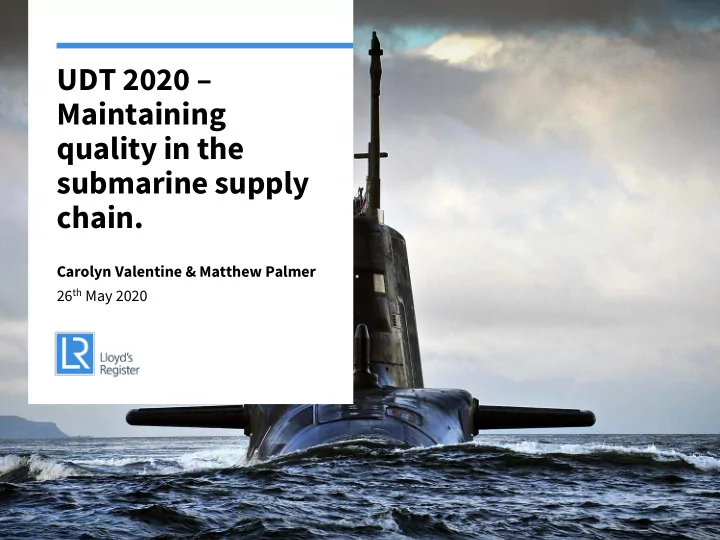
UDT 2020 – Maintaining quality in the submarine supply chain.

slide-2
SLIDE 2

Introduction

Lloyd's Register 2

  • Background of the

submarine supply chain

  • Management of

Transverse issues

  • Potential problems in the

submarine supply chain

  • Can we use the principles

from the ship supply chain?

  • Level of assurance based
  • n safety function
slide-3
SLIDE 3

Submarine supply chain

Lloyd's Register

Verify Visit Report

Site team

Submarine builder/maintainer

Supplier Assurance

Purchase Order

ITP

Independent third party verification (optional)

Supplier ITP ITP

Comms Comms

Builder/maintainer design teams input

Kick Off

slide-4
SLIDE 4

Basic Differences (Transverse issuses)

Lloyd's Register 4

  • Stealth Power
  • Submarines Stability
  • Closed Atmosphere
  • Defect Tolerance
  • Weight Watchers
  • System Integration
slide-5
SLIDE 5

What are the potential problems in the submarine supply chain

  • Local vs global
  • Long lead items ‘lock out’
  • Maintain the design
  • Limited supply chain and bespoke items
  • Spares
  • Record keeping

Lloyd's Register 5

slide-6
SLIDE 6

Surface ship supply chain and its application for submarines

  • Developed over many years
  • Ship Rules demanded by industry to protect assets
  • Built on vast a knowledge & experience base
  • Classification Society Rules work across the shipping industry
  • Readily adopted by naval ships
  • Share common features
  • Similar compliance demands
  • Exist in large numbers so good knowledge & experience base
  • Resource pressure on standards

Lloyd's Register 6

slide-7
SLIDE 7

Surface ship supply chain and its application for submarines

  • Compliance with prescriptive standards doesn’t address every safety risk.
  • Ship standards set minimum safety requirements.
  • Whole boat transverse requirements are derived from the ConOpS.
  • Transverse whole boat issues apply to every design level.
  • Higher quality requirements depending on risk category.
  • Ship standard with modifications or additions is an acknowledgement the

rule does not in itself address the requirements.

  • This approach can provide cost effective solutions for the designer.

Lloyd's Register 7

slide-8
SLIDE 8

Level of assurance bases on safety function

  • How and where the material/component is used?
  • Consequence of failure
  • Safety function could be broken down by hazard:

– Structure – Watertight integrity – Buoyancy and control – Propulsion – Power generation and distribution

Lloyd's Register 8

slide-9
SLIDE 9

Lloyd's Register

Manufacturing Risk

Risk Consequence of Material Failure

Likelihood Likelihood per Annum

Catastroph ic Critical Significant Marginal Negligible

Fatalities per Event >10 10 to >1 1 to >10-1 10-1 to >10-2 <10-2

Frequent

>1

Probable

1 to >10-1

Occasional

10-1 to >10-2

Remote

10-2 to >10-3

Improbable

10-3 to >10-4

Highly Improbable

10-4 to 10-5

Incredible

<10-5

Safety Function (c) Pipe Manoeuvring & Control Safety Function (p) Pipe Clips Power & Propulsion Safety Function (c) Pipe Manoeuvring & Control Safety Function (c) Compressed Air System Manoeuvring & Control Safety Function (c) Compressed Air System Manoeuvring & Control

  • Supplier Performance
  • Novel Process
  • Product Complexity
  • Product Value
  • Programme Critical
  • Common Mode Failure

Safety Function (i) Pressure Hull Valve Strength & WT Integrity Safety Function (i) Pressure Hull Back Up Valve Strength & WT Integrity Safety Function (i) Pressure Hull Back Up Valve Strength & WT Integrity

slide-10
SLIDE 10

Level of assurance based on safety function

Lloyd's Register

Pressure Hull Valve

Functions

Watertight integrity

Transverse

Whole Boat

  • Transverse
  • Survivability
  • Product Verification
  • Categorisation

System

Pressure and Piping System components

  • Performance Requirements
  • Construction and Installation
  • Trim and Compensating System
  • Sea Water Cooling Systems
  • System Testing, Integration and

Trials

Component

Pressure and Piping System components

  • Performance Requirements
  • Assessment
  • Materials
  • Copper and copper alloy piping

components

  • Valves
  • Testing

Materials

Rules for Materials

  • Approved Works
  • Testing Procedures
  • Copper Alloys
  • Corrosion Prevention
slide-11
SLIDE 11

System & Component Risk Combinations

Lloyd's Register

slide-12
SLIDE 12

Risk based approach

  • Traditional

– Inflexible – Assumes everything works as new – Is difficult to run ‘what ifs’

  • Goal Based

– Flexible – Allows for manipulation at lowest level – Can be extended if circumstances change – Copes with multiple degradation of systems – More easily updated

Lloyd's Register 12

Safety case

slide-13
SLIDE 13

Summary

Lloyd's Register

  • Consequence of failure drive higher build quality
  • Product & Build Quality key to through life reliability & availability
  • Supplied product is the foundation of build quality
  • Quality cannot be INSPECTED into a product
  • SQEP Independent verification provides Assurance
  • Verification supported by well defined solutions
  • Solutions that reflect product risk category
  • Quality can be BUILT into the product
slide-14
SLIDE 14

Lloyd's Register 14

Thank you

Carolyn Valentine & Matthew Palmer

LR Submarine Programme Manager

Naval Centre of Expertise

2nd Floor, The Sion, Crown Place, Nailsea Bristol BS48 1RB T +44 (0) 1275 515000 M +44 (0) 7764430644 E roger.coles@lr.org www.lr.org/marine