Using Art in History and Literature Classes: Whats the Story? An - - PowerPoint PPT Presentation

using art in history and literature classes what s the
SMART_READER_LITE
LIVE PREVIEW

Using Art in History and Literature Classes: Whats the Story? An - - PowerPoint PPT Presentation

Using Art in History and Literature Classes: Whats the Story? An Online Professional Development Seminar Part 1: Visual Analysis Part 2: Historical Context John Coffey, Deputy Director for Art Ashley Weinard, Educator North Carolina Museum


slide-1
SLIDE 1

We will begin promptly on the hour. The silence you hear is normal. If you do not hear anything when the images change, e-mail Caryn Koplik ckoplik@nationalhumanitiescenter.org for assistance.

Using Art in History and Literature Classes: What’s the Story?

An Online Professional Development Seminar

John Coffey, Deputy Director for Art Ashley Weinard, Educator North Carolina Museum of Art

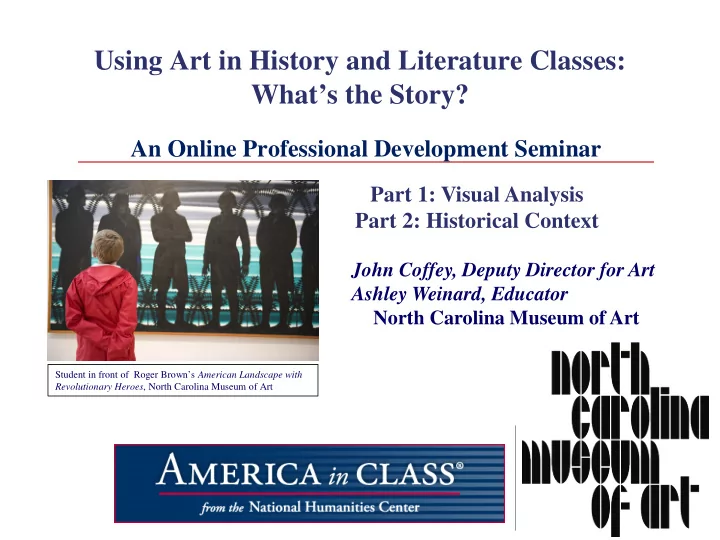
Student in front of Roger Brown’s American Landscape with Revolutionary Heroes, North Carolina Museum of Art

Part 1: Visual Analysis Part 2: Historical Context

slide-2
SLIDE 2

americainclass.org 2

  • Founded in 1947
  • The first state in the nation to

use public funds to buy an art collection

European painting from the Renaissance to the 19th century Egyptian funerary art Ancient Greek and Roman sculpture and vase painting American art of the 18th through 20th centuries, One of only two permanent displays of Jewish art in an American art museum. Museum Park is home to more than a dozen monumental works of art

slide-3
SLIDE 3

americainclass.org 3

americainclass.org

slide-4
SLIDE 4

americainclass.org 4

GOALS

  • To help make history and literature teachers more

comfortable with and confident about using art in their classes

  • To provide object-based discussion strategies to use with

students

  • To show how knowledge of historical context can affect a

viewer’s perception of a work of art

  • To help teachers meet the visual analysis component of the

Common Core State Standards

Using Art in History and Literature Classes

slide-5
SLIDE 5

americainclass.org 5

FROM THE FORUM

What we learned from the forum:

Teachers use a variety of art: Surrealists Middle Eastern Asian/Indian American: Hudson River School, John Caleb Bingham, John Gast Many teachers use art to “supplement” the teaching of history and literature. Art offers a way to provoke reflection on values. Teachers interpret art in a variety of ways—as cultural celebration, social critique, persuasive tool. The technical aspects of “reading” a painting intimidate some teachers and students.

Using Art in History and Literature Classes

slide-6
SLIDE 6

americainclass.org 6

FROM THE FORUM

What we asked in the forum:

How can we integrate images meaningfully and seamlessly into literature or culture classes? (In other words, what do we mean when we say we use art to “supplement” the teaching of literature and history?) What methods can we use to engage students in the study of art? How do you read a painting, and how can we teach students to do so? How can we become more intentional and focused in our use of art in class?

Using Art in History and Literature Classes

slide-7
SLIDE 7

americainclass.org 7

FROM THE FORUM

What we asked in the forum:

What questions can we ask to help students analyze art—in fact, all visual images—with greater depth and sophistication? How can we avoid falling into the trap of allowing students to believe that representative paintings are “accurate reflections of reality”? How does teaching art in an art class differ from teaching it in a history or literature class? Is art a primary or secondary source? How does teaching with art translate into an online environment?

Using Art in History and Literature Classes

slide-8
SLIDE 8

americainclass.org 8

Ashley Weinard, Museum Educator John Coffey, Deputy Director for Art

North Carolina Museum of Art

slide-9
SLIDE 9

americainclass.org 9

Intro: What can I do with art?

  • Introduce a concept, time period or genre
  • Teach literary or historical analysis
  • Gauge student questions/understanding

about a concept, period, etc.

  • Illustrate a historical context
  • Generate creative/original writing
  • Evaluate student understanding
  • Motivate students to learn…

Using Art in History and Literature Classes

slide-10
SLIDE 10

americainclass.org 10

Basic Tips for Discussing Works of Art

  • Let students look and explore first…

Begin with open-ended questions that allow students to explore the works of art before you direct their attention or

  • ffer your own interpretation.
  • Make students support their ideas…

Pose follow-up questions, such as “What detail in the painting makes you think that?”

  • Encourage self-reflection…

Return to the work of art after your study and ask students to consider how their impressions have changed. Using Art in History and Literature Classes

slide-11
SLIDE 11

americainclass.org 11

Part I: Modeling Visual Analysis

What can we discover about these three works of art by just looking closely and making connections to prior knowledge?

Using Art in History and Literature Classes

slide-12
SLIDE 12

americainclass.org 12

Easy Discussion Questions What is going on in this picture? What makes you think that? What more can you find? * What does this work of art make you wonder? Where might you find answers to your questions? * What information do you already know that could help you understand what you see? Using Art in History and Literature Classes

slide-13
SLIDE 13

americainclass.org 13

Christian Friedrich Mayr (American, born Germany, 1803-1851) Kitchen Ball at White Sulphur Springs, Virginia, 1838 North Carolina Museum of Art

Using Art in History and Literature Classes MAIN IMAGE #1

slide-14
SLIDE 14

americainclass.org 14

1870

Charles Felix Blauvelt (American, 1824-1900) A German Immigrant Inquiring His Way, 1855 North Carolina Museum of Art

Using Art in History and Literature Classes MAIN IMAGE #2

slide-15
SLIDE 15

americainclass.org 15

1870

Thomas Hart Benton (American, 1889-1975) Spring on the Missouri, 1945 North Carolina Museum of Art

Using Art in History and Literature Classes MAIN IMAGE #3

slide-16
SLIDE 16

americainclass.org 16

Easy Discussion Questions What is going on in this picture? What makes you think that? What more can you find? * What does this work of art make you wonder? Where might you find answers to your questions? * What information do you already know that could help you understand what you see? Using Art in History and Literature Classes

slide-17
SLIDE 17

americainclass.org 17

www.artnc.org

slide-18
SLIDE 18

americainclass.org 18

www.artnc.org/node/459

slide-19
SLIDE 19

americainclass.org 19

Part II: Adding in Historical Context

How does contextual information and interpretive analysis change how we view these works of art?

Using Art in History and Literature Classes

slide-20
SLIDE 20

We will begin promptly on the hour. The silence you hear is normal. If you do not hear anything when the images change, e-mail Caryn Koplik ckoplik@nationalhumanitiescenter.org for assistance.

Christian Friedrich Mayr (American, born Germany, 1803-1851); Kitchen Ball at White Sulphur Springs, Virginia, 1838 North Carolina Museum of Art

slide-21
SLIDE 21

americainclass.org 21

Using Art in History and Literature Classes Captain Fredrick Marryat, Diary in America, pp. 272-3 “Among others, attracted to the springs professionally, was a very clever German painter, who, like all Germans, had a very correct ear for music. He had painted a kitchen-dance in Old Virginia, and in the picture he had introduced all the well-known coloured people in the place; among the rest were the band of musicians, but I observed that one man was missing. “Why did you not put him in,” inquired I. “Why, Sir, I could not put him in; it was impossible; he never plays in tune. Why, if I put him in, Sir, he would spoil the harmony of my whole picture!”

slide-22
SLIDE 22

americainclass.org 22

Eastman Johnson (American, 1824-1906) Old Kentucky Home (Negro Life at the South), 1859 New York Public Library

Christian Friedrich Mayr (American, born Germany, 1803-1851) Kitchen Ball at White Sulphur Springs, Virginia, 1838 North Carolina Museum of Art

Using Art in History and Literature Classes

What might contemporary viewers have seen in this painting?

William Aiken Walker (American, 1838-1921) Two Cotton Pickers in the Field, date unknown

slide-23
SLIDE 23

We will begin promptly on the hour. The silence you hear is normal. If you do not hear anything when the images change, e-mail Caryn Koplik ckoplik@nationalhumanitiescenter.org for assistance.

Charles Felix Blauvelt (American, 1824-1900) A German Immigrant Inquiring His Way, 1855 North Carolina Museum of Art

slide-24
SLIDE 24

americainclass.org 24

1870

Charles Felix Blauvelt (American, 1824-1900) A German Immigrant Inquiring His Way, 1855 North Carolina Museum of Art

Contemporary Cartoons Using Art in History and Literature Classes

What might contemporary viewers have seen in this painting?

slide-25
SLIDE 25

americainclass.org 25

1870

Charles Felix Blauvelt (American, 1824-1900) A German Immigrant Inquiring His Way, 1855 North Carolina Museum of Art

Using Art in History and Literature Classes

David Gilmour Blythe (American, 1815-1865) A Match Seller, circa 1859 North Carolina Museum of Art John George Brown (American, born Great Britain), 1831-1913 A Tough Story, 1886 North Carolina Museum of Art

What might contemporary viewers have seen in this painting?

slide-26
SLIDE 26

We will begin promptly on the hour. The silence you hear is normal. If you do not hear anything when the images change, e-mail Caryn Koplik ckoplik@nationalhumanitiescenter.org for assistance.

Thomas Hart Benton (American, 1889-1975), Spring on the Missouri, 1945, North Carolina Museum of Art

slide-27
SLIDE 27

americainclass.org 27

1870

Thomas Hart Benton (American, 1889-1975) Spring on the Missouri, 1945. North Carolina Museum of Art

Benton, Lithographs for Kansas City Star, 1937

Using Art in History and Literature Classes

Photo by Dorothea Lange

What picture is this artist painting of early 20th Century America?

slide-28
SLIDE 28

americainclass.org 28

1870

Thomas Hart Benton (American, 1889-1975) Spring on the Missouri, 1945 North Carolina Museum of Art

Stanton McDonald-Wright American, 1890-1973 Street Synchrony, 1917 North Carolina Museum of Art

Contemporary Works of Art

Grant Wood (American, 1891–1942) Stone City, Iowa , 1930 Joslyn Museum of Art

Using Art in History and Literature Classes

What picture is this artist painting of early 20th Century America? How does it compare to other iconic images of America from the same time?

slide-29
SLIDE 29

americainclass.org 29

1870

Thomas Hart Benton (American, 1889-1975) Spring on the Missouri, 1945 North Carolina Museum of Art

Using Art in History and Literature Classes

Joseph Stella Voice of the City of New York Interpreted, 1920-22 The Brooklyn Bridge (The Bridge) Georgia O’Keeffe New York with Moon, 1935

What picture is this artist painting of early 20th Century America? How does it compare to other iconic images of America from the same time?

slide-30
SLIDE 30

americainclass.org 30

Reflection

How do you see and understand these works of art differently than you did when they were first introduced?

Using Art in History and Literature Classes

slide-31
SLIDE 31

americainclass.org 31

Final slide. Thank you