SLIDE 1
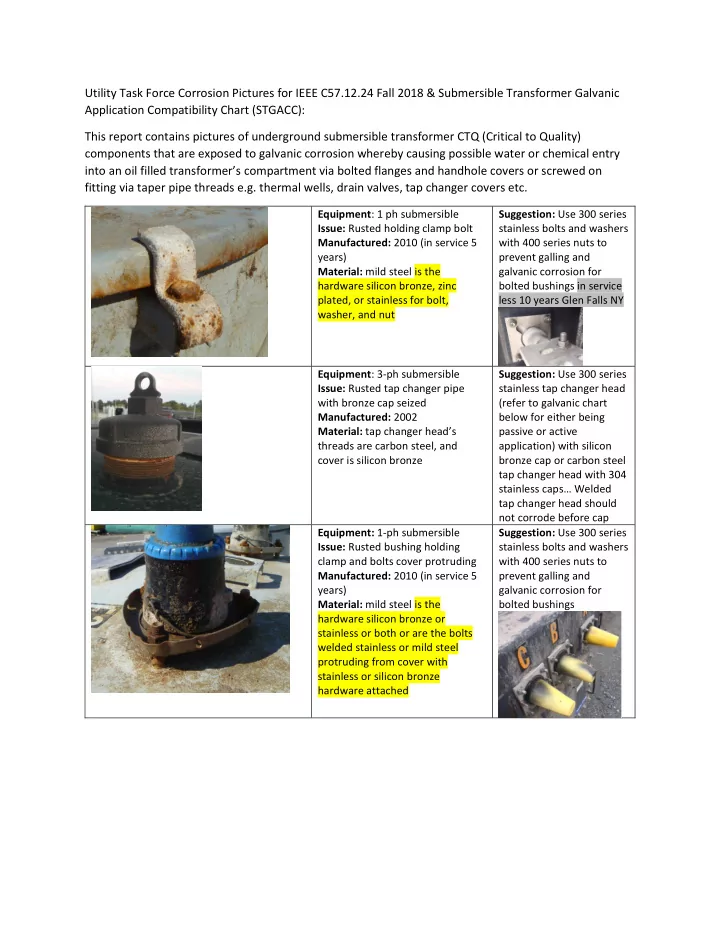
Utility Task Force Corrosion Pictures for IEEE C57.12.24 Fall 2018 & Submersible Transformer Galvanic Application Compatibility Chart (STGACC): This report contains pictures of underground submersible transformer CTQ (Critical to Quality) components that are exposed to galvanic corrosion whereby causing possible water or chemical entry into an oil filled transformer’s compartment via bolted flanges and handhole covers or screwed on fitting via taper pipe threads e.g. thermal wells, drain valves, tap changer covers etc.
Equipment: 1 ph submersible Issue: Rusted holding clamp bolt Manufactured: 2010 (in service 5 years) Material: mild steel is the hardware silicon bronze, zinc plated, or stainless for bolt, washer, and nut Suggestion: Use 300 series stainless bolts and washers with 400 series nuts to prevent galling and galvanic corrosion for bolted bushings in service less 10 years Glen Falls NY Equipment: 3-ph submersible Issue: Rusted tap changer pipe with bronze cap seized Manufactured: 2002 Material: tap changer head’s threads are carbon steel, and cover is silicon bronze Suggestion: Use 300 series stainless tap changer head (refer to galvanic chart below for either being passive or active application) with silicon bronze cap or carbon steel tap changer head with 304 stainless caps… Welded tap changer head should not corrode before cap Equipment: 1-ph submersible Issue: Rusted bushing holding clamp and bolts cover protruding Manufactured: 2010 (in service 5 years) Material: mild steel is the hardware silicon bronze or stainless or both or are the bolts welded stainless or mild steel protruding from cover with stainless or silicon bronze hardware attached Suggestion: Use 300 series stainless bolts and washers with 400 series nuts to prevent galling and galvanic corrosion for bolted bushings
SLIDE 2
Equipment: 3-ph submersible Issue: Rusted pipe flange threads, silicon bronze sampler seized Manufactured: 2002 Material: pipe flange is carbon steel, sampler is silicon bronze Suggestion: Use 304 stainless pipe plug on carbon steel pipe flange and Teflon tape barrier Equipment: 3-ph submersible Issue: Rusted pipe flange threads, silicon bronze sampler seized Manufactured: Pending Material: pipe flange is carbon steel, sampler is silicon bronze Suggestion: Use 304 stainless pipe plug on carbon steel pipe flange with Teflon tape barrier between different metals … welded flange should not corrode before fitting and or sampling device service since for past 10 years see good example below Equipment: 3-ph submersible Issue: Rusted pipe flange threads, sensor seized Manufactured: Pending Material: pipe flange is carbon steel, sensor is stainless is the sensor 316 or 304… refer to galvanic chart Suggestion: Use 304 stainless pipe plug on carbon steel pipe flange… flange should not corrode before sampling device in service since for past 10 years same as above
SLIDE 3 Equipment: 3-ph submersible Issue: Rusted carbon steel pad for decal plate Manufactured: Pending Material: pad is carbon steel, plate decal is silicon bronze Suggestion: Use 300 series stainless plate decal and screw being of same material (refer to galvanic chart below for either being passive or active application) Equipment: 3-ph submersible Issue: Rusted pipe nipple where drain valve is installed Manufactured: Pending Material: pipe nipple is carbon steel, drain valve is silicon bronze Suggestion: Use 304 stainless globe valve on carbon steel pipe flange (refer to galvanic chart below for either being passive or active application) and silicon bronze globe valve on stainless steel… pipe nipple should not have corroded before valve… no tank welded components should corrode first. Equipment: 3-ph submersible Issue: Rusted nipple where drain valve is installed Manufactured: 2013 Application: Sludge/High Polluted Material: pipe nipple is carbon steel, drain valve and pipe plug is silicon bronze Suggestion: Use 304 stainless globe valve on carbon steel pipe flange and silicon bronze globe valve on stainless steel… pipe nipple should not have corroded before valve… no tank welded components should corrode first. Equipment: 3-ph submersible Issue: Galvanic corrosion all over tank and cover + leaking drain valve drain valve is brass (or equivalent), had leaks at the fitting with the tank or the pipe between the 2. Drain valve eliminated since few years and replaced with a plug
Manufactured: 8 years in service; primer with powder top coat and Devtar (asphalt) on bottom of tank about 1 foot high Installed: Canada Northeast Removed: N/A Application: dry vaults or with little drainage water but many covered with water for some time Suggestion: Use some epoxy coatings with zinc rich primer which are superior for underground
stainless globe valve on carbon steel pipe flange and silicon bronze globe valve on stainless steel (continues next page)
SLIDE 4
Material: copper bearing steel tank and cover; no external accessories such as PRV, sight gage, thermometer; surrounded with bare copper grounding wire which accelerate galvanic corrosion on the tank Was the water in the vault stagnant and/or salty? What are the effects of Devtar (asphalt) in an aqueous salty solution… does it affect the PH accelerating other types of corrosion e.g. pitting, chemical, bacterial, etc. Equipment: 3-ph submersible Issue: Rust or other corrosion showing where the terminals were bolted to tin plated neutral Manufactured: 2013 Installed: 2013 Removed: 2018 Application: Coastal Material: tin plated copper neutral was the connecting terminal tin plated Equipment: 3-ph submersible Issue: None: No Rust showing where terminal was bolted to tin plated neutral Manufactured: 2015 Installed: 2016 Removed: 2018 Application: Coastal Material: tin plated copper neutral, shows a tin plated 2-hole terminal lead
SLIDE 5 Equipment: 3-ph submersible Issue: Rusted pipe flange threads, pipe plug possibly seized Manufactured: 2009 Installed: 2009 Removed: 2018 Application: Coastal Material: pipe flange is carbon steel, pipe plug is silicon bronze Suggestion: Use 304 stainless pipe plug on carbon steel pipe flange… tank welded flange should not corrode before sampling device Equipment: 1-ph submersible Issue: None: No galvanic corrosion where dissimilar metals touching;
- nly rusting at tank bottom
Manufactured: 2009; powder coat Installed: 2011 1024 Fossil Creek, Colorado Removed: 2018; no maintenance Application: Salt Water chloride Material: tank material mild steel with welded stainless nut provision and tin-plated bronze terminal; fitting barrier Teflon tape Perfect Recommendation: if user wants to continue to use bronze valves, terminals, etc. and/or there’s no stainless version
components that exist on the market…. A copper bearing steel tank with welded stainless provision and tin-plated bronze terminals all having fitting barriers with Teflon tape Equipment: 1-ph submersible Issue: Same as 1024 Fossil Creek
- nly rusting at tank bottom
Manufactured: 2001; powder coat Installed: 2002 6802 Autumn Ridge, Colorado Removed: 2012; no maintenance Application: Salt Water chloride Material: tank material mild steel; unsure if fitting had Teflon tape as a barrier Equipment: 1-ph submersible Issue: None: No galvanic corrosion where dissimilar metals touching Manufactured: 1992; powder coat Installed: 1993 1213 Alameda St. Colorado Removed: 2018; no maintenance Application: Salt Water Material: tank material mild steel with welded stainless nut provision and tin-plated bronze terminal; fitting barrier Teflon tape Perfect Recommendation: if user wants to continue to use bronze valves, terminals, etc. and/or there’s no stainless version
components that exist on the market…. A copper bearing steel tank with welded stainless provision and tin-plated bronze terminals all having fitting barriers with Teflon tape
SLIDE 6
Equipment: 3-ph submersible Issue: Rust showing where terminals were bolted to neutral Manufactured: 2009 Installed: 2009 Removed: 2018 Application: Coastal Material: copper neutral Was the neutral blade tin plated, was the connecting terminal tin plated, and what type of hardware was used Equipment: 3-ph submersible Issue: Sever pitting of the temperature gauge’s aluminum housing Manufactured: 2009 Installed: 2013 Removed: 2018 Application: Coastal Material: Aluminum housing with stainless steel screws on faceplate with brass/silicon bronze or brass thermal well as part of assembly; thermal well screwed into welded steel tank pipe flange. Suggestion: Use stainless housing with stainless thermal well instead of aluminum with silicon bronze or brass thermal well screwing onto carbon steel tank pipe flange Equipment: 3-ph submersible Issue: paint degradation flaking of the temperature gauge aluminum housing; severe rusting around pipe flange Manufactured: 2000 Installed: 2002 Removed: 2018 Application: Coastal Material: Aluminum housing with stainless steel screws on faceplate with brass/silicon bronze or brass thermal well as part of assembly; thermal well screwed into welded steel tank pipe flange. Suggestion: Use stainless housing with stainless thermal well instead of aluminum with silicon bronze or brass thermal well screwing onto carbon steel tank pipe flange
SLIDE 7
Equipment: 3-ph submersible Issue: Rusted pipe flange threads, pipe plug and sampler possibly seized Manufactured: 2001 Installed: 2002 Removed: 2018 Application: Coastal Material: pipe flanges are carbon steel; pipe plug and sampler are silicon bronze Suggestion: Use 304 stainless pipe plug on carbon steel pipe flange… tank welded flange should not corrode before sampling device Equipment: 3-ph submersible Issue: Sever pitting of the temperature gauge aluminum housing Manufactured: 2013 Installed: 2013 Removed: 2018 Application: Sludge/High Polluted Material: Aluminum housing with stainless steel screws on faceplate with brass/silicon bronze or brass thermal well as part of assembly; thermal well screwed into welded steel tank pipe flange. Suggestion: Use stainless housing with stainless thermal well instead of aluminum with silicon bronze or brass thermal well screwing onto carbon steel tank pipe flange
SLIDE 8 Equipment: 3-ph submersible Issue: Sever pitting of the temperature gauge aluminum housing Manufactured: 2015 Installed: 2015 Removed: 2018 Application: Sludge/High Polluted Material: Aluminum housing with stainless steel screws on faceplate with brass/silicon bronze or brass thermal well as part of assembly; thermal well screwed into welded steel tank pipe flange Suggestion: Use stainless housing with stainless thermal well instead of aluminum with silicon bronze or brass thermal well screwing onto carbon steel tank pipe flange Equipment: 3-ph submersible Issue: Rusted parking stands near hardware connection, bolts possibly seized Manufactured: 2009 Installed: 2009 Removed: 2018 Application: Sludge/High Polluted Material: parking stands are carbon steel; is the hardware silicon bronze, zinc plated, 316, or 304 Suggestion: Use 304 stainless washers and bolts with 400 series nuts instead of zinc plated steel
- r silicon bronze on carbon
steel Equipment: 3-ph submersible Issue: Rusted parking stands near hardware connection, bolts possibly seized Manufactured: 2012 Application: Sludge/High Polluted Material: parking stands are carbon steel; is the hardware silicon bronze, zinc plated, 316, or 304 Suggestion: Use 304 stainless washers and bolts with 400 series nuts instead of zinc plated steel
- r silicon bronze on carbon
steel
SLIDE 9 Equipment: 3-ph submersible Issue: Rusted ground flange assembly with bronze padlock, handle, lever, and shaft Manufactured: 2006 Installed: 2006 Removed: 2018 Application: Sludge/High Polluted Material: grounding welded assembly is carbon steel; padlock, lever, and shaft are bronze Suggestion: Use stainless ground flange assembly instead of carbon steel when paring with silicon bronze padlock, lever, and shaft (refer to galvanic chart below for either being passive or active application) Corrosion on tank below Devtar line. Corrosion on cooling radiator fin below Devtar line No corrosion at tank grounding pad. Equipment: 167kVA submersible Issue: drain valve is brass (or equivalent), had leaks at the fitting with the tank or the pipe between the 2. Drain valve eliminated since few years and replaced with a plug
Manufactured: 2004; e-coat and Devtar (asphalt) on bottom tank about 1 foot high Installed: Canada Northeast Removed: 2009 Application: dry vaults or with little drainage water but many covered with water for some time Material: copper bearing steel tank and cover; no external accessories such as PRV, sight gage, thermometer; surrounded with bare copper grounding wire which accelerate galvanic corrosion on the tank Was the water in the vault stagnant and/or salty? What are the effects of Devtar (asphalt) in an aqueous salty solution… does it affect the PH accelerating other types of corrosion e.g. pitting, chemical, bacterial, etc. Suggestion: Suggestion: Use some epoxy coatings with zinc rich primer which are superior for underground applications
SLIDE 10 Equipment: 3-ph submersible Issue: galvanic corrosion where dissimilar metals touching silicon bronze or brass thermal well screw into welded steel pipe flange Manufactured: 2005; 3mils of zinc- rich primer with 3mils of black epoxy finish top coat Installed: Boston, Massachusetts Northeast Removed: 2017 Application: Coastal Material: tank flange material steel with silicon bronze or brass thermal well, padlock, pipe plug, and drain valve Suggestion: if user wants to continue to use bronze valves, terminals, etc. and/or there’s no stainless version of those terminals
- r component that exist
- n the market…. A copper
bearing steel tank with welded stainless provision and tin-plated bronze terminals all having fitting barriers Teflon tape Another suggestion maybe thermal well, padlock, pipe plug, and drain valve being 304 stainless on welded steel pipe flange and nipple Equipment: 3-ph submersible Issue: slight galvanic corrosion where dissimilar metals touching
Manufactured: 2005; 3mils of zinc- rich primer with 3mils of black epoxy finish top coat Installed: New England Northeast Removed: 2017 Application: Coastal Material: tank material copper bearing steel
SLIDE 11 Equipment: 3-ph submersible Issue: None: No rust around stainless bolt and washer in carbon steel cover weld nut Manufactured: 2013 Application: Not Coastal Material: carbon steel welded nut, bolt and washer hardware are stainless is the hardware 316 or 304 Equipment: 3-ph submersible Issue: None: No rust around stainless bolt and washer in carbon steel cover weld nut Manufactured: 2006 Application: Not Coastal, ATL Material: pipe flange is carbon steel, bolt and washer hardware are stainless is the hardware 316
Equipment: 3-ph submersible Issue: slight rust on tap changer threads having bronze cap Manufactured: 2006 Application: Not Coastal, ATL Material: what are the tap changer thread’s material if stainless, was it cleaned or brushed with carbon steel Equipment: 3-ph submersible Issue: Rusted network protector Manufactured: This one was in service at 2 locations in 1989. For the second installation, the last 10 years Application: in Providence Rhode Island at a transit station; sidewalk area that is typically heavily treated with salt in the winter time for foot traffic. Material: protector is carbon steel what are the paint requirements and did heating escalate the galvanic corrosion process Suggestion: Did protector have adequate radiation needed for the protector housing… ensure test data was provided along with paint maps; temperature can accelerate galvanic corrosion Use some epoxy coatings with zinc rich primer which are superior for underground applications.
SLIDE 12 Submersible Transformer Galvanic Application Compatibility Chart (STGACC) Tank Material
Hardware (e.g. Bolts, nuts, washers) Material Valves and Gauges Material Screw on Fittings Material Plugs and Caps Material Bushing Flanges Material Parking Stands Material Copper Bearing Steel (Low Alloy Steel) Silicon Bronze (.35V) Tank will corrode Not- Recommended 304 (.55V) & 316 (.58V) Stainless Non- Active Tank will corrode Not Recommended 304 (.13V) Stainless Active (stagnant water) Recommended Silicon Bronze (.35V) Tank will corrode Not- Recommended 304 (.55V) & 316 (.58V) Stainless Non- Active Tank will corrode Not Recommended 304 (.13V) Stainless Active (stagnant water) Recommended Silicon Bronze (.35V) Tank will corrode Not- Recommended 304 (.55V) & 316 (.58V) Stainless Non- Active Tank will corrode Not Recommended 304 (.13V) Stainless Active (stagnant water) Recommended Silicon Bronze (.35V) Tank will corrode Not- Recommended 304 (.55V) & 316 (.58V) Stainless Non- Active Tank will corrode Not Recommended 304 (.13V) Stainless Active (stagnant water) Recommended 316 (.23V) Stainless Active (stagnant water) Tank will corrode Not- Recommended 304 (.55V) & 316 (.58V) Stainless Non-Active Tank will corrode Not Recommended 304 (.13V) Stainless Active (stagnant water) Recommended Same as Tank Material 304 Non-Active (Passive) Silicon Bronze (.2V) External Hardware will corrode Maybe Threshold Not- Recommended 430 Stainless (.42V) Active (stagnant water) External Hardware will corrode Not- Recommended 430 (.17V) Stainless Non-Active Recommended Silicon Bronze (.2V) Valves and Gauges will corrode Maybe Threshold Not- Recommended 430 Stainless (.42V) Active (stagnant water) Valves and Gauges will corrode Not- Recommended 430 (.17V) Stainless Non-Active Recommended Silicon Bronze (.2V) Screw on Fittings will corrode Maybe Threshold Not- Recommended 430 Stainless (.42V) Active (stagnant water) Screw on Fittings will corrode Not- Recommended 430 (.17V) Stainless Non-Active Recommended Silicon Bronze (.2V) Plug and Caps will corrode Maybe Threshold Not- Recommended 430 Stainless (.42V) Active (stagnant water) Plug and Caps will corrode Not- Recommended 430 (.17V) Stainless Non-Active Recommended 316 (.32V) Stainless Active (stagnant water) Flange will corrode Not- Recommended 304 (OV) Stainless same as tank material Non-Active Recommended 316 Stainless (.03V) Non-Active Recommended Same as Tank Material
SLIDE 13
304 Active (stagnant water) Silicon Bronze (.22V) Tank will corrode Not- Recommended 430 Stainless (.25V) Non- Active Tank will corrode Not- Recommended 430 (0V) Stainless Active (stagnant water) Recommended Silicon Bronze (.22V) Tank will corrode Not- Recommended 430 Stainless (.25V) Non- Active Tank will corrode Not- Recommended 430 (0V) Stainless Active (stagnant water) Recommended Silicon Bronze (.22V) Tank will corrode Not- Recommended 430 Stainless (.25V) Non- Active Tank will corrode Not- Recommended 430 (0V) Stainless Active (stagnant water) Recommended Silicon Bronze (.22V) Tank will corrode Not- Recommended 430 Stainless (.25V) Non- Active Tank will corrode Not- Recommended 430 (0V) Stainless Active (stagnant water) Recommended 316 (.45V) Stainless Non-Active Tank will corrode Not- Recommended 304 (OV) Stainless same as tank material Active (stagnant water) Recommended 316 Stainless (.1V) Active (stagnant water) Recommended Same as Tank Material 316 Non-Active (Passive) Silicon Bronze (.23V) External Hardware will corrode Not- Recommended 430 Stainless (.45V) Active (stagnant water) External Hardware will corrode Not- Recommended 430 (.2V) Stainless Non-Active External Hardware will corrode Maybe Threshold Not- Recommended Silicon Bronze (.23V) Valves and Gauges will corrode Not- Recommended 430 Stainless (.45V) Active (stagnant water) Valves and Gauges will corrode Not- Recommended 430 (.2V) Stainless Non-Active Valves and Gauges will corrode Maybe Threshold Not- Recommended Silicon Bronze (.23V) Screw on Fittings will corrode Not- Recommended 430 Stainless (.45V) Active (stagnant water) Screw on Fittings will corrode Not- Recommended 430 (.2V) Stainless Non-Active Screw on Fittings will corrode Maybe Threshold Not- Recommended Silicon Bronze (.23V) Plug and Caps will corrode Not- Recommended 430 Stainless (.45V) Active (stagnant water) Plug and Caps will corrode Not- Recommended 430 (.2V) Stainless Non-Active Plug and Caps will corrode Maybe Threshold Not- Recommended 304 (.45V) Stainless Active (stagnant water) Flange will corrode Not- Recommended 316 (OV) Stainless same as tank material Non-Active Recommended 304 Stainless (.03V) Non-Active Recommended Same as Tank Material
SLIDE 14
316 Active (stagnant water) Silicon Bronze (.12V) Recommended 430 Stainless (.15V) Non- Active Recommended 430 (.1V) Stainless Active (stagnant water) Recommended Silicon Bronze (.12V) Recommended 430 Stainless (.15V) Non- Active Recommended 430 (.1V) Stainless Active (stagnant water) Recommended Silicon Bronze (.12V) Recommended 430 Stainless (.15V) Non- Active Recommended 430 (.1V) Stainless Active (stagnant water) Recommended Silicon Bronze (.12V) Recommended 430 Stainless (.15V) Non- Active Recommended 430 (.1V) Stainless Active (stagnant water) Recommended 304 (.32V) Stainless Non-Active Tank will corrode Not- Recommended 316 (OV) Stainless same as tank material Active (stagnant water) Recommended 304 Stainless (.1V) Active (stagnant water) Recommended Same as Tank Material 409 Non- Active (Passive) Silicon Bronze (.02V) Recommended 304 (.22V) & 316 (.25V) Stainless Non- Active Tank will corrode Not Recommended 304 (.2V) & 316 (.1V) Stainless Active (stagnant water) External Hardware will corrode Maybe Threshold Not Recommended Silicon Bronze (.02V) Recommended 304 (.22V) & 316 (.25V) Stainless Non- Active Tank will corrode Not Recommended 304 (.2V) & 316 (.1V) Stainless Active (stagnant water) Valves and Gauges will corrode Maybe Threshold Not Recommended Silicon Bronze (.02V) Recommended 304 (.22V) & 316 (.25V) Stainless Non- Active Tank will corrode Not Recommended 304 (.2V) & 316 (.1V) Stainless Active (stagnant water) Screw on Fittings will corrode Maybe Threshold Not Recommended Silicon Bronze (.02V) Recommended 304 (.22V) & 316 (.25V) Stainless Non- Active Tank will corrode Not Recommended 304 (.2V) & 316 (.1V) Stainless Active (stagnant water) Plug and Caps will corrode Maybe Threshold Not Recommended 409 (OV) Stainless same as tank material Non- Active Recommended 304 (.2V) & 316 (.1V) Stainless Active (stagnant water) Flange will corrode Maybe Threshold Not Recommended Same as Tank Material
SLIDE 15
409 Active (stagnant water) Silicon Bronze (.22V) Tank will corrode Not Recommended 304 (.42V) & 316 (.45V) Stainless Non- Active Tank will corrode Not Recommended 304 (0V) & 316 (.1V) Stainless Active (stagnant water) Recommended Silicon Bronze (.22V) Tank will corrode Not Recommended 304 (.42V) & 316 (.45V) Stainless Non- Active Tank will corrode Not Recommended 304 (0V) & 316 (.1V) Stainless Active (stagnant water) Recommended Silicon Bronze (.22V) Tank will corrode Not Recommended 304 (.42V) & 316 (.45V) Stainless Non- Active Tank will corrode Not Recommended 304 (0V) & 316 (.1V) Stainless Active (stagnant water) Recommended Silicon Bronze (.22V) Tank will corrode Not Recommended 304 (.42V) & 316 (.45V) Stainless Non- Active Tank will corrode Not Recommended 304 (0V) & 316 (.1V) Stainless Active (stagnant water) Recommended 409 (OV) Stainless same as tank material Active (stagnant water) Recommended 304 (0V) & 316 (.1V) Stainless Active (stagnant water) Recommended Same as Tank Material Copper Bearing Steel (Low Alloy Steel) ~ -.63 Silicon Bronze ~ -.28 409 Non-Active ~ -.30 430 Non-Active ~ -.25 304 Non-Active ~ -.08 316 Non-Active ~ -.05 409 Active ~ -.5 430 Active ~ -.5 304 Active ~ -.5 316 Active ~ -.4 Reference: http://www.ssina.com/corrosion/galvanic.html http://www.designbyinitiative.com/files/8514/2711/8760/Galvanic_Table.pdf
SLIDE 16
Below shows the galvanic series measured in seawater for some common metals and alloys. When two metals are further apart in the list (e.g. a larger difference between the two numbers), the driving force for galvanic corrosion is increased. The most anodic (active) metals are at the top and most cathodic (noble) at the bottom. Both solid and hollow bars are shown for the stainless steels. The hollow bars represent actively corroding stainless steel, which has a different potential then passive (not corroding) stainless steel. In most applications, where dissimilar metals are combined, the passive (solid) bar should be used to determine the position of the stainless steel.
SLIDE 17