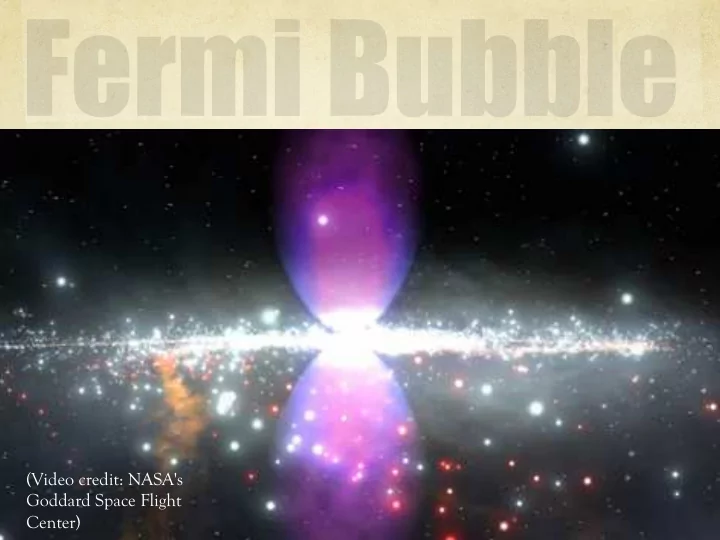
SLIDE 1 (Video credit: NASA's Goddard Space Flight Center)
SLIDE 2
Meng Su
Collaborators: Douglas P. Finkbeiner, Tracy R. Slatyer
Harvard University Jet 2012, NRAO, Charlottesville 2012.03.04
SLIDE 3 Fermi Bubbles
Giant gamma-ray structure with sharp edges discovered using Large Area Telescope on board Fermi Gamma-ray Space Telescope Appearing rise up & down from the Galactic center They are:
Ø 50 degrees high (∼8.5 kpc) Ø Well centered on longitude zero (close to latitude zero) Ø Imply ∼TeV electron energy!
Su, Slatyer, & Finkbeiner (2010)
SLIDE 4 Finkbeiner (2004)
WMAP haze
SLIDE 5 How to test the WMAP haze idea?
1) Can we see the IC gammas expected if the WMAP haze is synchrotron? (this would rule
2) Does the structure look like a transient (have sharp edges), or steady state (look hazy)?
Dobler et al (2010)
SLIDE 6 (from Tsunefumi Mizuno)
High energy gamma-rays are produced via interactions between cosmic-rays (CRs) and the interstellar medium (or the interstellar radiation field)
SLIDE 7 The Fermi-LAT 1.5 year maps
Su et al. (2010)
SLIDE 8 The Fermi-LAT three year maps
Su & Finkbeiner (2012)
SLIDE 9 Data minus Fermi diffuse emission model:
Su & Finkbeiner (2012)
SLIDE 10
Subtracting the Fermi diffuse emission model reveals a faint bilobular structure in the inner Galaxy. This is a complicated model - could the residual structure be an artifact? Model contains π0 and bremsstrahlung from gas maps; IC from GALPROP; North Polar Spur feature from Haslam map. Let’s try something very simple and see how robust this is.
SLIDE 11 Simple disk model
Su & Finkbeiner (2012)
SLIDE 12 Fermi Bubble from three year maps
Su & Finkbeiner (2012)
SLIDE 13 low energy gamma-ray template (dust-subtracted) as the IC component.
Su & Finkbeiner (2012)
SLIDE 14 The bubbles have Sharp edges!
Su & Finkbeiner (2012)
SLIDE 15 Su & Finkbeiner (2012)
SLIDE 16
Now we can do a multilinear regression at each energy, including dust and simple templates for disk, Loop I, and the bubbles
SLIDE 17 Su & Finkbeiner (2012)
SLIDE 18 Su et al. (2010)
SLIDE 19 Su & Finkbeiner (2012)
SLIDE 20 Su & Finkbeiner (2012)
SLIDE 21 Su & Finkbeiner (2012)
SLIDE 22 Su & Finkbeiner (2012)
SLIDE 23
Ø Does the edge have a harder spectrum than the interior? NO. Ø Is the north harder than the south? NO. Ø Bottom line: No matter how we do the fit,
the bubbles have a harder spectrum (index ∼ -2) than the other IC emission (index ∼ -2.5).
Ø The gamma-ray spectrum extends up to ∼ 50 GeV or more,
implying >∼ 100 GeV electrons.
Ø If it is CMB scattering, we have ∼ 1 TeV electrons!
SLIDE 24 . Mystery: How do we get TeV electrons 10 kpc off the disk in the last < Myr? In situ acceleration. Shocks? Reconnection? If they are formed quickly by AGN activity, then Kinetic energy >> 1055 erg. Could do, but this would be an impressive event for our humble little BH. Large starburst-produced bubble has a severe cooling time
- problem. The bubbles should be ∼107 yr old, but cooling
time for TeV (or even 100 GeV) electrons is much shorter
SLIDE 25 Su et al. (2010)
SLIDE 26 Compare with WMAP haze
Su & Finkbeiner. (2012)
SLIDE 27 The Fermi bubbles are clearly associated with WMAP haze The same electron spectrum can easily make both!
Su et al. (2010)
SLIDE 28 ROSAT 1.5 keV
(Su et al. 2010).
SLIDE 29 (Su et al. 2010).
SLIDE 30
Sharp edge in X-ray too!
SLIDE 31 So far: there appear to be a pair of giant (50 degree high) gamma-ray bubbles at 1-5 GeV, and probably up to at least 50 GeV. What are they?
Ø Black hole “burp” Ø Superwind bubble?
Ø Dark matter?
( Sylvain Veilleu’s talk yesterday )
SLIDE 32 Cooling time is short!
Su et al. (2010)
SLIDE 33 Guo & Mathews (2011)
SLIDE 34 galaxy cluster MS 0735.6+7421 in Camelopardus Perseus galaxy cluster
SLIDE 35
Take home message
SLIDE 36 8,
Fermi bubble!
X-ray X-ray Galactic disk Galactic wind? WMAP haze B field jet 8.5 kpc Sun
SLIDE 37 Fermi -LAT reveal two giant gamma-ray bubbles The gamma-ray emission associated with these bubbles has a
significantly harder spectrum (dN/dE ∼ E-2) with sharp edges
The bubbles are spatially correlated with the hard-spectrum microwave
excess known as the WMAP haze; the edges of the bubbles also line up with features in the ROSAT X-ray maps at 1.5 - 2 keV.
Faraday rotation measurement shows significant change on the edge of
the bubbles, indicating the magnetic field structure or gas density variation.
SLIDE 38
The Galactic gamma-ray bubbles which were most likely
created by some large episode of energy injection in the Galactic
center, such as past accretion events onto the central massive
black hole, or a nuclear starburst in the last ∼10 Myr
Dark matter annihilation/decay seems unlikely to generate
all the features of the bubbles
Study of the origin and evolution of the bubbles also has the
potential to improve our understanding of recent energetic events in the inner Galaxy and the high-latitude cosmic ray population.
SLIDE 39 Continue observation of Fermi XMM-Newton data coming soon with other X-ray
- bservations including Chandra and Suzaku
The eROSITA and Planck experiments will provide
improved measurements in X-rays and microwaves, respectively, associated with the Fermi bubbles
Radio observations and magnetic field structure of the
bubbles
Promising Future
SLIDE 40 Thank You for Your Attention!
(Video credit: NASA's Goddard Space Flight Center)
SLIDE 41
500-900 GeV electrons scattering CMB roll off at the right (low) energy.
SLIDE 42
Disclaimer: The purpose of the Su et al. paper is to study these sharp-edged “bubble” objects. This is not to say that these objects contain all of the “haze” emission; indeed there are interesting residuals in the data after subtracting a very simple model of the bubbles. We should separate the question of whether there is any DM signal from the question of whether the bubbles are real.
SLIDE 43
DM pessimist: The existence of these structures, and the large episode of energy injection they imply, will make it nearly impossible to derive anything about dark matter in the inner Galaxy.
SLIDE 44
DM pessimist: The existence of these structures, and the large episode of energy injection they imply, will make it nearly impossible to derive anything about dark matter in the inner Galaxy. DM optimist: There are some structures there we didn’t expect, but we can model them and dig deeper to find the DM annihilation signal. No worries!
SLIDE 45
DM pessimist: The existence of these structures, and the large episode of energy injection they imply, will make it nearly impossible to derive anything about dark matter in the inner Galaxy. DM optimist: There are some structures there we didn’t expect, but we can model them and dig deeper to find the DM annihilation signal. No worries! DM agnostic: Astrophysics is complicated. You’re running out of time… And we can’t wait for the trivia tonight.
SLIDE 46
It is easy to get bumps and wiggles in the wrong places...
SLIDE 47 Two arguments for CMB scattering:
Ø 1. The bubble intensity is ∼flat with latitude,
while starlight density is falling.
Ø 2. The shape of the IC spectrum.
500-900 GeV electrons scattering CMB roll off at the right (low) energy. (But see Crocker & Aharonian 2010) Together these imply that the Fermi bubbles are Mainly ∼TeV electrons scattering the CMB. (Note that the WMAP haze is produced by ∼10 GeV electrons. ) Now, how about X-rays?
SLIDE 48
Any Substructure of the bubbles?
SLIDE 49
SLIDE 50 North bubble Donut South bubble Loop I North arc
SLIDE 51
SLIDE 52
SLIDE 53 To understand the data…
Ø Full physical model:
Pro: uses everything we know to fit data. Con: only used what we put in the model Provides the most secure interpretation of the data
Ø Template analysis
Pro: the templates work pretty well; may reveal new emission
Con: must assess fit residuals carefully, because fit is never perfect Good for finding the unexpected!
SLIDE 54
SLIDE 55