What goes through your mind when you hear this?? Your sleep is a - - PowerPoint PPT Presentation

what goes through your mind when you hear this your sleep
SMART_READER_LITE
LIVE PREVIEW

What goes through your mind when you hear this?? Your sleep is a - - PowerPoint PPT Presentation

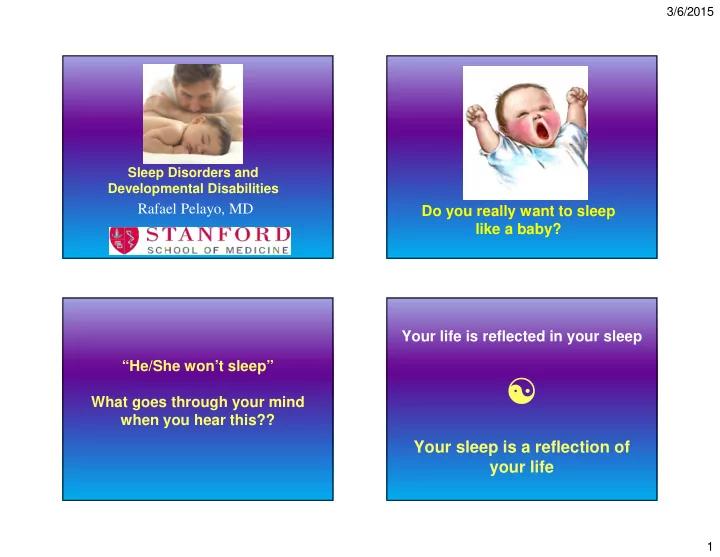
3/6/2015 Sleep Disorders and Developmental Disabilities Rafael Pelayo, MD Do you really want to sleep like a baby? Your life is reflected in your sleep He/She wont sleep What goes through your mind when you hear this?? Your


slide-1
SLIDE 1

3/6/2015 1

Sleep Disorders and Developmental Disabilities

Rafael Pelayo, MD Do you really want to sleep like a baby? “He/She won’t sleep” What goes through your mind when you hear this?? Your life is reflected in your sleep

Your sleep is a reflection of your life

slide-2
SLIDE 2

3/6/2015 2

Common Sleep Disorders

  • Normal Sleep?
  • Behavioral Insomnia of Childhood
  • OSA/SDB
  • Parasomnias
  • PLM/RLS
  • Narcolepsy
  • Delayed Sleep Phase Syndrome

Sleep History: 4 Elements

Amount Quality Timing State of Mind

Do you remember being tucked in?

How do we get a child to sleep in the lab?

slide-3
SLIDE 3

3/6/2015 3

No Need

10

The power of sleep Amount: Sleep Homeostasis

Sleep Stages

Awake Stage 1 and REM Stage 2 Stage 3 Stage 4 EEG Recordings Typical Nighttime Sleep Pattern in Young Adult

Awake Stage 1 Stage 2 Stage 3 Stage 4

1 2 3 4 5 6 7 Time (hours)

Sleep Quality:

Courtesy of Dale Edgar PhD

slide-4
SLIDE 4

3/6/2015 4

Courtesy of Dale Edgar PhD Courtesy of Dale Edgar PhD

Courtesy of Dale Edgar PhD

slide-5
SLIDE 5

3/6/2015 5

H H H O CH30 N H C C N C CH3 H H

SCN MEL

Melatonin (N-acetyl-5methoxytryptamine)

Sleep Timing

  • Sleep timing is influenced by

homeostatic and circadian factors

  • The less we sleep the more sleep we need

and vice versa

  • Twice a day our alertness level peaks
  • Twice a day our sleepiness peaks

19

Normal Actigraph

20

Abnormal Actigraph

slide-6
SLIDE 6

3/6/2015 6

The need for sleep is biological The way you sleep is learned What wakes you up may not be what keeps you awake What is the motivation to go to bed? What is the motivation to get

  • ut of bed?

Kids and Sleep: What Are They On?

Trends in medication prescribing for pediatric sleep difficulties in US

  • utpatient settings ‘07
  • Cross-sectional study on pts ≤17 yrs from ‘93-’04

NAMCS.

  • 18.6 million visits occurred for sleep related

difficulty in children most 6-12 yr.

  • 81% of visits Rx’ed a med (only 48% of the adult

patients with insomnia Rx’ed!)

  • … physicians frequently prescribed medications

for sleep difficulties in children in US outpatient

  • settings. Of particular concern is prescribing of

many unapproved medications for this population

slide-7
SLIDE 7

3/6/2015 7

25

  • Meta-analysis of RCT of melatonin in advancing

DSPS pts

  • 5 trials including 91 adults and 4 trials including

226 children showed that melatonin (0.3 -6 mg) advanced mean endogenous melatonin onset by 1.18 hours (0.89-1.48 h) and clock hour of sleep

  • nset by 0.67 hours ( 0.45-0.89 h). Melatonin

decreased sleep-onset latency by 23.27 minutes (4.83 -41.72 min). The wake-up time and total sleep time did not change significantly

The use of exogenous melatonin in delayed sleep phase disorder: a meta-analysis 2010 Potential Pharmacokinetic Basis for Zolpidem Dosing in Children With Sleep Difficulties ‘07

  • Open-label, dose-escalation study in children with
  • insomnia. 21 children, seven per age group (2-6, >6

to 12, >12 to 18 years), received a single dose of zolpidem at one of the three dose levels (0.125, 0.25,

  • r 0.50 mg/kg (20 mg maximum dose))
  • Overall, zolpidem was well tolerated and a pediatric

dose of 0.25 mg/kg is recommended for future efficacy studies

Do not to equate sedation with normal sleep! Paradoxical Reaction To A Hypnotic Medication

slide-8
SLIDE 8

3/6/2015 8

The real issue is not the pill but the insomnia The thought of sleeping wakes them up

SELF Correction

  • Social
  • Exercise
  • Light
  • Food

Sleeping should be silent

“...and on the box sat a fat and red-faced boy, in the state

  • f somnolency.” C. Dickens
slide-9
SLIDE 9

3/6/2015 9

Sleep Disorders in Children

Naso-Respiratory Function and Cranialfacial Growth James McNamara1979 as presented by James B. DuHammel DDS

Sleep Disorders in Children

Naso-Respiratory Function and Cranialfacial Growth James McNamara1979 as presented by James B. DuHammel DDS

Thin people can have OSA too

CPAP ain’t just CPAP no more

  • CPAP
  • CPAP with C-Flex™/ EPR
  • Bi-level
  • Bi-level with Bi-Flex™
  • Bi-level with a backup rate
  • Automated CPAP
  • Automated Bi-level
  • Adaptive Servo Ventilator (SV) PAP
slide-10
SLIDE 10

3/6/2015 10

OSA Treatments

  • PAP: autoPAP, Bi-level, autoBi-Level, ASV,

AVAPS, Bi-level ST, PAP for COPD

  • Surgery: Maxilomandibular advancement and

expansion, nasal valves and turbinates, pharyngoplasty, genioglossus advancement, Uvulopalatal flap

  • Oral appliances: dozens available
  • Conservative: Weight loss, positonal therapy,

weight loss

  • Novel treatments: Winx and Provent
  • Experimental options: Hypoglossal stimulators

CPAP Can Sleepy Students Learn Anything?

School Start Times for Adolescents AAP 2014 Insufficient sleep in adolescents as an important public health issue…the evidence strongly implicates earlier school start times (ie, before 8:30 am) as a key modifiable contributor to insufficient sleep…research has now demonstrated that delaying school start times is an effective countermeasure to chronic sleep loss. The AAP strongly supports the efforts of school districts to optimize sleep in students and urges high schools and middle schools to aim for start times that allow students the

  • pportunity to achieve optimal levels of sleep (8.5–9.5

hours)

slide-11
SLIDE 11

3/6/2015 11

Sleep impacts behavior

Sleep disorders mimic attention and learning disorders

Slumber Parties ain’t about sleeping

Any Questions?

National Institutes Of Health State-of-the-Science Manifestations And Management Of Chronic Insomnia In Adults June’05 Chronic insomnia is a major public health problem affecting millions

  • f individuals, along with their families and communities. Little is

known about the mechanisms, causes, clinical course, comorbidities, and consequences of chronic insomnia. Evidence supports the efficacy of cognitive-behavioral therapy and benzodiazepine receptor agonists in the treatment of this disorder. Very little evidence supports the efficacy of other treatments, despite their widespread use. Moreover, even for those treatments that have been systematically evaluated, the panel is concerned about the mismatch between the potential lifelong nature of this illness and the longest clinical trials, which have lasted 1 year or less. A substantial public and private research effort is warranted, including the development

  • f research tools and the conduct of longitudinal studies and

randomized clinical trials. Finally, there is a major need for educational programs directed at physicians, health care providers, and the public.

Benzodiazepine hypnotics

Hypnotic Drugs* Half-life (hr) Onset of Action (min)† Pharmacologically Active Metabolites Dose (mg) Quazepam (Doral) 48-120 30 N-desalkyl (flurazepam) 7.5-15 Flurazepam (Dalmane) 48-120 15-45 N-desalkyl (flurazepam) 15-30 Triazolam (Halcion) 2-6 2-30 None 0.125- 0.25 Estazolam (ProSom) 8-24 Intermedi ate None 1-2 Temazepam (Restoril) 8-20 45-50 None 15-30 Flunitrazepam (Rohypnol) 10.7-20.3 Short N-desmethyl (flunitrazepam) 0.5-1 Nitrazepam (Alodorm) 25-35 Intermedi ate None 5-10
slide-12
SLIDE 12

3/6/2015 12 Receptor Pharmacology of Sedating Antidepressant Drugs Summary of Other Drugs Used to Treat Insomnia

Drug tmax (hr) Metabolism t½ (hr) Mechanism of Action Melatonin 20-60 min Conjugation;
  • xidation by CYP
enzymes 40-60 min Agonist at melatonin type 1 and type 2 receptors Ramelteon 0.3 hrs Extensive first-pass metabolism; hepatic
  • xidation primarily
via CYP1A2; active metabolite M-II 1.2 (2-5 hours for M- II) Agonist at melatonin MT1 and MT2 receptors Diphenhydramine 2-2.5 Hepatic demethylation,
  • xidation
4-8 Antagonizes H1 receptors Valerian Uncertain
  • wing to
multiple constituents Uncertain owing to multiple constituents Uncertain
  • wing to
multiple constituents Uncertain; may increase GABA formation, interact with L-amino acid transporter receptor, or act as adenosine receptor agonist Choral hydrate Short Converted to trichloroethanol, which undergoes conjugation 5-10 (for trichloroetha nol) Barbiturate-like effect at GABAA receptors Quetiapine 1-2 CYP 3A4 6 Antagonizes H1, alpha1, M1, 5-HT2, D2 receptors Gamma- hydroxybutyrate 30-45 min Metabolized to GABA, succinic semialdehyde, H2O and CO2 20-70 min May act directly as neurotransmitter, increases brain dopamine levels

The trial of infant response to diphenhydramine: the TIRED study--a randomized, controlled, patient-oriented trial Merenstein et al 06

  • Double-blind, randomized, controlled clinical trial. 44 kids

aged 6 to 15 months. Placebo or diphenhydramine given for a week

  • Data safety monitoring board voted unanimously to stop the

trial early because of lack of effectiveness of diphenhydramine over placebo. Only 1 of 22 children receiving diphenhydramine showed improvement compared with 3 of 22 receiving placebo.

  • CONCLUSION: During 1 week of therapy and at follow-up

2 and 4 weeks later, diphenhydramine was no more effective than placebo in reducing nighttime awakening or improving

  • verall parental happiness with sleep for infants.

Peds Sleep Pharm

  • There is a need for greater information on the

pharmacological management of sleep disorders in children.

  • Pharmacological guidelines need to be

developed specifically for sleep disorders in children.

  • These guidelines should FDA approved for the

specific sleep disorder or for the pediatric age

  • range. This will avoid physicians from being

forced to prescribe medications as an “off label” indication.

slide-13
SLIDE 13

3/6/2015 13

Peds Sleep Pharm

  • Development of easy to swallow, chewable or liquid

forms of these medications would be well received by parents everywhere. When these are not available, instructions for compounding these medications into a suspension by pharmacists are needed.

  • Integration of behavioral and pharmacological

treatments may yield better patient outcomes. This would require pediatricians to have a comprehensive understanding of clinical sleep disorders in children.

  • Training programs should play lead role in enhancing

pediatricians’ knowledge of the pharmacological treatment of sleep disorders in children.

  • Non-pharmacological management of

problematic sleeping in children with developmental disabilities.

  • Spruyt K1, Curfs LM.
  • Author information
  • 1Maastricht University Medical Centre, Rett

Expertise Centre-Governor Kremers Centre, Maastricht, the Netherlands; Department of Developmental and Behavioral Pediatrics, Shanghai Children's Medical Center, Shanghai, China.