SLIDE 1
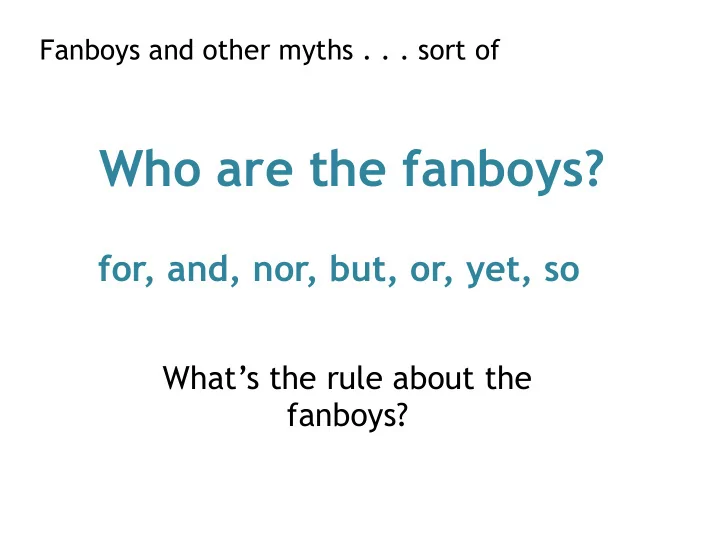
Fanboys and other myths . . . sort of
Who are the fanboys?
What’s the rule about the fanboys?
for, and, nor, but, or, yet, so
SLIDE 2
Fanboys and other myths . . . sort of
Who has heard . . .
Never begin a sentence with and, but, or
?
SLIDE 3
Fanboys and other myths . . . sort of
Never begin a sentence with and, but, or ?
This “rule” may be useful to prevent fragments: Incorrect: And your little dog too. vs. Correct: I’ll get you my pretty and your little dog too. Who said that?
SLIDE 4 Fanboys and other myths . . . sort of This rule is a problem when it causes sentences to go on too long: I like ice cream, and I like cake, but I don’t like the ice cream on the cake. vs. I like ice cream, and I like cake. But I don’t like ice cream on the cake.
could even be three sentences
Never begin a sentence with and, but, or ?
SLIDE 5
Fanboys and other myths . . . sort of
Revise
If you begin a sentence with and, but, or; make sure it’s complete. And if you join two complete sentences with one of those words, put in a comma to separate them. Comma Splice: I like cake and I like ice cream.
Never begin a sentence with and, but, or ?
as
SLIDE 6
Fanboys and other myths . . . sort of
Who has heard . . .
Never begin a sentence with because
?
SLIDE 7
Fanboys and other myths . . . sort of
Never begin a sentence with because ?
This “rule” may be useful to prevent incomplete sentences: Incorrect: Because I like ice cream. BUT Correct: Because I like ice cream, I ate a pint.
SLIDE 8
Fanboys and other myths . . . sort of
Revise
Make sure a sentence beginning with because, since, although, unless (or any other subordinating conjunction), has two parts. The second part must be a complete, independent sentence.
Never begin a sentence with because
as
SLIDE 9
Fanboys and other myths . . . sort of
Who has heard . . .
Never use I in your writing
?
SLIDE 10
Fanboys and other myths . . . sort of This “rule” is useful in scholarly, scientific writing: Incorrect: I measured the solution. Correct: The solution was measured.
Never use I in your writing?
SLIDE 11
Fanboys and other myths . . . sort of This “rule” can be a problem in writing cover letters and professional messages: Unclear: The author of this letter would be a useful employee for your company. Weird: The author of this email would like to meet with the reader of this email.
Never use I in your writing?
SLIDE 12
Fanboys and other myths . . . sort of
Revise
Use I when you are talking about or referring to yourself. (Don't refer to yourself in third person.)
Never use I in your writing
as
SLIDE 13
Fanboys and other myths . . . sort of
Who has heard . . .
Never use you in your writing
?
SLIDE 14
Fanboys and other myths . . . sort of This “rule” is useful to prevent confusion: You can fix your nylons with nail polish. (to the class) Correct: Nail polish can fix nylons. Never use you in your writing? — confusing/ambiguous
SLIDE 15
Fanboys and other myths . . . sort of This “rule” is a problem when it causes awkward constructions: Weird: The company is sending the reader of this email a refund. Correct: The company is sending you a refund. Never use you in your writing?
SLIDE 16
Fanboys and other myths . . . sort of
Revise
Use you when you are directly addressing a person or group but not for a generalization.
Never use you in your writing
as
SLIDE 17
Fanboys and other myths . . . sort of
Who has heard . . .
Put commas in wherever you would pause
?
SLIDE 18
Fanboys and other myths . . . sort of This “rule” will just get you in trouble: Incorrect: I like ice cream but, I don’t like cake. Correct: I like ice cream, but I don’t like cake.
Put in commas wherever you would pause?
SLIDE 19
Fanboys and other myths . . . sort of
Revise
Check out a writer’s handbook for the real rules.
Put in commas wherever you would pause?
as
SLIDE 20
Fanboys and other myths . . . sort of
Who has heard . . .
The thesis statement goes at the end of the first paragraph
?
SLIDE 21 Fanboys and other myths . . . sort of
This “rule” can help you to remember to put in a thesis, but that’s not usually an appropriate location: Creative writing: wait until the end, imply it,
- r put it wherever you want
Professional writing: the thesis statement goes in the first or second sentence—at least the topic and purpose
The thesis statement goes at the end of the first paragraph?
SLIDE 22 Fanboys and other myths . . . sort of
Which of these is correct? ABCs
ABC’s
Use your company style guide
style and stick with it.
Mp3, mp3, mP3
MP3 iFixit
SLIDE 23
Fanboys and other myths . . . sort of
Who has heard . . .
Never split an infinitive
?
SLIDE 24 Fanboys and other myths . . . sort of
Never split an infinitive?
This “rule” is useful to confuse people about grammar and make you sound stuffy. Outdated and irrelevant to English: “You can’t say, ‘To boldly go where no one has gone before’” Where is that quote from?
Beber Boire Bere To drink
Do follow this “rule”: If your boss insists on it.
SLIDE 25
Fanboys and other myths . . . sort of
Who has heard . . .
Never end a sentence with a preposition
?
SLIDE 26 Fanboys and other myths . . . sort of
Never end a sentence with a preposition?
This “rule” is also useful to confuse people about grammar and make you sound stuffy. Outdated and irrelevant to English: “You can’t say, ‘Can you believe what mothers have to put up with?’” Correction required by this “rule”: Can you believe with what mothers must put up? Do follow this “rule”: If your boss insists on it.
SLIDE 27
Fanboys and other myths . . . sort of
Who has heard . . .
Avoid all helping verbs: (must, could, have, be, etc.)?
?
SLIDE 28
Fanboys and other myths . . . sort of
Avoid all helping verbs: (must, could, have, be, etc.)?
This “rule” may be useful to reduce wordiness: Before: Jack was hired by Mack. After: Mack hired Jack.
SLIDE 29
Fanboys and other myths . . . sort of
Avoid all helping verbs: (must, could, have, be, etc.)?
This “rule” is a problem when it changes meaning: We ate lunch. vs. We have eaten lunch. (still bearing on the present) It rains. vs. It’s raining.
SLIDE 30
Fanboys and other myths . . . sort of
Revise
Don’t overuse helping verbs.
Avoid all helping verbs: (must, could, have, be, etc.)?
as