YUS LINE SERVICE IMPROVEMENT STRATEGY Platform Edge Doors Business - - PowerPoint PPT Presentation

yus line service improvement strategy
SMART_READER_LITE
LIVE PREVIEW

YUS LINE SERVICE IMPROVEMENT STRATEGY Platform Edge Doors Business - - PowerPoint PPT Presentation

YUS LINE SERVICE IMPROVEMENT STRATEGY Platform Edge Doors Business Case September 30, 2010 1 Presentation Outline Introduction Service Improvement Strategy Platform Edge Doors (PEDs) Business Case Reliability/Capacity


slide-1
SLIDE 1

1

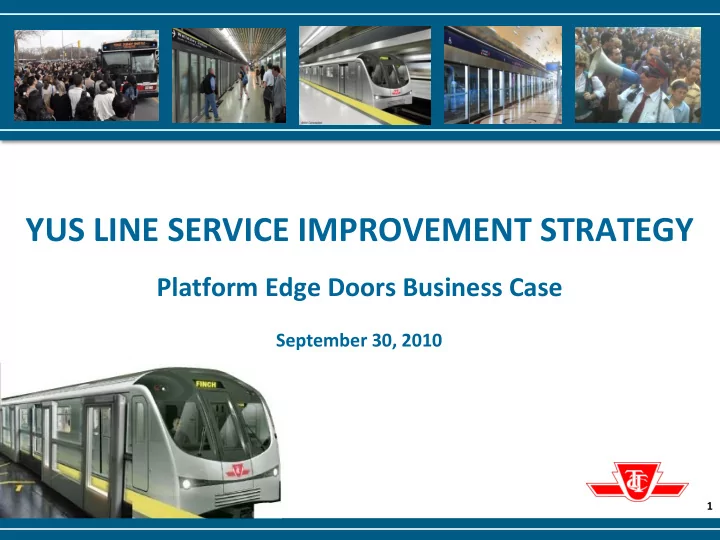
YUS LINE SERVICE IMPROVEMENT STRATEGY

Platform Edge Doors Business Case

September 30, 2010
slide-2
SLIDE 2

2

Presentation Outline

  • Introduction
  • Service Improvement Strategy
  • Platform Edge Doors (PEDs)
  • Business Case
  • Reliability/Capacity Improvement
  • Summary/Recommendations
slide-3
SLIDE 3

3

Introduction

The YUS line is the most critical asset of the TTC:

  • Provides 78% trips to the Central Business

District

  • Of TTC’s 1.5M riders each day, 700k use YUS
  • Equivalent capacity of 5 DVPs
  • Currently operating at a 10% shortfall in capacity
slide-4
SLIDE 4

4

Introduction

Toronto's commute times are a "glaring downfall" in the city's economic picture -- even worse than the notorious traffic snarls in Los Angeles, according to a new Board of Trade report.

National Post, March 30, 2010

There is no capacity left in the GTA’s road and highway systems to address this challenge.

slide-5
SLIDE 5

5

Service Improvement Strategy

Current capacity is 26 trains/hour in peak Need to move to 35 trains/hour to meet required forecast capacity in 2030 How do we increase capacity and reliability?

  • Move more trains per hour; currently constrained by

signal system headway

  • Train capacity
  • More efficient use of trains interior space
  • Longer trains
  • Reliability, ensuring that the line is operated at peak

capacity

slide-6
SLIDE 6

6

NOVA’s International Benchmarking *

Industry Best Practices

  • Toronto will not achieve the target

level of reliability through automation alone

  • Even with TR and ATC, Toronto needs

to reduce total incidents by 75% to achieve the target reliability level of 1 peak failure per week

  • Toronto needs to target key areas first

and then evaluate every aspect of the subway in terms of reliability

* Presented by NOVA at the June 2, 2010 Commission Meeting

slide-7
SLIDE 7

7

0.0 0.1 0.2 0.3 0.4 0.5 0.6 To

Reliability is Key Improvement Area

7

Million Car Kilometres Between Incidents Causing a Delay > 5 Minutes to Service (2008)

TTC

Top 7 metros: Asia, South America

Key Areas for Improvement:

  • New Rolling Stock
  • Modern Signalling and Train

Control

  • Management of trains in stations
  • Platform Edge Doors

Toronto #5 for Europe + North America

slide-8
SLIDE 8

8

PLATFORM EDGE DOORS (PEDs)

slide-9
SLIDE 9

9

PEDs

PEDs are commonly being installed around the world and are primarily used to:

  • Maintain physical segregation between

passengers waiting on the platform and the track.

  • Prevent passengers from moving between the

platform and the train unless the train is fully stationary in its correct position.

slide-10
SLIDE 10

10

General PED Benefits/ Impacts

Stakeholders Impacts Public Safety Improved Reliability Reduction in Noise Air quality TTC Operation & Maintenance Staff stress and trauma Perception of the TTC network Capital costs / Residual value

slide-11
SLIDE 11

11

SYSTRA Deliverables

  • Review of TTC’s Constructability Study of PEDs

in our current stations

  • Review of TTC’s cost estimates for PEDs in

existing and new stations

  • Business Case for the installation of PEDs
slide-12
SLIDE 12

12

PED Business Case

The Business Case is based on an analysis of the impacts for the community considering positive and negative impacts of an investment over the economic life of the project Two criterion were evaluated:

  • Economic Net Present Value

(ENPV)

  • Economic Internal Rate of

Return (EIRR)

slide-13
SLIDE 13

13

PED Business Case

Major Assumptions:

  • 30 year benefit
  • Ridership increase 1.5% per year
  • Installation for the complete TTC

network over 6 years

  • Capital installation cost of $9.8M

per station

slide-14
SLIDE 14

14

Summary of Net Present Value

Values in 2010 CAD Discount rate at 8%

  • YUS + TYSSE
  • BD
  • SHEPPARD

Economic Benefits M$ 567.1 Investments M$

  • 511.6

Economic Net Present Value M$ 55.5 Notes:

  • 1. Additionally, options of installing PEDs on individual lines was examined. As expected,

due to the high passenger volume on the YUS, it provided the greatest return.

  • 2. While not displayed, the Economic Internal Rate of Return exceeded the 8% set by the

Treasury Board.

slide-15
SLIDE 15

15

Sensitivity Analysis

A sensitivity analysis was conducted with the following parameters:

  • Capital cost
  • PED O&M costs
  • Rate of growth of GDP/capita
  • Ridership forecast
  • Value of severe/fatal injuries
  • Value of time

Analysis determined that NPV and EIRR remained favorable

slide-16
SLIDE 16

16

Conclusion

  • PED are necessary to

achieve TTC performance

  • bjectives
  • CBA gives a positive NPV

and an EIRR > 8%

  • PED installation a complex

task, must be operation focused

slide-17
SLIDE 17

17

SYSTRA Recommendations

  • Install the PEDs which is a viable, economic and operational

solution which would enhance the overall TTC operations

  • Co-ordinate all new improvement as a whole to implement a

global engineering approach

  • Carry out detailed reconnaissance of sites
  • Ensure installation plan is:
  • Performance based schedule
  • Efficient to minimize disruption to service
  • Take advantage of the market situation
slide-18
SLIDE 18

18

SYSTRA Recommendations (2)

  • Mitigate risk through:

– Managing scope creep – Identifying and managing interfaces – Tight controls on PED Supplier – Involving Operations Departments early in design and implementation process – Developing a prototype installation

slide-19
SLIDE 19

19

Safety, Reliability and Environmental Benefits

Benefit Safety Reliability Intentional and unintentional train contact   Unauthorized at track level   Debris and Fires   Train Doors  Environmental 

slide-20
SLIDE 20

20

Reliability Improvement

slide-21
SLIDE 21

21

Reliability Improvement

  • Reliability

improved to top European or North American property and equivalent to Asian properties

0.0 0.1 0.2 0.3 0.4 0.5 0.6 To

Million Car Kilometres Between Incidents Causing a Delay > 5 Minutes to Service (2008)

Toronto #5 for Europe + North America

1.0 4 1.5 1.6

TTC

Top 7 metros: Asia, South America Key Areas for Improvement:

  • New Rolling Stock
  • Modern Signalling and Train Control
  • Management of trains in stations
  • Platform Edge Doors
slide-22
SLIDE 22

22

Capacity Improvement

Adopting these improvements creates the equivalent of another YUS branch This represents another 2 DVP equivalents

slide-23
SLIDE 23

23

Summary

  • Future transportation growth can only be

achieved by Transit, not roads (2002 Official Plan)

  • The YUS Line is the most critical Transit Asset
  • The YUS Line requires TRs, ATC, PEDs and

Station Managers to meet the capacity & reliability challenge

  • These initiatives will provide Toronto with a

World Class Subway

slide-24
SLIDE 24

24

Recommendations

  • Direct staff to continue with planning for PED

installation

  • Staff to include PEDs in 2011 – 2015 Capital

Budget

slide-25
SLIDE 25

25

Questions