
SLIDE 1
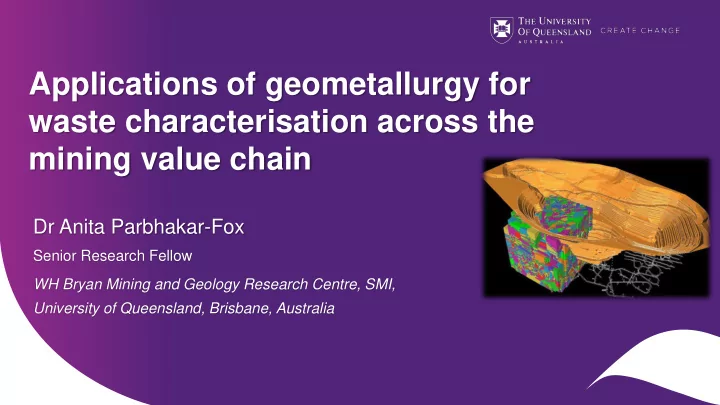
Applications of geometallurgy for waste characterisation across the mining value chain
Dr Anita Parbhakar-Fox
Senior Research Fellow WH Bryan Mining and Geology Research Centre, SMI, University of Queensland, Brisbane, Australia
Applications of geometallurgy for waste characterisation across the - - PowerPoint PPT Presentation
Applications of geometallurgy for waste characterisation across the mining value chain Dr Anita Parbhakar-Fox Senior Research Fellow WH Bryan Mining and Geology Research Centre, SMI, University of Queensland, Brisbane, Australia What is
Senior Research Fellow WH Bryan Mining and Geology Research Centre, SMI, University of Queensland, Brisbane, Australia
Defined linkages are essential
Defined linkages are essential
Small-scale, simple, low-cost Full-scale, complex, high cost
Handheld tools Hyperspectral mineralogy Data mining ‘Next-gen’ technologies Automated mineralogy Simple chemical tests
Type Silicate Structure Mineral Group Example VNIR Response SWIR Response TIR Response Silicates Inosilicates Amphibole Actinolite Non-diagnostic Good Good Pyroxene Diopside Good Moderate Good Cyclosilicates Tourmaline Dravite Non-diagnostic Good Moderate Neosilicates Garnet Grossular Moderate Non-diagnostic Good Olivine Foresterite Good Non-diagnostic Good Sorosilicates Epidote Clinozoisite Non-diagnostic Good Good Phyllosilicates Mica Muscovite Non-diagnostic Good Moderate Chlorite Chlinochlore Non-diagnostic Good Moderate Clay minerals Illite Non-diagnostic Good Moderate Kaolinite Non-diagnostic Good Moderate Tectosilicates Feldspar Orthoclase Non-diagnostic Non-diagnostic Good Albite Non-diagnostic Non-diagnostic Good Silica Quartz Non-diagnostic Non-diagnostic Good Non-silicates Carbonates Calcite Calcite Non-diagnostic Good Good Dolomite Dolomite Non-diagnostic Good Good Hydroxides Gibbsite Non-diagnostic Good Moderate Sulfates Alunite Alunite Moderate Good Moderate Gypsum Non-diagnostic Good Good Borates Borax Non-diagnostic Good Uncertain Halides Chlorides Halite Non-diagnostic Moderate Uncertain Phosphates Apatite Apatite Moderate Moderate Good Oxides Hematite Hematite Good Non-diagnostic Non-diagnostic Spinel Chromite Non-diagnostic Non-diagnostic Non-diagnostic Sulfides Pyrite Non-diagnostic Non-diagnostic Non-diagnostic
Linton et al. (2018)
Cor Core ph photography Min ineral Cl Class s map Ch Chlor lorite wavelength pos posit ition Ch Chlor lorite match intensit ity Geo Geotechnical par parameters
Core photography Mineral map Carbonate match
Mixed pixels are classified based on the most abundant spectra
Class map colour index
Aspectral Sericite Sericite + chlorite Quartz-carbonate Chlorite Clinochlore Quartz/silica Carbonate Low match Carbonate match High match
Co Core pho photogr graphy Min Mineral class ma map Su Sulfid fide di distrib ibutio ion Log Log Su Sulfid ide di distrib ibutio ion
Scaled Neutralising Potential/ Acid Potential values Relative reactivity values Calculated Mineral abundance
(Jambor et al., 2007; Parbhakar-Fox and Lottermoser, 2014) (Sverdrup, 1990)
Chlorite: 60 % Carbonate: 30 % Example Quartz: 10 %
* 0.02 * 1 * 0.006 * 1 = 30 = 0.00012 * 0.004 * 0 = 0 Pixel GDI = ~30
Geoenvironmental Domaining Index (GDI)
Core images Mineral maps
Hyperspectral data
Jackson et al. (2018)
,000 to
900 Extreme risk risk Do Dominance of
cid formin ing min inerals
lfides id identif tified as fir first t min ineral l > > 75 %. . No
rimary ry neu eutrali lisers (A (AP >> >>NP).
900 to
Hig High risk risk Sulfi lfides com
lfides es id iden enti tifie ied as 2nd
nd and 3rd rd min
ineral < < 75 %. . No pri rimary neu eutralis isers (A (AP >N >NP). 0 to
,000 Pot
ential l risk risk Do Dominated ed by silic ilica/quartz, seri ericit ite, ch chlo lorit ite. Few sulfid lfides es present, min inor r pri rimary ry neu eutrali lisers (AP≠NP). Som
gypsum pres esen ent. 10,0 ,000 to
,000 Low risk risk Ca Carbonate abundance < < 50 % (A (AP<NP). 40,0 ,000 to
,000 Very ery lo low risk risk Ca Carbonate dom
first Co Cores escan min ineral > > 50 %. . Lon Long ter erm acid cid neu eutrali lising capacity lik likely ely (A (AP<<NP).
Jackson et al. (2018)
Cor
photography Clas lassi sifi fied min ineral map ap Sul Sulfi fide rec ecognition Car arbonate ide identifi fication
Jackson et al. (2018)
Chlorite dominated
Cor
photography Clas lassi sifi fied min ineral map ap Sul Sulfi fide rec ecognition Car arbonate ide identifi fication
Jackson et al. (2018)
Sericite-dominated
Cor
photography Clas lassi sifi fied min ineral map ap Sul Sulfi fide rec ecognition Car arbonate ide identifi fication
Jackson et al. (2018)
Additional applications when scanning column feed materials prior to kinetic testing – results to be published later in 2019
En Environmental Log Loggin ging Ch Chemical St Stain ainin ing Har ardness me measurements pXR pXRF Fi Field eld che hemic ical tes ests
Acid cid Rock
Drain inage In Index (A (ARDI)
Parbhakar-Fox et al. (2011; 2018); Opitz et al. (2016); Cornelius et al. (2017)
EQUOtip
Min ineral hardness to
ermine rate
eath thering g and predic ict elu eluti tion of
cid/ neu eutrali lisation
Parbhakar-Fox et al. (2015)
Parbhakar-Fox et al. (2015)
SPL Lite Target sulphide phases & characterise grain properties
Buc Buckwalt lter-Davis is (20 (2013) Six tailings samples New Caloumet mine, Canada
Ho Hours
XBSE GXMAP Characterise grain properties for mineral of interest and examine associations
Ar Aranta (20 (2010): 4 waste rock samples, Antamina Mine, Peru Par arbhakar-Fox (2012): ): 10 waste rock samples, Lode-Au mine, 9 IOCG samples, Australia Edr draki i et t al
(2014): Cu-Au porphyry tailings
Ho Hours
30 mins
FEI Quanta 600
XM XMOD Parbhakar-Fox et al. (2017)
Calculate mineralogy using assay data (e.g., Berry et al., 2015; Beavis et al. 2017; Howard et al., 2019) Extract more information from existing data sets e.g., mineralogy and texture (Cracknell et al., 2018) Opportunity to enhance waste domaining e.g., using Ca and Mg from assay (Jackson et al., 2019) Matlab SQL
Orexplore core scanning – structural features,
(200 µm voxel resolution)
Sulphide distribution - Sunrise Dam Pyrite – Rio Blanco tourmaline breccia Cu deposit
3D A-ARDI assessments TruScanTM Minalyze CS
26
Forecast the potential for future mine wastes to fix atmospheric CO2 (using TIR data): Develop GHG consumption index Identify ‘soft’ zones based
Predictive dust characterisation protocol Spent heap leach materials: identify and characterise post-leach mineralogy (e.g., alunite-group)
Spent heap leach pile, Croydon Au-mines, QLD
Redr edraw awn fr from
(2001 01)
Parbhakar-Fox et al. (2018): https://www.mdpi.com/2075-163X/8/10/454
Planning to return and drill up to 5 drill holes @ 60 m depth perform geometallurgical and geoenvironmental testwork
Min ineralogical l & ch chem emical data analy lysis to
ict AMD ch characteristics ‘Next gen’ technologies and new ch chemical testin ting Sen ensor-based waste asses essments duri ring
l stages Tailings ‘fingerprinting’ durin ring dep eposition Ch Characterisati tion of
his istoric min ine e sit ites es and waste to
ermine reu euse New asses essmen ent t too
ls and processing ap approaches
Sustainable Minerals Institute University Experimental Mine 40 Isles Road, Indooroopilly, QLD 4068
T +61 7 3365 5977 M+61 400 850831 E a.parbhakarfox@uq.edu.au
to mitigate the risks related to variability (e.g., collect additional data, revise the mine plan, adapt or change the process strategy, or engineer flexibility into the system)
entire mine value chain are being established
creating an environment for sharing orebody knowledge, leading to the integration of such data and knowledge into mine planning and scheduling
Companies es th that t em embrace th the e geo eometall llurgic ical l approach will ill ben enefit it fr from in incr creased net t present valu lue and sharehold lder valu lue
Dominy et al. (2018)