Common Barriers to the Use of Patient-Generated Data Across - - PowerPoint PPT Presentation

common barriers to the use of patient generated data
SMART_READER_LITE
LIVE PREVIEW

Common Barriers to the Use of Patient-Generated Data Across - - PowerPoint PPT Presentation

Common Barriers to the Use of Patient-Generated Data Across Clinical Settings Peter West, Richard Giordano Health Science, University of Southampton Mark J. Weal Computer Science, University of Southampton Max Van Kleek, Nigel Shadbolt


slide-1
SLIDE 1

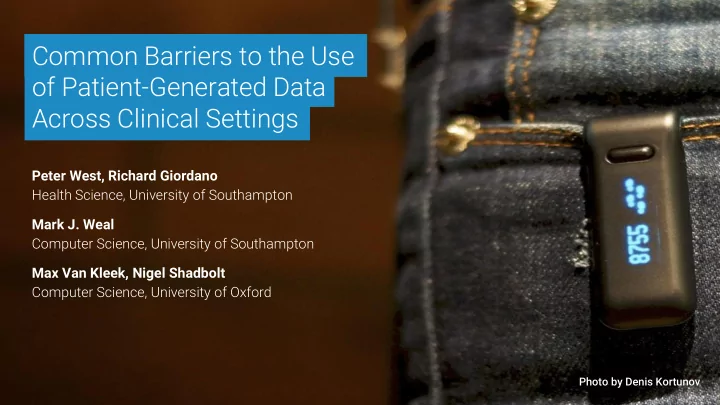
Common Barriers to the Use

  • f Patient-Generated Data

Across Clinical Settings

Photo by Denis Kortunov

Peter West, Richard Giordano Health Science, University of Southampton Mark J. Weal Computer Science, University of Southampton Max Van Kleek, Nigel Shadbolt Computer Science, University of Oxford

slide-2
SLIDE 2

Patient-Generated Data

Any kind of data which a patient has recorded using their own means.

Wearables Fitbit, Apple Watch Journals Hand-written and electronic Health products Blood pressure cuffs, weighing scales Smartphone apps Google Fit, Strava

slide-3
SLIDE 3

Health Self-Tracking Tools are Increasingly Popular

Over 15 million Fitbits sold in first quarter 2017 (Statista 2018) One third of US adults track at least one indicator of health (such as weight or symptoms) on using an app (MobiHealth News 2013)

Photo by Phillip Pessar

slide-4
SLIDE 4

Diabetes 422 million worldwide Almost 4x more than 1980

(Mathers 2006)

Heart failure 6.5 million in USA Predicted to rise 46% by 2030

(American Heart Association 2017)

Challenges facing healthcare

We are living longer! But, this means more chronic illness. Doctors are facing increasing workload and a need for more personalised care.

slide-5
SLIDE 5

Visions for Patient-Generated Data

Neff and Nafus (2016). Self-Tracking Personalising medicine towards individual patients Fill the gaps between visits Early detection of health abnormalities

slide-6
SLIDE 6

Chung et al (2016). Boundary negotiating artifacts in personal informatics PGD acts as a boundary object PGD can empower patients as part of health decision making

Related Work

slide-7
SLIDE 7

Related Work

Mentis et al (2017) - Crafting a View of Self-Tracking Data in the Clinical Visit Using patient-generated data is a collaborative process between doctor and patient

slide-8
SLIDE 8

Our previous findings

West et al (2016) - The Quantified Patient in the Doctor’s Office PGD can form part of a diagnosis workflow Doctors lacked confidence in measurements There are challenges around how PGD are represented.

slide-9
SLIDE 9

Research Question

What are the common barriers to using patient-generated data in clinical workflows?

slide-10
SLIDE 10

Workflows

  • 1. The order in which work is

conducted

  • 2. How the actors interact

Clinician Patient Patient-generated data

slide-11
SLIDE 11

Method

Literature Review To identify barriers across different clinical settings found in prior work. Semi-Structured Interviews To understand how these barriers manifest within clinician workflows.

+

slide-12
SLIDE 12

Literature review

We followed a systematic approach using PRISMA. Searched 7 databases including ACM, Web of Science, and PubMed. Included papers which reported on clinician’s lived experiences of using patient-generated data. Thematic analysis to identify common themes. Analysed 22 papers

slide-13
SLIDE 13

Themes

12 themes across 22 papers

slide-14
SLIDE 14

Interviews: Participants

13 clinicians were selected using the following criteria: I. They were a certified healthcare professional II. They regularly worked with patients

  • III. The sample reflected a

variety of specialisms All were practicing in the UK

slide-15
SLIDE 15

Interviews: Semi-Structured Approach

Our aim was to elicit perspectives on patient-generated data, so we asked questions pertaining to:

  • their clinical background and relevant contexts,
  • their typical encounters with patient-generated data,
  • how they would evaluate and use such data,
  • how such data might impact their work.

Using semi-structured interviews allowed discussions of concepts which we had not been anticipated.

slide-16
SLIDE 16

Analysis

We coded interview transcripts and consolidated with literature review themes. Several chronological stages of using patient-generated data become evident. We used the Workflow Elements Model (Unertl et al 2010) to develop a workflow based on these stages. We consider the actors, the artefacts used, the actions taken, the characteristics of these actions, and the outcomes of these actions. We then analysed the barriers we had identified by the workflow stages they appeared in.

slide-17
SLIDE 17

Results

slide-18
SLIDE 18

A workflow of six stages

slide-19
SLIDE 19

Stage 1: Align patient and clinician objectives

“If you ask about their data, you might see shiftiness tinged with a bit of irritation

  • r anger, tell-tale signs that something isn’t stacking up.”

P5, mental health specialist Patient motivation is not always obvious

slide-20
SLIDE 20

Stage 1: Align patient and clinician objectives

“You do get patients who fixate on self-tracking a bit too much. That can be a hindrance, because they say look at all this effort I’ve put in, and then you glance at it, and say ‘actually that’s not that relevant to what brought you in today.’”

P7, emergency doctor Crafting mutual

  • bjectives for the

consultation. Misaligned objectives

slide-21
SLIDE 21

Stage 2: Evaluate data quality

“There is a question about how precise their equipment is and if they are doing it

  • right. But if they bring in the equipment and show you it, you can see that it's fairly

accurate.”

P8, junior surgeon Data quality is often unclear

slide-22
SLIDE 22

? ? ? ? ? ? ? ?

Stage 2: Evaluate data quality

Did they skip recording because they were unwell and they were in bed at home? “Or is it because they were out partying so they didn't bother to make the reading?”

P4, cardiologist Data is often incomplete

slide-23
SLIDE 23

Stage 3: Judge data utility

“This data is not necessarily relevant to what's brought you in today. It is of some use, but in the acute setting it's difficult because you want to deal with the problem that they've got there and then.”

P7, emergency doctor Patient-generated data may not be relevant

slide-24
SLIDE 24

Stage 4: Rearrange the data

“They have produced this themselves, which means it's usable to them, rather than me, as a clinician, telling them how to record their daily thoughts and feelings.”

P5, mental health specialist Value of information prepared in a way which makes sense to the patient. Unfamiliar structure

slide-25
SLIDE 25

Stage 5: Interpret the data

“Most procedures we do for atrial fibrillation are for symptomatic gain, so the patient's perception of symptoms is more important than what they're objectively getting.”

P3, cardiologist Subjectivity can be an important quality

slide-26
SLIDE 26

Stage 5: Interpret the data

“What is the patient's definition of `terrible'? Because if one is `terrible', and five is `great', what exactly does two mean? What is three? What is the difference between two and three?”

P5, mental health specialist Ambiguity in subjective data

slide-27
SLIDE 27

Stage 6: Decide on a plan or action

“We're moving away from a paternalistic model of medicine, where the doctor tells the patient what to do, towards a partnership approach of empowering the patient to be more responsible for their condition.”

P9, hospital doctor Moving towards more collaborative decision making

slide-28
SLIDE 28

There are barriers in each workflow stage

slide-29
SLIDE 29

Design Challenges and Implications

slide-30
SLIDE 30

Data Collection Tools and Practices

How can we improve compliance of data collection? We could aim to automate data collection to reduce burden and improve compliance. But not all forms of data collection can be automated. Goal setting?

Photo by Wiyre Media

slide-31
SLIDE 31

Data Collection Tools and Practices

Collect context and provenance information:

  • What was used to collect the data?
  • How has it been manipulated?
  • Has the device been clinically evaluated?
slide-32
SLIDE 32

Tools for Use and Interpretation

Draw on clinical standards for displaying information. Filter data to only show relevant information.

slide-33
SLIDE 33

Clinical Practice and Training

Increase collaboration with patient so they understand reasons for self-tracking, addressing problems of misaligned objectives, ambiguity in the data, and improving patients’ awareness of what to track. “If a patient can understand their condition better then they understand how to manage their condition better, and then you’re more likely to empower them to take responsibility for their condition. It’s a joint effort. You have to work in partnership with the patient to achieve that.” P9, hospital doctor

slide-34
SLIDE 34

Limitations of this work

We interviewed clinicians only (not patients) This is one side of the study, and complements CHI work on patient data interaction We interviewed a sample of clinical roles There’s are many other roles in healthcare, so our work is not representative of every role. These are representative of the roles we interviewed All our participants are clinicians in the UK We would like to extend this to other countries.

slide-35
SLIDE 35

Summary

We aimed to identify barriers to using patient-generated data in different clinical settings. We found that doctors often follow a workflow for utilising patient-generated data. Understanding this workflow could help address barriers through design and HCI research.

Pe Peter r West University of Southampton p.west@soton.ac.uk

slide-36
SLIDE 36

References

  • Projections of global mortality and burden of disease from 2002 to 2030. Mathers CD, Loncar D. PLoS Med, 2006,

3(11):e442.

  • American Heart Association Heart Disease and Stroke Statistics 2017 At-A-Glance (Additional link to full stats on the

At-A-Glance)

  • Kim M Unertl, Kevin B Johnson, and Nancy M Lorenzi. 2012. Health information exchange technology on the front lines
  • f healthcare: workflow factors and patterns of use. Journal of the American Medical Informatics Association.
  • Helena M. Mentis, Anita Komlodi, Katrina Schrader, Michael Phipps, Ann Gruber-Baldini, Karen Yarbrough, and Lisa
  • Shulman. 2017. Crafting a View of Self-Tracking Data in the Clinical Visit. In Proceedings of the 2017 Conference on

Human Factors in Computing Systems (CHI ’17)

  • Chia-Fang Chung, Kristin Dew, Allison Cole, Jasmine Zia, James Fogarty, Julie A. Kientz, and Sean A. Munson. 2016.

Boundary negotiating artifacts in personal informatics: patient-provider collaboration with patient-generated data. In Proceedings of the 2016 Conference on Computer-Supported Cooperative Work & Social Computing (CSCW ’16). Association for Computing Machinery, New York, 770–786. DOI: