SLIDE 1
EE201/MSE207 Lecture 8
Measurement and uncertainty principle
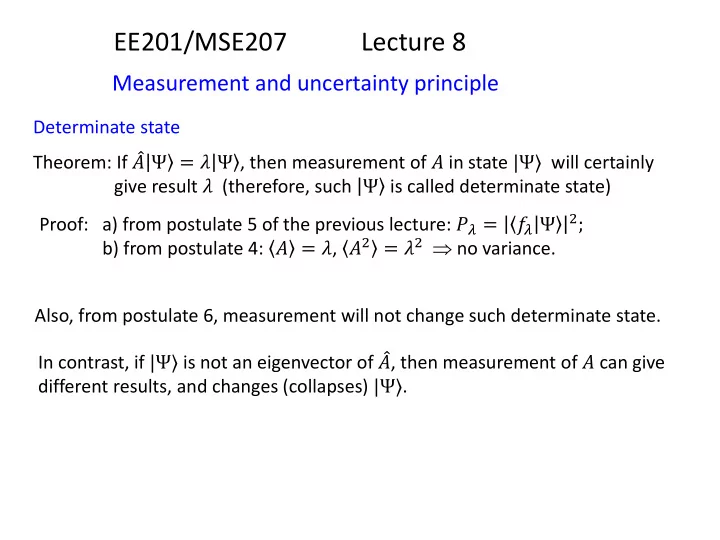
Determinate state Theorem: If 𝐵 Ψ = 𝜇 Ψ , then measurement of 𝐵 in state |Ψ〉 will certainly give result 𝜇 (therefore, such Ψ is called determinate state) Proof: a) from postulate 5 of the previous lecture: 𝑄𝜇 = 𝑔
𝜇 Ψ 2;
b) from postulate 4: 𝐵 = 𝜇, 𝐵2 = 𝜇2 no variance. Also, from postulate 6, measurement will not change such determinate state. In contrast, if |Ψ〉 is not an eigenvector of 𝐵, then measurement of 𝐵 can give different results, and changes (collapses) |Ψ〉.
SLIDE 2
Theorem 1 If two Hermitian operators commute, 𝐵, 𝐶 = 0, then there exists a basis consisting of eigenvectors of both 𝐵 and 𝐶 simultaneously. (These states are determinate states of both 𝐵 and 𝐶, i.e. 𝜏
𝐵 = 𝜏𝐶 = 0. )
Theorem 2 (generalized uncertainty principle) For Hermitian 𝐵 and 𝐶, if 𝐵, 𝐶 ≠ 0, then Example
𝑦, 𝑞 = 𝑗ℏ
𝜏𝑦
2 𝜏𝑞 2 ≥
ℏ 2
2
𝜏𝑦𝜏𝑞 ≥ ℏ 2 Compatible and incompatible observables
Question: When a state can be a determinate state for two operators 𝐵 and 𝐶?
(why important: consider measurement sequence A, B, A)
Answer: If 𝐵 and 𝐶 commute, 𝐵, 𝐶 = 0, then this is possible (“compatible”); if 𝐵, 𝐶 ≠ 0, then this is usually impossible (“incompatible”). More rigorously, two theorems from linear algebra (without proof).
(Heisenberg uncertainty principle) (𝜏 is the standard deviation)
𝜏
𝐵 2 𝜏𝐶 2 ≥
1 2𝑗 𝐵, 𝐶
2
SLIDE 3
Energy-time uncertainty
You can often find inequality
Δ𝐹 Δ𝑢 ≥ ℏ 2
1) It is formally incorrect, but often gives correct intuition. 2) It is correct in the following sense. Theorem For any observable 𝑅 (which does not explicitly depend on time)
𝜏𝐹 𝜏𝑅 𝑒〈𝑅〉 𝑒𝑢 ≥ ℏ 2
(So, if anything changes significantly during Δ𝑢, then the energy spread should be large enough, Δ𝐹 Δ𝑢 ≥ ℏ 2. In stationary state Δ𝐹 = 0, therefore nothing changes.) Proof Straightforward from 𝜏𝐼𝜏𝑅 ≥ 1 2𝑗 𝐼, 𝑅
2
and
𝑒〈𝑅〉 𝑒𝑢 = 𝑗 ℏ 𝐼, 𝑅
𝑒〈𝑅〉 𝑒𝑢 = 𝑒 𝑒𝑢 Ψ 𝑅Ψ = 𝑒Ψ 𝑒𝑢 𝑅Ψ + Ψ 𝑅 𝑒Ψ 𝑒𝑢 + Ψ 𝜖 𝑅 𝜖𝑢 Ψ = = −𝑗 ℏ 𝐼Ψ 𝑅Ψ + Ψ 𝑅 −𝑗 ℏ 𝐼Ψ = 𝑗 ℏ Ψ 𝐼 𝑅Ψ − Ψ 𝑅 𝐼Ψ = 𝑗 ℏ 〈Ψ| 𝐼, 𝑅 Ψ〉 = ( 𝑗 ℏ) 〈 𝐼, 𝑅 〉
SLIDE 4 𝑦-representation and 𝑞-representation
It is easy to check that both
𝑦 and 𝑞 are Hermitian (as for any observable).
We need to prove 𝑔 𝑈 = 〈 𝑈𝑔|〉. For 𝑈 = 𝑦 this is very simple: 𝑔∗ 𝑦 𝑦 𝑦 𝑒𝑦 = 𝑦 𝑔 𝑦
∗ 𝑦 𝑒𝑦.
For 𝑈 = 𝑞 we need integration by parts: 𝑔∗ 𝑦
−𝑗ℏ 𝑒
𝑒𝑦 𝑦 𝑒𝑦 =
= 𝑗ℏ 𝑒𝑔∗(𝑦)
𝑒𝑦
𝑦 𝑒𝑦 = −𝑗ℏ 𝑒𝑔 𝑦
𝑒𝑦 ∗
𝑦 𝑒𝑦.
Find eigenstates of
𝑦 and 𝑞 𝑈𝑔 𝑦 = 𝜇 𝑔(𝑦)
Eigenstates of 𝑦:
𝑦 𝑔 𝑦 = 𝜇 𝑔(𝑦) 𝑔 𝑦 = 𝐵 𝜀(𝑦 − 𝜇)
Not normalizable, choose 𝐵 = 1.
𝑔
𝜇 𝑦 = 𝜀(𝑦 − 𝜇), then 𝑔
𝜇 𝑔 𝜈 = 𝜀 𝜈 − 𝜇
Check: 𝜀 𝑦 − 𝜇 𝜀 𝑦 − 𝜈 𝑒𝑦 = 𝜀(𝜈 − 𝜇) (since 𝑦 = 𝜈)
SLIDE 5 Eigenstates of 𝑞:
−𝑗ℏ 𝑒 𝑒𝑦 𝑦 = 𝜇 (𝑦) 𝑦 = 𝐶 𝑓𝑗𝜇
ℏ𝑦
𝜇 𝑦 =
1 2𝜌ℏ 𝑓𝑗𝜇
ℏ𝑦, then 𝜇 𝜈 = 𝜀 𝜈 − 𝜇
Check: 1
2𝜌ℏ 𝑓−𝑗𝜇
ℏ𝑦𝑓𝑗𝜈 ℏ𝑦 𝑒𝑦 =
1 2𝜌ℏ 𝑓𝑗𝜈−𝜇
ℏ 𝑦 𝑒𝑦 = 𝜀(𝜈 − 𝜇)
since
−∞ ∞ 𝑓𝑗𝑙𝑦𝑒𝑦 = 2𝜌 𝜀 𝑙
and 𝜀 𝑏𝑦 = 𝜀(𝑦)
|𝑏|
Digression: proof of the formula
−∞ ∞ 𝑓𝑗𝑙𝑦𝑒𝑦 = 2𝜌 𝜀 𝑙
Fourier transform 𝑔 𝑦 =
1 2𝜌 𝑓𝑗𝑙𝑦𝐺 𝑙 𝑒𝑙, 𝐺 𝑙 = 1 2𝜌 𝑓−𝑗𝑙𝑦 𝑔 𝑦 𝑒𝑦
Therefore 𝐺 𝑙 = 1 2𝜌 𝑒𝑦 𝑓−𝑗𝑙𝑦 1 2𝜌 𝑓𝑗𝑙′𝑦𝐺 𝑙′ 𝑒𝑙′ = 1 2𝜌 𝑓𝑗 𝑙′−𝑙 𝑦𝑒𝑦 𝐺 𝑙′ 𝑒𝑙 𝜀(𝑙 − 𝑙′)
SLIDE 6
Similarity of 𝑦-representation and 𝑞-representation
𝑔
𝜇 𝑦 = 𝜀(𝑦 − 𝜇)
𝑦-eigenstates (x-basis) 𝑞-eigenstates (p-basis)
𝜇 𝑦 = 1 2𝜌ℏ 𝑓𝑗𝜇
ℏ𝑦
We can say that Ψ 𝑦 are actually components of vector |Ψ〉 in x-basis:
Ψ 𝑦 =
−∞ ∞
Ψ 𝑦′ 𝜀 𝑦 − 𝑦′ 𝑒𝑦′
basis vectors components Similarly, we can write it in p-basis:
Ψ 𝑦 =
−∞ ∞
Φ 𝑞 1 2𝜌ℏ 𝑓𝑗𝑞
ℏ𝑦 𝑒𝑞
basis vectors components Φ 𝑞 = 1 2𝜌ℏ
−∞ ∞
𝑓−𝑗𝑞
ℏ𝑦 Ψ 𝑦 𝑒𝑦
We can regard Φ 𝑞 as a wavefunction in p-space Actually, more often people use Φ 𝑙 in 𝑙-space, where 𝑙 = 𝑞/ℏ, then eigenstates (basis vectors) are 1
2𝜌 𝑓𝑗𝑙𝑦.
SLIDE 7 Operators 𝑦 and 𝑞 in p-space
𝑞Φ 𝑞 = 𝑞 Φ(𝑞)
Expected by analogy. Formal proof:
= −𝑗ℏ Φ 𝑞 1 2𝜌ℏ 𝑗𝑞 ℏ 𝑓𝑗𝑞
ℏ𝑦𝑒𝑞 = 𝑞 Φ 𝑞
1 2𝜌ℏ 𝑓𝑗𝑞
ℏ𝑦𝑒𝑞
−𝑗ℏ 𝜖Ψ(𝑦) 𝜖𝑦 = −𝑗ℏ 𝜖 𝜖𝑦 Φ 𝑞 1 2𝜌ℏ 𝑓𝑗𝑞
ℏ𝑦𝑒𝑞 =
𝑦Φ 𝑞 = 𝑗ℏ 𝜖 𝜖𝑞 Φ(𝑞)
Proof: 𝑦Ψ(𝑦) = Φ 𝑞
1 2𝜌ℏ 𝑦 𝑓𝑗𝑞
ℏ𝑦𝑒𝑞 =
−𝑗ℏ 𝜖 𝜖𝑞 𝑓𝑗𝑞
ℏ𝑦
= by parts = 𝑗ℏ 𝑒Φ(𝑞) 𝑒𝑞 1 2𝜌ℏ 𝑓𝑗𝑞
ℏ𝑦𝑒𝑞
Commutator does not change 𝑦, 𝑞 = 𝑦, −𝑗ℏ 𝜖 𝜖𝑦 = 𝑗ℏ 𝑦, 𝑞 = 𝑗ℏ 𝜖 𝜖𝑞 , 𝑞 = 𝑗ℏ
SLIDE 8 Probabilities Ψ 𝑦
2𝑒𝑦 and Φ 𝑞 2𝑒𝑞 Φ 𝑞 is as good a wavefunction as Ψ 𝑦 For x-measurement, probability to find particle near 𝑦0 is 𝒬 𝑦0 𝑒𝑦 (postulate 5, rem. a), with 𝒬 𝑦0 = 𝑔
𝑦0 Ψ 2 = 𝜀 𝑦 − 𝑦0 Ψ 𝑦 𝑒𝑦 2 = Ψ 𝑦0 2
Similarly, for p-measurement, probability to find momentum near 𝑞0 is 𝒬 𝑞0 𝑒𝑞, with 𝒬 𝑞0 = 𝑞0 Ψ
2 = 1 2𝜌ℏ e−𝑗𝑞0
ℏ 𝑦 Ψ 𝑦 𝑒𝑦
2
= Φ 𝑞0
2
SLIDE 9
Minimum-uncertainty states
From Heisenberg uncertainty relation, we know that 𝜏𝑦𝜏𝑞 ≥
ℏ 2
Which states satisfy the lower bound, 𝜏𝑦𝜏𝑞 =
ℏ 2 ?
Answer:
Ψ 𝑦 = 𝐵 𝑓−𝑏 𝑦−𝑦0 2/2ℏ 𝑓𝑗𝑞0𝑦/ℏ
(in optics they are called “squeezed states”) It has 𝑦 = 𝑦0 , 𝑞 = 𝑞0 ,
𝜏𝑦 = ℏ 2𝑏 , 𝜏𝑞 = 𝑏ℏ 2 ,
In p-representation very similar form: 𝐵 = 𝑏 𝜌ℏ
1/4
Φ 𝑞 = 1 2𝜌ℏ 𝑓−𝑗𝑞
ℏ𝑦 Ψ 𝑦 𝑒𝑦 = 𝑓𝑗𝑞0𝑦0/ℏ 𝐵
𝑏 𝑓− 𝑞−𝑞0 2/(2ℏ𝑏) 𝑓−𝑗𝑦0𝑞/ℏ