Food waste an issue that affects all aspects of society producers, - - PowerPoint PPT Presentation

food waste
SMART_READER_LITE
LIVE PREVIEW

Food waste an issue that affects all aspects of society producers, - - PowerPoint PPT Presentation

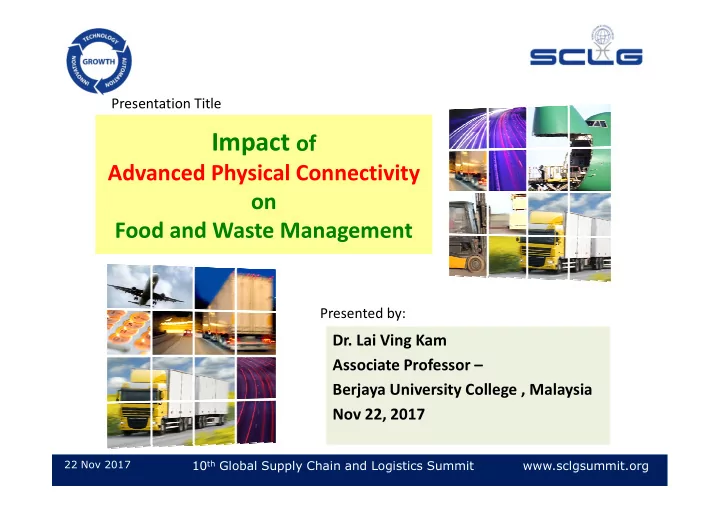
Presentation Title Impact of Advanced Physical Connectivity on Food and Waste Management Presented by: Dr. Lai Ving Kam Associate Professor Berjaya University College , Malaysia Nov 22, 2017 10 th Global Supply Chain and Logistics Summit


slide-1
SLIDE 1

Presentation Title

Impact of

Advanced Physical Connectivity

  • n

Food and Waste Management

22 Nov 2017

10th Global Supply Chain and Logistics Summit www.sclgsummit.org

Presented by:

  • Dr. Lai Ving Kam

Associate Professor – Berjaya University College , Malaysia Nov 22, 2017

slide-2
SLIDE 2

an issue that affects all aspects of society– producers, growers, retail, hospitality, consumers and those who experience food poverty.

Today – SOME KEY STATS:

  • Around one billion people

will eat too much

  • Around one billion people

Food waste

WHY REDUCE FOOD WASTE? Reducing food waste

  • good for the world,
  • good for food security and
  • good for the climate

22 Nov 2017

10th Global Supply Chain and Logistics Summit www.sclgsummit.org

9 Feb 2011

will go to bed hungry

  • Over 20,000 people will die

from hunger

  • An estimated one third of

all food produced in the world ends up as waste.

Source: http://www.stopfoodwaste.ie/food-we- waste/irelands-food-waste-forum/

  • good for the climate
  • The costs of decreasing food waste are

relatively low, but the potential benefits are substantial.

  • Less food waste leads to more efficiency,

more economic productivity and reductions in emissions of greenhouse gases that contribute to climate change.

slide-3
SLIDE 3

Food and Nutrition Security

  • a Growing Challenge

EU study

Globally, 3.5 billion people are malnourished, yet ~ 2 billion people are overweight - ‘double burden’ of malnutrition. Globally to feed 9 billion by 2050 need to increase production by + 60%, yet 1/3 of the food we produce is

Wasted Food is a Big Problem

22 Nov 2017

10th Global Supply Chain and Logistics Summit www.sclgsummit.org

9 Feb 2011

production by + 60%, yet 1/3 of the food we produce is wasted. Increasing global demand for meat & animal products, which is not sustainable Urgency & complexity: Compounded effects of population growth, urbanization, migration, resource scarcity and climate change - affect the entire global food chain

slide-4
SLIDE 4

31% or 133 billion pounds

  • f food from U.S. retail

food stores, restaurants, and homes goes uneaten.

Mitigate Climate Change & Conserve Resources

All of the resources that went into

Food is the single largest component

  • f municipal solid waste going to

Landfills (U.S. EPA) As food rots in landfills, it generates methane, a greenhouse gas over 20 times more potent than carbon

22 Nov 2017

10th Global Supply Chain and Logistics Summit www.sclgsummit.org

9 Feb 2011

All of the resources that went into producing that wasted food – including the land, labour, water, pesticides, and fertilizers – could have been saved or gone to uses of higher value to society.

times more potent than carbon dioxide (U.S. EPA) Landfills are the third largest source

  • f methane in the U.S.

(U.S. EPA)

slide-5
SLIDE 5

Preventing food waste = 1st priority

Awareness raising, iInformation & education Food redistribution

At ALL stages of the food chain

Agriculture and fisheries Food manufacturing Retailers/wholesalers Households Caterers

Food waste

to further assess how to limit

22 Nov 2017

10th Global Supply Chain and Logistics Summit www.sclgsummit.org

iInformation & education Food redistribution programmes Logistical improvements Role of food packaging Transforming unavoidable food waste into a resource Feed & energy recovery

  • separate collection of food waste

necessary

to further assess how to limit food waste throughout the entire food chain; to investigate incentives to halve the disposal of edible food waste

slide-6
SLIDE 6

Food systems approach

Food and Nutrition Security (FNS) : Sustainability of the Food Chain:

Food Waste Minimisation Food Packaging Optimisation Consumer Information Needs

EU study

22 Nov 2017

10th Global Supply Chain and Logistics Summit www.sclgsummit.org

9 Feb 2011

Food and Nutrition Security (FNS) :

desires a sustainable food systems approach from inputs, to primary production (agriculture, aquaculture & fisheries), harvesting, storage, processing, packaging, distribution, waste streams, to consumer intake – and back!

slide-7
SLIDE 7

Consumer information needs and sustainability

  • Communicating environmental

performance for food = crucial

  • Driver of global resource use
  • Environmental pressures further

increase

  • Consumers aware of challenges?
  • Encourage consumers and producers –

fostering more sustainable choices

Current challenges:

  • New and complex area of

information, in particular for food

  • Information overload and

proliferation of labels

22 Nov 2017

10th Global Supply Chain and Logistics Summit www.sclgsummit.org fostering more sustainable choices

proliferation of labels

  • Reliability of information
  • Only information not

enough! green choice should be the easy and affordable choice

Solutions and ways forward:

  • Clear, reliable and comparable information
  • Further consumer research
  • Exchange of best practices/guidance from

multi-stakeholder platforms implementation and working together on concrete actions

slide-8
SLIDE 8

FOOD WASTE PREVENTION

Assessing your Area

To prevent Food Waste you must first identify where and why food waste is being

  • generated. Then come up with

solutions to prevent this waste as close to the wasting point as possible.

Before you start, consider FOOD WASTE PREVENTION – Solutions

22 Nov 2017

10th Global Supply Chain and Logistics Summit www.sclgsummit.org

  • The main food waste

producing business types in your area

  • Typical quantities of food

waste generated by different business

  • The main types of food waste

generated by different business

Source : Nourish eu Healthy & Create Food Region

slide-9
SLIDE 9

PREVENTION

  • Reducing the waste produced
  • Redistributing surplus food to

humans

  • Redistributing surplus food

(without processing) to livestock RECOVERY Processing waste/surplus food for livestock feed Home composting Energy from Waste (incineration and fuel*)

FOOD WASTE PREVENTION – Solutions

22 Nov 2017

10th Global Supply Chain and Logistics Summit www.sclgsummit.org

RECYCLING Anaerobic Digestion (energy recovery system but counts as recycling for Directive) Composting DISPOSAL Food disposal units to sewer Landfill

Source : Nourish eu Healthy & Create Food Region

slide-10
SLIDE 10

STOP FOOD WASTE INITIATIVE

  • 1. Promotion of food waste prevention message
  • Provide information
  • Website, materials, newsletter, social media,

commercial information and support, commercial food waste tool (new)

  • National Promotion and national Events
  • Cookery demos

War on Food Waste- Proactive and destiminictic

  • 6. Strategies for the collection of

food waste

  • 7. Procurement strategies & contracts

22 Nov 2017

10th Global Supply Chain and Logistics Summit www.sclgsummit.org

  • 2. Promoting composting
  • Provide information
  • Master Composters & Demo Sites
  • 3. Raise Awareness
  • 4. Education & Training
  • 5. Integrated advice on healthy

eating & food waste

  • 7. Procurement strategies & contracts
  • 8. Strategies for Policies that

relate to food packaging

  • 9. Food labelling & hygiene/safety

policy

  • 10. Food Distribution redefine
slide-11
SLIDE 11

What Can We Do? Reduce food waste through improved ordering, prepping, & storage Recover wholesome, uneaten food and donate it to feed

22 Nov 2017

10th Global Supply Chain and Logistics Summit www.sclgsummit.org

9 Feb 2011

food and donate it to feed people in need Recycle discarded food for other uses including animal feed, compost, and energy generation

slide-12
SLIDE 12

At a government level, measures that can be utilised include

  • Tax and food safety regulations

that can act to promote the redistribution of surplus food for human consumption.

  • Regulations that influence what

food waste and related by-products can safely be used as animal feed

22 Nov 2017

10th Global Supply Chain and Logistics Summit www.sclgsummit.org

can safely be used as animal feed Co-creating the Agri-food Platform Food Technology Agricultural Technology Distribution Technology

Strategies for Policies that relate to food packaging

Food labelling & hygiene/safety policy

slide-13
SLIDE 13

Impacts of waste on Environment

Waste breaks down in landfills to form methane, a potent greenhouse gas Change in climate and destruction of

  • zone layer due to waste biodegradable

Littering, due to waste pollutions, illegal

22 Nov 2017

10th Global Supply Chain and Logistics Summit www.sclgsummit.org

9 Feb 2011

Littering, due to waste pollutions, illegal dumping, Leaching: is a process by which solid waste enter soil and ground water and contaminating them.

U.S. Environment Protection Agency (2009)

slide-14
SLIDE 14

Waste Management

What are Wastes?

Waste (also known as rubbish, trash, refuse, garbage, junk, litter, and ort) is unwanted

  • r useless materials.

In biology, waste is any of the many unwanted substances or toxins that are expelled from living

Basel Convention Definition

  • f Wastes

“substances

  • r
  • bjects

which are disposed of or are intended to be disposed

  • f
  • r

are required to be disposed of by the provisions of the

22 Nov 2017

10th Global Supply Chain and Logistics Summit www.sclgsummit.org

substances or toxins that are expelled from living

  • rganisms, metabolic waste;

such as urea and sweat.

by the provisions of the law”

IMPACTS OF WASTE IF NOT MANAGED WISELY

  • Affects our health
  • Affects our socio-economic conditions
  • Affects our coastal and marine environment
  • Affects our climate
slide-15
SLIDE 15

IMPACTS OF WASTE IF NOT MANAGED WISELY

  • Greenhouse Gas (GHGs )are

accumulating in Earth’s atmosphere as a result of human activities, causing global mean surface air temperature and subsurface ocean temperature to rise.

  • Rising global temperatures are

expected to raise sea levels and

Activities that have altered the chemical composition of the atmosphere:

  • Buildup of GHGs primarily carbon dioxide (CO2)

methane (CH4), and nitrous oxide (N20).

  • C02 is released to the atmosphere by the burning
  • f fossil fuels, wood and wood products, and

solid waste.

22 Nov 2017

10th Global Supply Chain and Logistics Summit www.sclgsummit.org

9 Feb 2011 expected to raise sea levels and change precipitation and other local climate conditions.

  • Changing regional climates could

alter forests, crop yields, and water supplies.

  • Affect human health, animals, and

many types of ecosystems.

  • CH4 is emitted from the decomposition of
  • rganic wastes in landfills, the raising of

livestock, and the production and transport of coal, natural gas, and oil.

  • N02 is emitted during agricultural and industrial

activities, as well as during combustion of solid waste and fossil fuels. In 1977, the US emitted about one-fifth of total global GHGs.
slide-16
SLIDE 16

WHAT SHOULD BE DONE

Reduce Waste

  • Reduce office paper waste by

implementing a formal policy to duplex all draft reports and by making training manuals and personnel information available electronically.

  • Improve product design to use less

materials.

  • Redesign packaging to eliminate

Reuse

  • Reuse corrugated moving boxes

internally.

  • Reuse office furniture and

supplies, such as interoffice envelopes, file folders, and paper.

  • Use durable towels, tablecloths,

22 Nov 2017

10th Global Supply Chain and Logistics Summit www.sclgsummit.org

  • Redesign packaging to eliminate

excess material while maintaining strength.

  • Work with customers to design and

implement a packaging return program.

  • Switch to reusable transport

containers.

  • Purchase products in bulk.
  • Use durable towels, tablecloths,

napkins, dishes, cups, and glasses.

  • Use incoming packaging

materials for outgoing shipments.

  • Encourage employees to reuse
  • ffice materials rather than

purchase new ones.

slide-17
SLIDE 17

WHAT SHOULD BE DONE Donate/Exchange

  • old books
  • old clothes
  • old computers

Consumer Education

  • Develop an “office recycling

procedures” packet.

  • Send out recycling reminders to all

employees including environmental articles.

  • Train employees on recycling

practices prior to implementing recycling programs.

  • Conduct an ongoing training

process as new technologies are introduced and new employees join

Employee Education

  • education campaign on

waste management that includes an extensive internal web site, quarterly newsletters, daily bulletins, promotional signs and helpful reference labels

22 Nov 2017

10th Global Supply Chain and Logistics Summit www.sclgsummit.org

  • excess building materials
  • ld equipment to local
  • rganizations

introduced and new employees join the institution.

reference labels within the campus of an institution.

Conduct outreach program adopting an ecologically sound waste management system which includes:

  • waste reduction
  • segregation at source
  • composting
  • recycling and re-use
  • more efficient collection
  • more environmentally sound disposal
slide-18
SLIDE 18

Can Advanced Physical Connectivity changing the face of Food and waste management

Digital distribution (combining B2B and B2C commerce)

22 Nov 2017

10th Global Supply Chain and Logistics Summit www.sclgsummit.org

Omnichannel logistics / Digital distribution From smart lockers to deliveries to your cars, logistics players are coming up with innovative solutions to challenge of "last-mile" delivery.

slide-19
SLIDE 19

Physical Connectivity

Impacted by Multiple Factors Driving the Relationship

Factors impacting Connectivity Management Global Supply Chain Environment Connectivity Intermodal Relationship

22 Nov 2017

10th Global Supply Chain and Logistics Summit www.sclgsummit.org

Cost to serve the Market Market competitions Technology and its lifecycle Product and its lifecycle Business Model Alignment Collaborative Value Creation New technological tools provide powerful and promising new ways of working

slide-20
SLIDE 20

High Speed rail – shortening connecting Time

Land Bases

Super connectivity permit less perishability

22 Nov 2017

10th Global Supply Chain and Logistics Summit www.sclgsummit.org

Legend ____ High speed railway built / Under- construction / to be built / in plan. Source: People’s daily, Xinhua News agency

5/20/2016 22 Adam Mo/ Dr. VK Lai India Supply Chain Summit 19-20 May 2016

Land Bases Supper connectivity

slide-21
SLIDE 21

Super connectivity contribute to Food Waste reduction

22 Nov 2017

10th Global Supply Chain and Logistics Summit www.sclgsummit.org

Asia-Euro-Africa connectivity Network

Land Bases Supper connectivity support less than truck load On demand delivery

Extended Super connectivity

slide-22
SLIDE 22

Physical Connectivity boost efficient and responsive food distribution

Connectivity in Adaptive Responsive Supply Chain

Hub and Spoke: Wider Global Supply Chain Major Hub

22 Nov 2017

10th Global Supply Chain and Logistics Summit www.sclgsummit.org

Major Hub

Feeders Feeders Sub Feeders Feeders

slide-23
SLIDE 23

Major Hub

Feeders Super Connectivity Infrastructure

Global Trade Redefined Digital Free Trade Zone (DFTZ) Super Hub and Spoke: Wider Global Supply Chain

Speed – key to adaptive Responsive Supply Chain

22 Nov 2017

10th Global Supply Chain and Logistics Summit www.sclgsummit.org Feeders Sub Feeders Feeders Super Connectivity Infrastructure

slide-24
SLIDE 24

Consumer marketplaces-retail has already been changed forever.

Change brings with it opportunity.

Top Megatrends

  • Trend :

Replacement of multiple distribution network strategies with an omnichannel.

22 Nov 2017

10th Global Supply Chain and Logistics Summit www.sclgsummit.org

Smart and flexible logistics solutions will require a combined network of smaller and larger distribution/storage/ sales points.

slide-25
SLIDE 25

Last Mile Delivery / Delivery system / Distribution Store Front as Inventory management point Mobile Order Management Order /warehouse Management / Catalogue Channel-agnostic returns management Workforce management Allocation Policy Store fulfilment

A-RSC

Adaptive Responsive Supply Chain (A-RSC)

The emergence of Omnichannel Operations

22 Nov 2017

10th Global Supply Chain and Logistics Summit www.sclgsummit.org

Online Omni Channel Business intelligence

Infrastructure required Network Speed and Agility

returns management

Supply Chain fundamental Delivering the right quality at the lowest cost, with the agreed service level. How to manage efficient food distribution ? Speedy On-demand connectivity and customer satisfaction =

Profitable sales increment

Connectivity

slide-26
SLIDE 26
  • 1. USE AGILE APPROACHES

TO IT AND BUSINESS

  • 2. FOUR THINGS YOU

NEED TO DO

22 Nov 2017

10th Global Supply Chain and Logistics Summit www.sclgsummit.org

  • Change how you think about designing your network and

fulfilling orders

  • Consider a variety of options for last mile and delivery
  • Aggressively integrate upstream and downstream to lower

total cost in the value chain

  • Build and partner for the right tech capabilities
slide-27
SLIDE 27

Preventing food wastage

22 Nov 2017

10th Global Supply Chain and Logistics Summit www.sclgsummit.org

slide-28
SLIDE 28

What We Must Do !

22 Nov 2017

10th Global Supply Chain and Logistics Summit www.sclgsummit.org

slide-29
SLIDE 29

Intelligent Product R&D / Manufacturing and Fulfillment

AI 5G

2020 Product Design and Development process

22 Nov 2017

10th Global Supply Chain and Logistics Summit www.sclgsummit.org Intelligent Manufacturing

Sustainable Manufacturing

Last Mile Delivery / Delivery system / Distribution Store Front as Inventory management point Mobile Order Management Order /warehouse Management / Catalogue Online Omni Channel Business intelligence

Infrastructure required Network Speed and Agility

Channel-agnostic returns management Workforce management Allocation Policy Store fulfilment

slide-30
SLIDE 30

Sustainability as Strategic SC Emphaasis

Demand –Driven Adaptive Responsive Supply Chain Management

Physical Connectivity Technology Adaptive Connectivity

22 Nov 2017

10th Global Supply Chain and Logistics Summit www.sclgsummit.org

9 Feb 2011

Adaptive responsive Supply Chain Strategy

Internet Communication Technology

Connectivity Infrastructure And Network Design

Multi Echelon Business Model Strategy Multi technologies interface application technology Talent with Competency on Sustainability