Local initiatives towards zero waste in Phitsanulok Municipality, - - PDF document

local initiatives towards zero waste in phitsanulok
SMART_READER_LITE
LIVE PREVIEW

Local initiatives towards zero waste in Phitsanulok Municipality, - - PDF document

Local initiatives towards zero waste in Phitsanulok Municipality, Thailand Janya Sang-Arun Policy researcher Sustainable Consumption and Production Group Institute for Global Environmental Strategies (IGES) IGES-SCP Phitsanulok zero waste


slide-1
SLIDE 1

1

Local initiatives towards zero waste in Phitsanulok Municipality, Thailand Janya Sang-Arun

Policy researcher Sustainable Consumption and Production Group Institute for Global Environmental Strategies (IGES)

Janya Sang-Arun IGES | http://www.iges.or.jp Review and Planning Workshop on Eco-town, 11-13 December 2012, Penang

IGES-SCP

Phitsanulok zero waste model

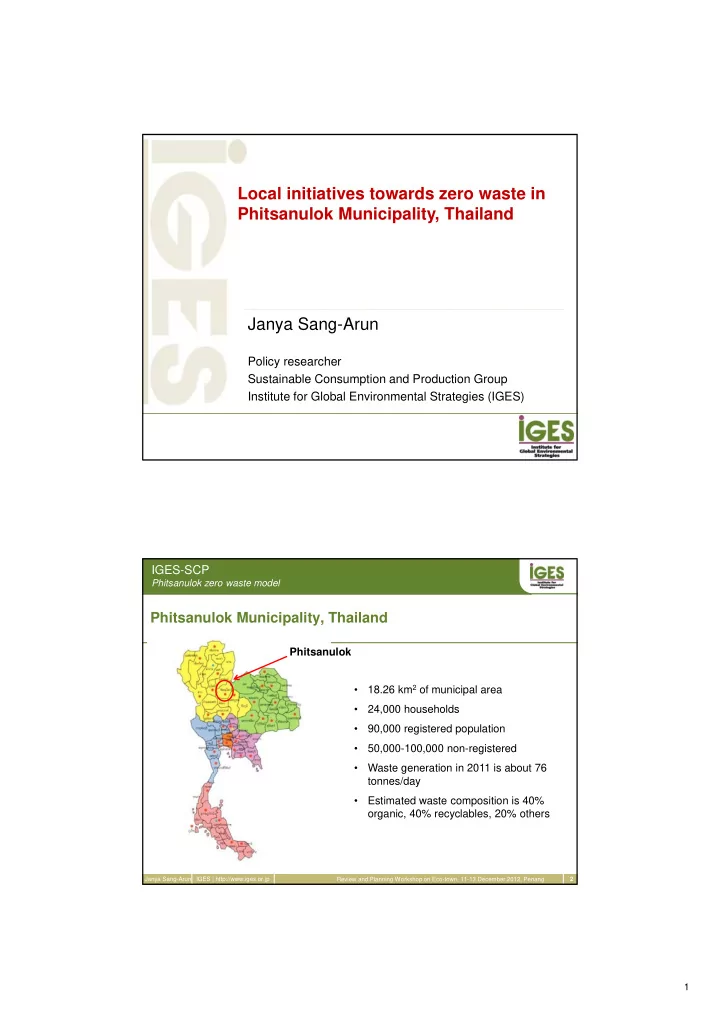
Phitsanulok Municipality, Thailand

2

Phitsanulok

  • 18.26 km2 of municipal area
  • 24,000 households
  • 90,000 registered population
  • 50,000-100,000 non-registered
  • Waste generation in 2011 is about 76

tonnes/day

  • Estimated waste composition is 40%
  • rganic, 40% recyclables, 20% others
slide-2
SLIDE 2

2

Janya Sang-Arun IGES | http://www.iges.or.jp Review and Planning Workshop on Eco-town, 11-13 December 2012, Penang

IGES-SCP

Phitsanulok zero waste model

Driving force of the zero waste policy in Phitsanulok Municipality

  • Rapid increase of waste generation (1.5 kg/person/day)
  • The municipality changed open dumping sites very often and each time the

distance from the town to dumping site is further

  • Increase social resistant from local community on disposal sites
  • Land price is increasing

3

Photo: Suthi Hantrakul

Janya Sang-Arun IGES | http://www.iges.or.jp Review and Planning Workshop on Eco-town, 11-13 December 2012, Penang

IGES-SCP

Phitsanulok zero waste model

Improvement of municipal solid waste management toward zero waste landfill

  • Started in 1996 with support from GIZ (Deutsche Gesellschaft für

Internationale Zusammenarbeit (GIZ) GmbH)

  • Aimed for zero waste landfill since 2007
  • Introducing the 3Rs (reduce, reuse, recycle) based on voluntary basis
  • Introducing polluter pay principle
  • Introducing community based waste management and public participation

– Avoiding use of non-biodegradable and promoting reuse – Household and community composing – Recyclable waste separation for sale

  • Applying mechanical biological treatment (MBT) prior to sanitary landfill
  • Converting plastic to oil (not fully operated yet)

4

slide-3
SLIDE 3

3

Janya Sang-Arun IGES | http://www.iges.or.jp Review and Planning Workshop on Eco-town, 11-13 December 2012, Penang

IGES-SCP

Phitsanulok zero waste model

Household waste

Sellable Materials Organic Waste Waste to be Disposal I nfected Waste Hazardous Waste

Sell by residents

Household composting

Mechanical biological treatment (MBT)

Storage Incineration by hospital Community Base Solid Waste Management CBM Disposed by Private company

Screening

Refuse Derived Fuel Daily cover

Source: Phitsanulok Municipality

Phitsanulok Model on municipal solid waste

Janya Sang-Arun IGES | http://www.iges.or.jp Review and Planning Workshop on Eco-town, 11-13 December 2012, Penang

IGES-SCP

Phitsanulok zero waste model

Examples of awareness raising campaign and training

  • n community based waste management

6

CBM training for communities Mobile awareness raising program

Promoting reducing use of plastic shopping bag Photo: Suthi Hantrakul

Mobile awareness raising program

slide-4
SLIDE 4

4

Janya Sang-Arun IGES | http://www.iges.or.jp Review and Planning Workshop on Eco-town, 11-13 December 2012, Penang

IGES-SCP

Phitsanulok zero waste model

Promoting recycling business

7

  • Involvement of waste buyers since the beginning of project

development process.

  • Active interaction with residents (e.g. door knocking program)

and other stakeholders.

  • Involvement of educational institutes (schools, university).
  • Continuous awareness raising and follow-up activities.
  • Facilitating the mechanism of waste separation for sale and

regulating the environmental and health impacts, without interfering with the business mechanism.

  • Introduction of waste bank program
  • Free market competition = many waste buyers.

Janya Sang-Arun IGES | http://www.iges.or.jp Review and Planning Workshop on Eco-town, 11-13 December 2012, Penang

IGES-SCP

Phitsanulok zero waste model

Participatory recycling business model in Phitsanulok, Thailand

8

Municipality:

Initiator, Motivator, Facilitator, Regulator and Inspector

Waste buyers and sorting facility: Wongpanit

Active recyclable waste collectors, waste buyers and waste circulators Train waste pickers and itinerant waste buyers on environment, health, waste sorting techniques, etc Motivate and encourage residents on recyclable waste separation for sale Operate waste banks Join waste market events Sell household waste Act as volunteers for environments Buy recyclables and sell sorting materials to recyclers Sharing roles Residents Waste pickers and buyers

slide-5
SLIDE 5

5

Janya Sang-Arun IGES | http://www.iges.or.jp Review and Planning Workshop on Eco-town, 11-13 December 2012, Penang

IGES-SCP

Phitsanulok zero waste model

Common flows of recyclable waste under free market conditions in Phitsanulok Municipality

9

Itinerant waste buyers Junkshops Waste sorting and dismantling facility (private) Recyclers (private) Residents Schools Waste banks Waste banks Waste pickers in town Waste pickers at dumpsite Students Waste collection crews Community Main flow Other flow

Janya Sang-Arun IGES | http://www.iges.or.jp Review and Planning Workshop on Eco-town, 11-13 December 2012, Penang

IGES-SCP

Phitsanulok zero waste model

Price of recyclable materials is fluctuated but mostly increase

Note: Domestic price of recyclable materials in Thailand (Wongpanit’s price) 1 unit = 1 kg for most of materials expect for E-waste and glass

10

229 161 81 30 26 24 24 19 17 16 16 15 14 1

  • 11
  • 50

50 100 150 200 250 0.00 1.00 2.00 3.00 4.00 5.00 6.00 7.00 8.00 9.00

Price change (%) Waste price (USD/unit) May-10 May-11 % increase

slide-6
SLIDE 6

6

Janya Sang-Arun IGES | http://www.iges.or.jp Review and Planning Workshop on Eco-town, 11-13 December 2012, Penang

IGES-SCP

Phitsanulok zero waste model

Benefits of sustainable recycling business

11

Waste pickers Municipality Waste sorting facility Itinerant waste buyers Junkshops Residents

  • Reduce waste for disposal
  • Reduce environmental impact
  • Extend lifetime of landfill
  • Reduce budget for WM
  • Get more WM fee from residents
  • Work in better conditions

(health and social status)

  • Upgrade to itinerant waste

buyers

  • Work in better conditions
  • Earn more from larger quantity

and variety of sellable waste

  • Earn from selling waste
  • Can pay waste fee to

municipality

  • Earn more from larger

quantity and variety of sellable waste

  • Earn more from larger quantity

and variety of sellable waste

  • Expand to international market

Benefits for all

Janya Sang-Arun IGES | http://www.iges.or.jp Review and Planning Workshop on Eco-town, 11-13 December 2012, Penang

IGES-SCP

Phitsanulok zero waste model

Sustainable organic waste management: household and community composting

12

slide-7
SLIDE 7

7

Janya Sang-Arun IGES | http://www.iges.or.jp Review and Planning Workshop on Eco-town, 11-13 December 2012, Penang

IGES-SCP

Phitsanulok zero waste model

Changes in MSW to landfill site after introducing the 3Rs in Phitsanulok, Thailand

142 139 127 82 84 78 80 82 84 84 89 82 76 2.1 10.6 42.3 40.8 45.1 43.7 42.3 40.8 40.8 37.3 42.3 46.5 5 10 15 20 25 30 35 40 45 50 20 40 60 80 100 120 140 160

1997 1998 1999 2000 2001 2002 2003 2004 2005 2006 2007 2008 2009 % of reduction compared to 1997 Waste for collection service (tonnes/day)

Saving 210,000 USD/yr

Janya Sang-Arun IGES | http://www.iges.or.jp Review and Planning Workshop on Eco-town, 11-13 December 2012, Penang

IGES-SCP

Phitsanulok zero waste model

The business sector

  • Increase recyclable materials available for the production side
  • Quantity of recyclables increased
  • Increase business opportunity
  • Numbers of junkshops increased (4 9 shops)
  • Numbers of tricycle waste buyers increased
  • Numbers of waste pickers decreased (240  70)

14

Change in socio-economic conditions

The residents

  • Earn from selling recyclable wastes

 (3.3-13.3USD/month)

  • Possible to pay for waste management fee

(1USD/month)

slide-8
SLIDE 8

8

Janya Sang-Arun IGES | http://www.iges.or.jp Review and Planning Workshop on Eco-town, 11-13 December 2012, Penang

IGES-SCP

Phitsanulok zero waste model

Mechanical - Biological Waste Treatment prior to sanitary landfill

Area: 35.2 hectares

Homogenizing and forming the pile Passive composting for 9 months Compost like product Plastic

Janya Sang-Arun IGES | http://www.iges.or.jp Review and Planning Workshop on Eco-town, 11-13 December 2012, Penang

IGES-SCP

Phitsanulok zero waste model

Conversion of plastic to oil

16

Pyrolysis Refuse Derived Fuel :RDF

Source: Phitsanulok Municipality

slide-9
SLIDE 9

9

Janya Sang-Arun IGES | http://www.iges.or.jp Review and Planning Workshop on Eco-town, 11-13 December 2012, Penang

IGES-SCP

Phitsanulok zero waste model

Achievement of zero waste target

17

100%

Janya Sang-Arun IGES | http://www.iges.or.jp Review and Planning Workshop on Eco-town, 11-13 December 2012, Penang

IGES-SCP

Phitsanulok zero waste model

Reduction of GHG emissions (Lifecycle approach)

18

 78 t/d of waste (2010)  87% emission reduction (LCA), or  84% emission reduction on the waste sector (avoided landfill)

  • 54%

750 264 3341 69 1615 78 21438

5,000 10,000 15,000 20,000 25,000 Transportation Operation MBT Pyrolysis Conventional sanitary landfill

GHG emissions (tCO2eq/yr)

Integration Baseline

NGV

Diesel

slide-10
SLIDE 10

10

Janya Sang-Arun IGES | http://www.iges.or.jp Review and Planning Workshop on Eco-town, 11-13 December 2012, Penang

IGES-SCP

Phitsanulok zero waste model

GHG emissions from material recycling (rough estimation)

19

Recyclables Weight (t/d) GHG emissions per tonne (tCO2eq) Total emissions (tCO2eq/d) Paper

8.7

  • 2.08
  • 18.0

Plastic

5.4

0.25 1.4 Aluminium

1.4

  • 12.08
  • 17.4

Steel

5.0

  • 1.85
  • 9.3

Glass

15.5

  • 0.46
  • 7.1

Net 36

  • 50.5

Note: Suchada et al., (2003), approximate composition of collected recyclables by various participants in the municipality is 24% paper, 15% plastic, 43% glass, 4% aluminum and 14% steel.

Phitsanulok Municipality contributes to avoidance 50.5 tCO2eq/day when compare with non-recycling

If this emission is included, the Municipality can achieve zero GHG emissions (LCA).

Janya Sang-Arun IGES | http://www.iges.or.jp Review and Planning Workshop on Eco-town, 11-13 December 2012, Penang

IGES-SCP

Phitsanulok zero waste model

Conclusion

  • Phitsanulok Municipality has gradually achieved the zero waste target

through the 3Rs implementation, polluter pay principle, public participation, pre-treatment prior to landfill and pyrolysis

  • The remaining waste to landfill is approximately 5%
  • Further action is required but cost and economic incentives is a critical

issue.

20

slide-11
SLIDE 11

11

Janya Sang-Arun IGES | http://www.iges.or.jp Review and Planning Workshop on Eco-town, 11-13 December 2012, Penang

IGES-SCP

Phitsanulok zero waste model

Transfer of software technology to Battambang City, Cambodia

  • Started in July 2012 with financial supports from the Ministry of Environment of Japan under

a New Market Mechanism Program (carbon market)

  • IGES and Phitsanulok Municipality provided technical supports
  • Implementation in October 2012 with multi-stakeholders engagement: City Government,

NGOs, Waste collection company, and Market committees.

21