Nerve cell model and asymptotic expansion Yasushi ISHIKAWA - - PDF document

nerve cell model and asymptotic expansion
SMART_READER_LITE
LIVE PREVIEW

Nerve cell model and asymptotic expansion Yasushi ISHIKAWA - - PDF document

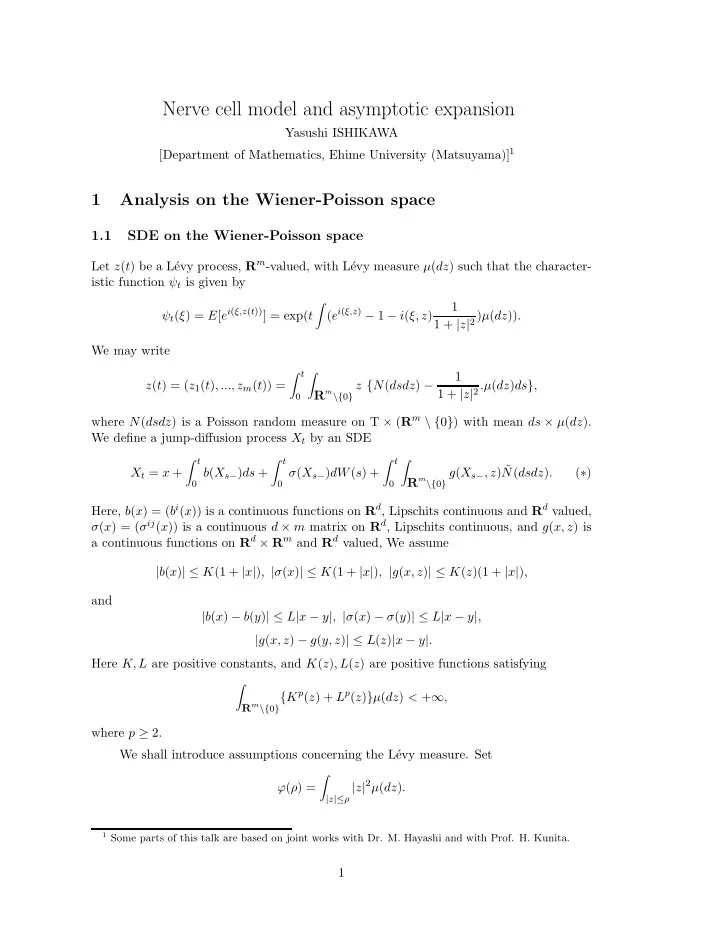
Nerve cell model and asymptotic expansion Yasushi ISHIKAWA [Department of Mathematics, Ehime University (Matsuyama)] 1 1 Analysis on the Wiener-Poisson space 1.1 SDE on the Wiener-Poisson space evy process, R m -valued, with L Let z ( t ) be


slide-1
SLIDE 1

Nerve cell model and asymptotic expansion

Yasushi ISHIKAWA [Department of Mathematics, Ehime University (Matsuyama)]1

1 Analysis on the Wiener-Poisson space

1.1 SDE on the Wiener-Poisson space

Let z(t) be a L´ evy process, Rm-valued, with L´ evy measure µ(dz) such that the character- istic function ψt is given by ψt(ξ) = E[ei(ξ,z(t))] = exp(t

  • (ei(ξ,z) − 1 − i(ξ, z)

1 1 + |z|2 )µ(dz)). We may write z(t) = (z1(t), ..., zm(t)) =

t

  • R

m\{0}

z {N(dsdz) − 1 1 + |z|2 .µ(dz)ds}, where N(dsdz) is a Poisson random measure on T × (Rm \ {0}) with mean ds × µ(dz). We define a jump-diffusion process Xt by an SDE Xt = x +

t

b(Xs−)ds +

t

σ(Xs−)dW(s) +

t

  • R

m\{0}

g(Xs−, z) ˜ N(dsdz). (∗) Here, b(x) = (bi(x)) is a continuous functions on Rd, Lipschits continuous and Rd valued, σ(x) = (σij(x)) is a continuous d × m matrix on Rd, Lipschits continuous, and g(x, z) is a continuous functions on Rd × Rm and Rd valued, We assume |b(x)| ≤ K(1 + |x|), |σ(x)| ≤ K(1 + |x|), |g(x, z)| ≤ K(z)(1 + |x|), and |b(x) − b(y)| ≤ L|x − y|, |σ(x) − σ(y)| ≤ L|x − y|, |g(x, z) − g(y, z)| ≤ L(z)|x − y|. Here K, L are positive constants, and K(z), L(z) are positive functions satisfying

  • Rm\{0}

{Kp(z) + Lp(z)}µ(dz) < +∞, where p ≥ 2. We shall introduce assumptions concerning the L´ evy measure. Set ϕ(ρ) =

  • |z|≤ρ

|z|2µ(dz).

1 Some parts of this talk are based on joint works with Dr. M. Hayashi and with Prof. H. Kunita.

1

slide-2
SLIDE 2

We say that the measure µ satisfies an order condition if there exists 0 < α < 2 such that lim inf

ρ→0

ϕ(ρ) ρα > 0. We assume µ satisfies the order condition. We make a perturbation of the trajectory F = ξs, 0 < s < t by ε+

u , which will be

introduced in Sect. 1.2. Let u = (u1, ..., uk). Then ξs,t(x) ◦ ε+

u = ξtk,t ◦ φzk ◦ ξtk−1,tk ◦ φzk−1 · · · ◦ φz1 ◦ ξs,t1

(∗∗) Example of SDE (Linear SDE) Xt is given by dXt = V0(Xt−)dt +

m

  • j=1

Vj(Xt−)dzj(t). (1.1) Here V0, V1, ..., Vm are smooth vector fields on Rd. In what follows we assume b(x) and σ(x) are g(x, z) functions having bounded deriva- tives of all orders, for simplicity.

1.2 The nondegeneracy condition

We say that F satisfies the (ND) condition if for all p ≥ 1, k ≥ 0 there exists β ∈ (α

2 , 1]

such that sup

ρ∈(0,1)

sup

v∈R d , |v|=1

sup

τ∈Ak(ρ)

E[

  • (v, Σv) + ϕ(ρ)−1
  • A(1)

|(v, ˜ DuF)|21{| ˜

DuF |≤ρβ} ˆ

N(du)

−1

  • ǫ+

τ

  • p

] < ∞, where Σ is the Malliavin’s covariance matrix Σ = (Σi,j), where Σi,j =

  • T

(DtFi, DtFj)dt. More precisely we can prove the following result. Proposition 1 Let F ∈ D∞ satisfy the (ND) condition. For any m there exist k, l, p > 2 and Cm > 0 such that |ϕ ◦ F|′

k,l,p ≤ Cm(

  • β≤m

|(1 + |F|2)β|k,l,p)ϕ−2m (1.9) for ϕ ∈ S. Here |F|k,l,p is a 3-parameters Sobolev norm on the Wiener-Poisson space, and |F|′

k,l,p

is its dual norm given above. ϕ−2m is a norm introduced on S as follows. 2

slide-3
SLIDE 3

Let S be the set of all rapidly decreasing C∞-functions and let S′ be the set of tempered distributions. For ϕ ∈ S we introduce a norm ϕ2m = (

  • |α|+|β|≤m

{|(1 − ∆)β(1 + |y|2)αϕ|2}dy)

1 2

(1.10) for m = 1, 2, .... We let S2m to be the completion of S with respect to this norm. We remark S ⊂ S2m, m = 1, 2, ... We introduce the dual norm ψ−2m of ϕ2m by ψ−2m = sup

ϕ∈S2m,ϕ2m=1

|(ϕ, ψ)|, (1.11) where (ϕ, ψ) =

ϕ(x) ¯

ψ(x)dx. We denote by S−2m the completion of S with respect to the norm ψ−2m. Further, put S∞ = ∩m≥1S2m, S−∞ = ∪m≥1S−2m By (1.9) we can extend ϕ to T ∈ S−2m. Since ∪m≥1S−2m = S′, we can define the composition T ◦ F for T ∈ S′ as an element in D′

∞.

A sufficient condition for the composition using the Fourier method is the (ND) condition stated above.

1.3 The (UND) condition

We state a sufficient condition for the asymptotic expansion so that Φ ◦ F(ǫ) can be expanded as Φ ◦ F(ǫ) ∼

  • m=0
  • |n|=m

1 n!(∂nΦ) ◦ f0 · (F(ǫ) − f0)n ∼ Φ0 + ǫΦ1 + ǫ2Φ2 + ... in D′

for Φ ∈ S′, under the assumption that F(ǫ) ∼

  • m=0

ǫjfj ∼ f0 + ǫf1 + ǫ2f2 + ... in D∞. Definition 1 We say F(ǫ) = (F 1, . . . , F d) satisfies the (UND) condition (uniformly non-degenerate) if for any p ≥ 1 and any integer k it holds that lim sup

ǫ→0

sup

ρ∈(0,1)

sup

v∈Rd |v|=1

ess sup

τ∈Ak(ρ)

E[|((v,Σ(ǫ)v) +ϕ(ρ)−1

  • A(1)

|(v, ˜ DuF(ǫ))|21{| ˜

DuF (ǫ)|≤ρβ} ˆ

N(du))−1 ◦ ǫ+

τ |p] < +∞,

where Σ(ǫ) = (Σi,j(ǫ)), Σi,j(ǫ) =

  • T DtF i(ǫ)DtF j(ǫ) dt.

Note that these are not formal expansions, but they are asymptotic expansions with respect to the norms |.|k,l,p and |.|′

k,l,p respectively.

3

slide-4
SLIDE 4

Proposition 2 (Hayashi-I [3]) Suppose F(ǫ) satisfies the (UND) condition, and that F(ǫ) ∼ ∞

j=0 ǫjfj in D∞. Then, for all Φ ∈ S′, we have Φ◦F(ǫ) ∈ D′ ∞ has an asymptotic

expansion in D′

∞ :

Φ ◦ F(ǫ) ∼

  • m=0
  • |n|=m

1 n!(∂nΦ) ◦ f0 · (F(ǫ) − f0)n ∼ Φ0 + ǫΦ1 + ǫ2Φ2 + ... in D′

∞.

Here Φ0, Φ1, Φ2 are given by the formal expansion Φ0 = Φ ◦ f0, Φ1 =

d

  • i=1

f i

1(∂xiΦ) ◦ f0,

Φ2 =

d

  • i=1

f i

2(∂xiΦ) ◦ f0 + 1

2

d

  • i,j=1

f i

1f j 1(∂2 xixjΦ) ◦ f0,

Φ3 =

d

  • i=1

f i

3(∂xiΦ) ◦ f0 + 2

2!

d

  • i,j=1

f i

1f j 2(∂2 xixjΦ) ◦ f0 + 1

3!

d

  • i,j,k=1

f i

1f j 1f k 1 (∂3 xixjxkΦ) ◦ f0

... 4

slide-5
SLIDE 5

2 Application to the asymptotic expansion

2.1 Neuron cell model : H-H (Hodgkin-Huxley) model

A H-H model is a biological model of an active nerve cell (neuron) which produces spikes (electric bursts) according to the input from other neurons. The simplified H-H model, called Fitzhugh-Nagumo model, is described in terms of (V (t), n(t)) by ∂V ∂t (t, V (t)) = −g · h(V (t) − ENa) − n4(t, V (t) − EK) + I(t), ∂n ∂t (t, V (t)) = α(V (t))(1 − n(t)) − β(V (t))n(t). (∗) Here h(.) denotes “conductance” of the natrium (sodium) ion channel, g is a coefficient, I(.) is an input current, and n(t) = n(t, v(t)) denotes the depolarization rate (permeability) of potasium ion chanel. Constants ENa, EK correspond to standstill electric potential due to natrium, potasium ions respectively, and α(.) and β(.) are some functions describing the transition rate from closed potasium channel to open potasium channel (open potasium channel to closed potasium channel), respectively. In case we study the chain of nerve cells, we have to take into consideration the effect

  • f transmission of external signals and noise throgh synapse. To this end we introduce a

jump-diffusion process z(t) to model the signal and noise. A stochastic model V (t, ǫ) in this case is described by the SDE dV (t, ǫ) = −g · h(V (t) − ENa)dt − n4(t, V (t) − EK)dt +

  • ti≤t

Ai1{ti}(t) + I(t)dt + ǫdz(t), dn(t) = α(V (t))(1 − n(t))dt − β(V (t))n(t)dt. (∗∗) Here (ti) denotes the arrival times of external spikes, ǫ > 0 is a parameter, and dz(t) denotes a stochastic integral with respect to the noise process z(t). In this model we take z(t) to be a jump-diffusion; the diffusion part corresponds to the continuous noise (i.e. white noise), and the jump part corresponds to the discontinuous

  • noise. The reason for taking such kind of noise is that the transmission of information

among nerve cells are due to chemical particles (synaptic vesicles) which may induce discontinuous random effects. We construct the following model; the pair (V (t), n(t)) is denoted by (Xǫ

t , Y ǫ t ).

t = x0 +

t

c1(Xǫ

s, Y ǫ s )ds +

  • ti≤t

Ai1{ti}(t) +

t

I(s)ds + Zǫ

t,

Y ǫ

t = y0 +

t

c2(Xǫ

s, Y ǫ s )ds.

(2.1) Here c1(x, y) = k(1 −

  • x2 + y2)x − y,

5

slide-6
SLIDE 6

c2(x, y) = k(1 −

  • x2 + y2)y + x,

with k > 0, and x2

0 + y2 0 < 1, x0, y0 not depending on ǫ.

The process Zǫ

t denotes a

  • ne-dimensional L´

evy process depending on a small parameter ǫ > 0, Ai > 0 denotes the amplitude of the shift at i-th spike, and (ti) denotes the arrival times of the exterior spikes (deterministic). In case Ai ≡ 0, I(t) ≡ 0 and ǫ = 0, this equation denotes the deterministic motion in the unit disk, described by dr dt = kr(1 − r), dφ dt = 1 in the polar coordinate. Since k > 0, starting from any point inside the disk (r = 0), the particle moves to grow up to it holds that r = 1, and stay on the circle thereafter. This corresponds to a stationary state of the axial fiber cell. On the other hand, the noise Zǫ

t corresponds to the effect due to the input from other

neurons via synapses. We take Zǫ

t to be a jump-diffusion in this model; the diffusion part

corresponds to the continuous noise (i.e. white noise), and the jump part corresponds to the discontinuous noise. The reason for taking such kind of noise is that the transmission of information among nerve cells are due to chemical particles (synaptic vesicles) which may induce discontinuous random effects. More precisely, we assume the noise process Zǫ

t satisfies the SDE

dZǫ

t = ǫ(σ(t, Zǫ t−)dW(t) + dJt) = ǫ σ(t, Zǫ t−)dW(t) + ǫ dJt,

0 = z0 = 0.

(2.2) Here W(t) is the Wiener process (standard Brownian motion) on T = [0, 1]. Jt is a compound Poisson process Jt =

N(t)

  • i=1

Yi, (2.3) where Yi are i.i.d. random variables obeying the normal law N(0, 1) represented by Yj =

  • T 1dW(t) = W(1), and N(t) is a Poisson process with intensity λ > 0. We assume (Yi),

W(t) and N(t) are mutually independent. The function σ(t, x) in (2.2) is a function which is strictly positive, infinitely times continuously diffrentiable with bounded derivatives of all orders for all variables, and is assumed to satisfy |σ(t, x)| ≤ K(1 + |x|), |σ(t, x) − σ(t, y)| ≤ L|x − y|, K > 0, L > 0 (2.5) for all x, t. By this assumption, F(ǫ) = Zǫ

t satisfies the (UND) condition.

Under these assumptions the SDE (2.2) has a unique solution. We sometimes write σ(t, x) as σt(x) in what follows. We also write σt = σ(t, z0). Let (x0(t), y0(t)) be the solution of the ODE dx0(t) = c1(x0(t), y0(t))dt, x0(0) = x0. dy0(t) = c2(x0(t), y0(t))dt, y0(0) = y0. 6

slide-7
SLIDE 7

2.1.1 Comparison under the expectation We assume Ai ≡ 0, I(t) = 0 in what follows. We then extend (2.1) to dXǫ

t = c1(Xǫ t , Y ǫ t )dt + ǫ σ(t, Xǫ t , Y ǫ t )dW(t) + ǫ dJt,

dY ǫ

t = c2(Xǫ s, Y ǫ s )dt.

(2.6) Here the function σ(t, x, y) satisfies the similar properties as (2.5). Let T = 1 and let h ∈ S. Our aim is to obtain the approximate expression of E[h(Xǫ

T )],

(2.7) where Xǫ

T = Xǫ t |t=T and (Xǫ t , Y ǫ t ) is given by (2.6).

We introduce another process d ˜ Xǫ

t = c1(x0(t), y0(t))dt + ǫσ(t, ˜

t , y0(t))dW(t) + ǫdJt, ˜

0 = x0,

d ˜ Y ǫ

t = c2(x0(t), y0(t))dt, ˜

Y ǫ

0 = y0.

(2.8) Below we shall compare (2.6) with E[h( ˜ Xǫ

T )].

(2.9) Namely E[h(Xǫ

T )] = E[h( ˜

T )] + (approximation error).

Fortunately, the second order coeffcient in the expansion of the first term in R.H.S. in (2.8) can be given explicitly by using Malliavin calculus. In the way 0 < ǫ ≤ 1 may be regarded as small, however it is not expected that ǫ → 0 ; since our aim is the comparison (not the convergence). 2.1.2 Expansion of ˜ Xǫ

t

Recall that ˜ Xǫ

t is given by the SDE

d ˜ Xǫ

t = c1(x0(t), y0(t))dt + ǫσ(t, ˜

t , y0(t))dW(t) + ǫdJt, ˜

0 = x0.

(2.10) We have a similar lemma as Lemma 3 in [?], and the mapping ǫ → ˜ Xǫ

t is n times

differentiable a.s. for ǫ ∈ (0, 1] for n = 1, 2, .... We put ˜ X(n)

t

(ǫ) = dn ˜ Xǫ

t

dǫn , n = 1, 2, ... as above. We then have that ˜ X(1)

t

(0), ˜ X(2)

t

(0) satisfy d ˜ X(1)

t

(0) = σ(t, x0(t), y0(t))dW(t) + dJt, ˜ X(1)

0 (0) = 0.

(2.11) 7

slide-8
SLIDE 8

d ˜ X(2)

t

(0) = 2∇xσ(t, x0(t), y0(t)) ˜ X(1)

t

(0)dW(t), ˜ X(2)

0 (0) = 0,

(2.12)

  • respectively. For the precise proof of the form of the SDE, see [1] Theorem 6-24.

Then we have an expansion ˜ XT (ǫ) ∼ ˜ XT (0) + ǫ ˜ X(1)

T (0) + 1

2ǫ2 ˜ X(2)

t

(0) + ... in D∞. (2.13) Let ˜ Xǫ

t denote the process given by SDE (2.10). We will make a composition h ◦ ˜

t

with h ∈ S. In this case we have to take care of ˜ Xǫ

t and ˜

Y ǫ

t simultaneously, since ˜

Y ǫ

T also

depends on ˜ Xǫ

T . We will expand it as follows :

h( ˜ Xǫ

T ) ∼ h(x0(T) + ǫ ˜

X(1)

T (0)) + 1

2ǫ2h′(x0(T) + ǫ ˜ X(1)

T (0)) ˜

X(2)

T (0) + ... in D′ ∞.

(2.14) Hence it follows E[h( ˜ Xǫ

T )] = E[h(x0 + ǫ ˜

X(1)

T (0) + 1

2ǫ2 ˜ X(2)

T (0) + ...)]

= E[h(x0(T) + ǫ ˜ X(1)

T (0))] + 1

2ǫ2E[h′(x0(T) + ǫ ˜ X(1)

T (0)) ˜

X(2)

T (0)] + ...

. (2.15) Here again, the first term in R.H.S. of (2.15) corresponds to the value of h at the first

  • rder noise with respect to the observation of ˜

XT (ǫ). In order to calculate (2.15), we use the SDE (2.12). Using this property, we can lead the asymptotic expansion for h( ˜ Xǫ

T ) as follows.

Theorem 2.1 Let T = 1. For a smooth function h, E[h( ˜ Xǫ

T )] = E[h(x0(T) + ǫ ˜

X(1)

T (0))]+

ǫ2

T

c1(x0(t), y0(t))

T

t

σ(s, x0(s), y0(s))∇xσ(s, x0(s), y0(s))dsdt ×E[h′′(x0(T) +

  • T

c1(x0(t), y0(t))dt +

  • T

σ(t, x0(t), y0(t))dW(t) + JT )] +(

  • T

σ2(t, x0(t), y0(t))

T

t

σ(s, x0(s), y0(t))∇σ(s, x0(s), y0(t))dsdt) ×E[h′′′ x0(T) +

  • T

c1(x0(t), y0(t))dt +

  • T

σ(t, x0(t), y0(t))dW(t) + JT

  • ]

+λT(

  • T

tσ(t, x0(t), y0(t))∇σ(t, x0(t), y0(t))dt)E[h′′′ x0(T) +

  • T

c1(x0(t), y0(t))dt +

  • T

σ(t, x0(t), y0(t))dW(t) + JT + Y ′ ]

  • + O(ǫ3).

(2.16) Here Y ′ is an independent copy of Y1. 8

slide-9
SLIDE 9

References

[1] K. Bichteler, J. M. Gravereaux, J. Jacod, Malliavin Calculus for Processes with

  • Jumps. New York, USA, Gordon and Breach Science Publishers, 1987.

[2] Fujiwara T, Kunita H, Stochastic differential equations for jump type and L´ evy pro- cesses in diffeomorhisms group, J Math Kyoto Univ 1985, 25, 71–106. [3] M. Hayashi and Y. Ishikawa, Composition with distributions of Wiener-Poisson vari- ables and its asymptotic expansion, Math. Nach. 285, No. 5-6, 619-658 (2012). [4] Y. Ishikawa, Stochastic calculus of variations for jump processes, Studies in Mathe- matics 54, Walter-de-Gruyter, Berlin, 2013. [5] Y. Ishikawa and H. Kunita, Malliavin calculus on the Wiener-Poisson space and its application to canonical SDE with jumps, Stochastic processes and their applications 116 (2006) 1743–1769. [6] H. Kunita, Stochastic flows acting on Schwartz distributions, J. Theor. Prabab. 7 (1994), 247–278. [7] H. Kunita, Analysis of nondegenerate Wiener-Poisson functionals and its application to Itˆ

  • ’s SDE with jumps, Sankhya 73 (2011), 1–45.

[8] D. Nualart, The Malliavin calculus and related topics, Second edition, Probability and its Applications (New York), Springer-Verlag, Berlin, 2006. [9] N. Yoshida, Conditional expansions and their applications, Stochastic processes and their applications 107 (2003) 53–81. 9