Overview of -ray related activities Recent highlights and a glimpse - - PowerPoint PPT Presentation

overview of ray related activities
SMART_READER_LITE
LIVE PREVIEW

Overview of -ray related activities Recent highlights and a glimpse - - PowerPoint PPT Presentation

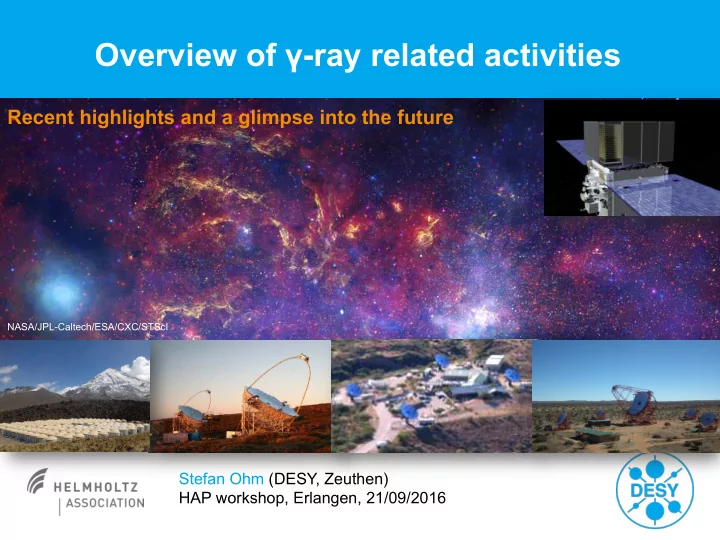
Overview of -ray related activities Recent highlights and a glimpse into the future NASA/JPL-Caltech/ESA/CXC/STScI Stefan Ohm (DESY, Zeuthen) HAP workshop, Erlangen, 21/09/2016 Major instruments for the detection of rays (2011) Fermi


slide-1
SLIDE 1

Recent highlights and a glimpse into the future

Overview of γ-ray related activities

Stefan Ohm (DESY, Zeuthen) HAP workshop, Erlangen, 21/09/2016

NASA/JPL-Caltech/ESA/CXC/STScI
slide-2
SLIDE 2

Stefan Ohm | HAP workshop, Erlangen | 21/09/16 | Page 2

Major instruments for the detection of γ rays (2011)

MAGIC HESS Fermi VERITAS

slide-3
SLIDE 3

Stefan Ohm | HAP workshop, Erlangen | 21/09/16 | Page 3

The γ-ray sky in 2011 (at the ICRC in Beijing)

Fermi-LAT > Highlights

§ Catalogues (2FGL, AGN)

  • New source classes (e.g. Novae,

Globular clusters, Starburst galaxies)

  • Large γ-ray PSR population
  • Crab flares
  • High-energy GRBs

IACTs > Highlights

§ Source populations increase (e.g. AGN, SNRs, PWNe) § Detailed source analyses including MWL information § Extragalactic background light measurements § Crab pulsation up to 400 GeV (MAGIC) § IACT cooperations increase (binaries, radio galaxies)

Crab – MAGIC M87 – all IACTs W41 – Fermi + HESS

slide-4
SLIDE 4

Stefan Ohm | HAP workshop, Erlangen | 21/09/16 | Page 4

Major instruments for the detection of γ rays (2016)

MAGIC HESS Fermi HAWC VERITAS

slide-5
SLIDE 5

Stefan Ohm | HAP workshop, Erlangen | 21/09/16 | Page 5

The γ-ray sky in 2016 (at the Gamma in Heidelberg)

Fermi-LAT > Highlights

§ More catalogues (3FGL, 3FHL, 1FIG)

  • Transient monitoring, rapid variability,

multi-messenger searches

  • Fermi triggering IACTs
  • Galactic Centre (line, excess)
  • Fornax A, LMC, high-z AGN (EBL)

IACTs > Highlights

§ More sources § Better measurements of existing sources § More multi-messenger and multi-wavelength studies § Regular IACT cooperations (+ HAWC)

HESS J0632 – all IACTs PWNpop – HESS EBL – MAGIC

slide-6
SLIDE 6

Stefan Ohm | HAP workshop, Erlangen | 21/09/16 | Page 6

Evolution of the field: Instruments and Analysis

> Instruments

§ New instruments (HAWC) § New telescopes (MAGIC-II, HESS-II) § New hardware (VERITAS PMT, and HESS-I camera upgrade) § New trigger and readout schemes

> Analysis

§ Improvements on all fronts ➝ up to factor ~2 in sensitivity § Pushing to lower and higher energies § Operation at the sensitivity limit ➝ Systematics becomes more of an issue

HESS-II HAWC VERITAS MAGIC

de Naurois & Rolland Fermi-LAT New VERITAS PMTs New HESS-I drawer

slide-7
SLIDE 7

Stefan Ohm | HAP workshop, Erlangen | 21/09/16 | Page 7

Evolution of the field: Observation strategies

Key science Deep exposures Precision measurements Initial discoveries

(first years of operation)

Surveys Population studies

MPI for Gravitational Physics / W. Benger-Zib NASA / Dana Berry / Skyworks Digital MAGIC, 2016, preliminary

Time-domain Transients Multi-messenger Multi-wavelength

slide-8
SLIDE 8

Stefan Ohm | HAP workshop, Erlangen | 21/09/16 | Page 8

Surveys: The H.E.S.S. Galactic Plane Survey

> 10-year survey > 78 VHE sources > Many objects extended > Publication in preparation > Data release to the public in the form of maps

slide-9
SLIDE 9

Stefan Ohm | HAP workshop, Erlangen | 21/09/16 | Page 9

Surveys: The northern hemisphere (Cygnus)

> HAWC perfect for surveys

§ ~95% duty cycle, ~2 sr FoV

> Cygnus region

§ close, massive star-forming region § full of potential particle accelerators § very complex region

> VERITAS Cygnus survey

§ Deep observations (>300 hrs) § Reveals PWNe and SNR § No emission from Cygnus cocoon § MWL studies underway H.E.S.S. GPS

slide-10
SLIDE 10

Stefan Ohm | HAP workshop, Erlangen | 21/09/16 | Page 10

> 1st extragalactic detection of stellar-type objects at VHE

§ Independent probe of Galactic accelerators § Extreme environment (SFR, radiation fields, CR densities)

> New TeV source class discovery: superbubble 30 DorC > VHE survey continues > Also Fermi finds stellar-type

  • bjects in LMC:

§ PSR § PWN § SNR § γ-ray binary § + diffuse emission

Surveys: Large Magellanic Cloud

New SNR Most luminous PWN 1st superbubble ever

H.E.S.S., Science 2015

slide-11
SLIDE 11

Stefan Ohm | HAP workshop, Erlangen | 21/09/16 | Page 11

> PWNe population to study

§ particle properties § PWN evolution (e.g. B-fields, NT particles) § importance of environment

> Spectra of γ-ray SNRs probe

§ ambient medium § particle acceleration, interaction and escape § underlying particle population

Population studies: PWNe and SNRs

HESS, submitted (2016)

slide-12
SLIDE 12

Stefan Ohm | HAP workshop, Erlangen | 21/09/16 | Page 12

Precision Measurements: Young SNRs

> RX J1713-3946

§ ~2000 yr old SNR § One of the most important sources at VHE § first resolved shell of a SNR in γ rays (2005)

> By now (Abdallah et al., 2016 subm.)

§ More data, much more sensitive analyses § Probing particle properties (B-fields, Emax) § TeV shell more extended than X-ray shell ➝ Prove of particles leaving the shock region!

Region 3

slide-13
SLIDE 13

Stefan Ohm | HAP workshop, Erlangen | 21/09/16 | Page 13

Precision Measurements: Middle-aged SNRs

> Origin of Galactic CRs

§ Characteristic π0-decay cutoff seen in IC 443 and W44 § Hard to detect in VHE γ rays § Prove of proton acceleration to high energies in SNRs

> W51C (Jogler & Funk 2016)

§ ~30kyr old SNR interacting with molecular cloud § Break at ~300 MeV indicative of π0-decay § Connection between Fermi and MAGIC hints at single particle population (i.e. protons) W51C

slide-14
SLIDE 14

Stefan Ohm | HAP workshop, Erlangen | 21/09/16 | Page 14

> HESS J0632+057

§ γ-ray binary (massive star + compact object) § nearby (1.1 – 1.7 kpc), eccentric (e ~ 0.8) system in 315-day orbit

> More than 10 years of IACT observations > Search for (intra-)orbit variability and study of particle acceleration and interaction in extreme environment

Long-term monitoring: γ-ray binary HESS J0632+057

Schlenstedt, Maier (VERITAS), 2016

slide-15
SLIDE 15

Stefan Ohm | HAP workshop, Erlangen | 21/09/16 | Page 15

> Ongoing efforts to search for DM in dwarf galaxies, Galactic Centre, Galaxy clusters > Different approaches

§ Stacking, Combination of data sets § New likelihood techniques

> Examples

§ Fermi-LAT + MAGIC observations of Segue 1 dwarf ➝ improve in overlap region between instruments § A decade of HESS Galactic Centre observations ➝ First time probing thermal relic cross section

Fundamental physics: Dark Matter searches

Fermi-LAT stacking + MAGIC (Ahnen et al. (JCAP, 2016) 039 HESS, (Abdallah et al., PRL, 117, 111301)

slide-16
SLIDE 16

Stefan Ohm | HAP workshop, Erlangen | 21/09/16 | Page 16

§ Access to Planck scale via large distances and/or high energies § GRBs, AGN flares or PSRs provide good test-bed § Different objects probe different phase space

> Quantum structure of space-time can produce energy dependence of speed of light:

Fundamental physics: Lorentz Invariance Violation (LIV)

  • J. Rico, (MAGIC), Gamma2016

> Global efforts

§ MAGIC, VERITAS and HESS are teaming up for global LIV search ➝ Improve sensitivity, combine different source types, reduce systematics § Agreement signed by all parties, groups established, work started

slide-17
SLIDE 17

Stefan Ohm | HAP workshop, Erlangen | 21/09/16 | Page 17

> Importance of the time domain

§ ~20% of Fermi 3FGL sources variable (+ GRBs, short transients, novae, periodic sources) § Transient sources are among the ones with the highest scientific impact

> Compact objects and physics under the most extreme conditions in the universe

§ Crab flares probe particle acceleration mechanisms § GRBs and AGN flares probe fundamental physics (e.g. LIV) § AGN flares probe emission site, probe cosmology and star-formation history

> Origin of astrophysical neutrinos (steady vs. flaring sources) > Electromagnetic counterparts to gravitational wave events (e.g. GRBs) > (Not to forget UHECRs that probe the very local universe)

The future: Time domain and multi-messenger prospects

slide-18
SLIDE 18

Stefan Ohm | HAP workshop, Erlangen | 21/09/16 | Page 18

> >90% duty cycle > ~half-sky > ~1 – 100 deg ang. res. > ~10 triggers per year

The future: Time domain and multi-messenger prospects

> >90% duty cycle > ~half-sky > ~0.1 – 10 deg ang. res. > modest sensitivity > ~15% duty cycle > ~5 deg FoV > ~0.1 deg ang. res. > excellent sensitivity

➝ Communication, event filtering and fast response are key!

slide-19
SLIDE 19

Stefan Ohm | HAP workshop, Erlangen | 21/09/16 | Page 19

Summary and Outlook

> γ-ray astronomy made a huge leap forward in the past decade > Shift from initial source discoveries to key science

§ Deep exposures, precision measurements, surveys, catalogues, population studies § Reaching the limits for current instruments in core energy range (for steady sources) § Still room for improvements at high energies (recent PeVatron discovery) § new instruments (e.g. TAIGA) operating at high energies being commissioned

> Multi-messenger and time-domain astroparticle physics era started

§ Communication is key § Next decade will see explosion of triggers (optical surveys, radio, etc.)

> Next generation CTA for ground-based γ-ray astronomy on the horizon