Patient perceptions of their health care professionals Implications - - PowerPoint PPT Presentation

patient perceptions of their health care professionals
SMART_READER_LITE
LIVE PREVIEW

Patient perceptions of their health care professionals Implications - - PowerPoint PPT Presentation

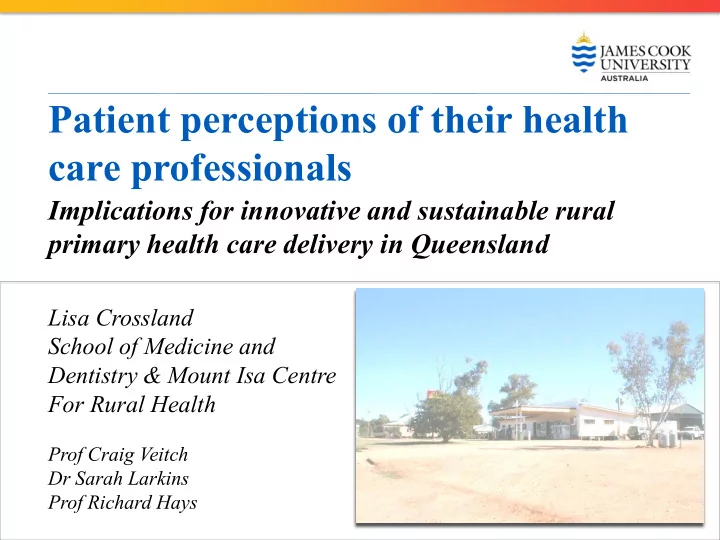
Patient perceptions of their health care professionals Implications for innovative and sustainable rural primary health care delivery in Queensland Lisa Crossland School of Medicine and Dentistry & Mount Isa Centre Place image/s within


slide-1
SLIDE 1

Patient perceptions of their health care professionals

Place image/s within black outline if you want. If you choose to include images, the black outline is for positioning purposes only. Remove outline after images are placed.

Implications for innovative and sustainable rural primary health care delivery in Queensland

Lisa Crossland School of Medicine and Dentistry & Mount Isa Centre For Rural Health

Prof Craig Veitch Dr Sarah Larkins Prof Richard Hays

slide-2
SLIDE 2

Introduction

  • 1. Background
  • 2. Aims and objectives
  • 3. Methods
  • 4. Key results – patient perceptions
  • 5. Implications
  • 6. References
slide-3
SLIDE 3

Background

International and National

  • System review and restructure
  • Workforce shortages
  • Debate on the role and function of new services1,2,3

Australia

  • Workforce shortages
  • Increasing elderly population
  • Rationalise costs and service provision
  • National Hospital and Health Reform4,5,6,7, 8,9

It is unrealistic to introduce innovation to the primary health care workforce without first understanding how the general public perceives the role of existing professionals (9)

slide-4
SLIDE 4

Aims & objectives

Investigate patient perceptions of the skills and roles of existing primary health care professionals in rural and remote service settings

(i) patient perceptions of existing health care professionals; and perceptions of the PHC professionals themselves (ii) differences and similarities between rural patients’ perceptions

  • f PHC professionals and the key factors that contribute to these

(iii) patients’ broad stereotypical views of the health care disciplines (iv) how these perceptions impact on existing and innovative approaches to rural primary health care delivery

slide-5
SLIDE 5

Method 1

Phase 1: Case studies – service and community profile information (The Context) Phase 2 : In-depth interviews with patients to investigate skills and roles (The Perceptions) Phase 3: Comparative, inductive analysis of results – unique and common to each service model (case studies) (The Findings)

slide-6
SLIDE 6

Method 2

Comparative case study approach

  • 4 discrete service types
  • RRMAs 5-7

Theoretical frameworks

  • Social interactionism
  • Organisational Change Theory (OCT)

Participants

  • 16 PHC professionals
  • 43 patients
  • All interviews completed in the PHC services
slide-7
SLIDE 7

Four service types

Model A: GP-led The “Hospital Doctor” Solo GP with hospital Practice Nurse Local paramedics Local allied health Model B : GP-led The “He’s It” Solo GP , no hospital Practice Nurse Local paramedics Visiting allied health Model C: RIPERN-led The “No different to a GP” Rural Isolated Practice Endorsed Nurse (RIPERN) No local paramedic Visiting allied health RFDS support Model D: Multipurpose The “Does Everything” GP Multipurpose Health Service Community & ward-based nurses Highly flexible Local GP practices in town

slide-8
SLIDE 8

Patient perceptions of skills 1

  • “Knows Us”

Well [the nurse], the biggest skill is she knows us all and she knows our

  • conditions. She works with bush people,

she lives here and she knows we put up with a lot before we come to the clinic.

(F, RIPERN model)

You don’t get the same treatment anywhere else, they know me here, my history…they are happy and they want you to get well. (M, Solo GP no hospital

model)

  • “Refers”
  • “Is confident &

gives confidence”

slide-9
SLIDE 9

Patient perceptions of skills 2

  • Clinical skills only

when prompted

  • No difference GP &

RIPERN

  • Differences in practice

nurses

  • Limited knowledge of

allied health professionals & paramedics

[The RIPERN] is the key… the doctors, well they just back her up… They’re not much different, they do pretty much the same things. (M, RIPERN model) The nurses, they do things on the front line – see everyone – wound dressings and blood and things – all of that. (F, solo GP no hospital) Well, I never really see the nurse… I’ve never had anything done by the nurse in the doctors surgery. (F, solo GP with hospital)

slide-10
SLIDE 10

Stereotypes of disciplines 1

  • GP-led models
  • Perceptions of medical

hierarchies persist

  • Nurses as caring

“Florence Nightingales”

  • GPs as “leaders”

I think, the nurses, you know, they’re like Florence Nightingale. They have the caps and the starched uniforms and all of that. They care about you…

(M, solo GP no hospital)

I see a GP as the leader…its his degree, his training … and his communication (solo GP,

no hospital)

slide-11
SLIDE 11

Stereotypes of disciplines 2

  • RIPERN & MPHS
  • Medical hierarchies less pronounced
  • RIPERN
  • Nurses as “leaders”
  • GPs as “supporters”
  • MPHS
  • Less clarity
  • Roles interchangeable
  • Flexible

I come up here to the clinic but it’s usually to see the GP, the GP is the one who will help with my problems, he’s the one who can write the scripts … (F, RIPERN service)

slide-12
SLIDE 12

Factors influencing perceptions

  • 1. Age and gender
  • 2. Disease status and role
  • 3. Long-term exposure to service models
  • longevity of PHC professional in community
  • organisation and delivery of health care
slide-13
SLIDE 13

Implications for existing models

  • Maintenance of solo practitioner models?
  • Equal support for both solo GP and non GP-led

models –Funding, relief, onsite opportunities for clinical training –Recruitment and retention strategies

slide-14
SLIDE 14

Implications for team-work

  • Defining the concept and practice of team-

based health care in rural settings

  • Review existing organisation and government

based reporting structures, policies and infrastructure to maintain existing and facilitate flexible team-based approaches

  • Who is and should be the co-ordinator?
slide-15
SLIDE 15

Implications for innovation

  • Community consultation and education
  • Education for existing PHC professionals
  • Taking into account current health care
  • rganisation enabling new roles to fit most

effectively into existing service models

slide-16
SLIDE 16

Table of Characteristics

COMMUNITY characteristics SERVICE characteristics IMPLICATIONS: Trial

  • f innovative approaches

Demonstrated desire to secure a resident PHC service Long standing vacancy: No present PHC service or history of high PHC professional turnover Physician Assistants Community experience of flexible PHC professional roles Use of team-based approaches to care by resident PHC professionals within an existing PHC service (eg. MPHS) Team-based approaches PHC Paramedics Experience of coordinated care within single PHC clinic setting Use of team-based approaches to care delivery with visiting health care professionals PHC Paramedics Physician Assistants Long-term experience of non-GP led models of care Care historically provided by non-GP led models (eg. RIPERN service) Physician Assistants

slide-17
SLIDE 17

Conclusion

  • 1. The normal mode of health care delivery matters
  • 2. Important to support both GP and non-GP led models
  • 3. Further research: existing team-work approaches; how to link

patient perceptions to quality care and health outcomes

  • 4. Trial of innovative workforce approaches matched to

appropriate service settings There are so many people like myself … my blood pressure, I mean I don’ t know how we’d manage with anyone else here… anything half-baked, you know? There are a lot of people in town that need constant attention – that’s work for a GP. (F, solo GP with hospital)

slide-18
SLIDE 18

References…

1. Building a Health Service fit for the Future. A National Framework for Service Change in the NHS Scotland, The Scottish Executive, National Health Service; National Parliament of Scotland, 2005. 2. Brooks, P and Ellis N (2006) Health Workforce Innovations Conference, Medical Journal of Australia, Vol 184 (3): pp 106. 3. Duckett, S (2005) Interventions to facilitate workforce restructure, Australian and New Zealand Health Policy, Vol 2 (14) Accessed online: www.anzhealthpolicy.com/info 22/06/06. 4. National Health and Hospitals Reform Commission (2009) A healthier future for all Australians: Final Report Department of Health and Ageing; Canberra, Australian Government. 5. Sinking Deeper into the Abyss: A concise overview of current and future trends in the Australian urban, rural and remote general practice workforce, Health Workforce Queensland, 2006. 6. Australian Health Workforce Productivity Commission, Australian Productivity Commission, Australian Government, 2005. 7. Veitch C, (2005) Rural health: Past, Present and Future, Inaugural Lecture, James Cook University, Townsville, Queensland, Australia. 8. National Health and Hospitals Reform Commission (2009) A healthier future for all Australians: Final Report Department of Health and Ageing; Canberra, Australian Government. 9. Black, N; Rafferty, A; et al. (2004) Health care workforce research: Identifying the agenda, Journal of Health Services Research and Policy, Vol 9, Suppl 1: S62-4.