Rydal Park: Medical Center Addition Architectural Engineering - - PowerPoint PPT Presentation

rydal park
SMART_READER_LITE
LIVE PREVIEW

Rydal Park: Medical Center Addition Architectural Engineering - - PowerPoint PPT Presentation

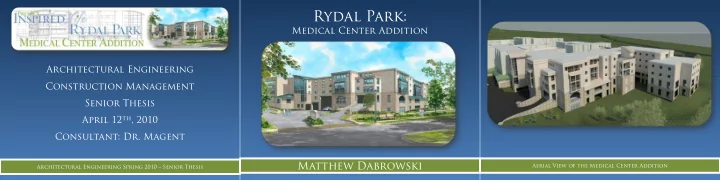
Rydal Park: Medical Center Addition Architectural Engineering Construction Management Senior Thesis April 12 th , 2010 Consultant: Dr. Magent Matthew Dabrowski Aerial View of the Medical Center Addition Architectural Engineering Spring 2010


slide-1
SLIDE 1

Rydal Park:

Medical Center Addition Architectural Engineering Construction Management Senior Thesis April 12th, 2010 Consultant: Dr. Magent

Architectural Engineering Spring 2010 – Senior Thesis

Matthew Dabrowski

Aerial View of the Medical Center Addition

slide-2
SLIDE 2

Presentation Outline

Architectural Engineering Spring 2010 – Senior Thesis

I. Introduction II. Analysis I: Integrated Project Delivery

  • III. Analysis II: Mechanical System Energy Efficiency

IV. Analysis III: Photovoltaic Array Feasibility V. Final Conclusions and Recommendations VI. Acknowledgements

  • VII. Questions

Architectural Engineering Spring 2010 – Senior Thesis Matthew Dabrowski – Construction Management

slide-3
SLIDE 3

Project Background

Presentation Outline:

I. Introduction A. Project Background II. Analysis I: Integrated Project Delivery

  • III. Analysis II: Mechanical System Efficiency

IV. Analysis III: Photovoltaic Array Analysis V. Final Conclusions and Recommendations

Figure: Location – Jenkintown, PA

Project Title: Function: Location: Project Cost: Construction duration: Building Size: Project Delivery Method: Rydal Park CCRC Medical Center Facility for the Memory Impaired Rydal Park, Jenkintown, PA $26,590,000 Nov 2009 – May 2011 142,862 SF / 5 Stories (2 Parking / 3 Living) Design-Bid-Build & Negotiated GMP

Architectural Engineering Spring 2010 – Senior Thesis Matthew Dabrowski – Construction Management

1

slide-4
SLIDE 4

Project Team

Presentation Outline:

I. Introduction B. Project Team II. Analysis I: Integrated Project Delivery

  • III. Analysis II: Mechanical System Efficiency

IV. Analysis III: Photovoltaic Array Analysis V. Final Conclusions and Recommendations

Figure: project delivery org chart

Presby’s Inspired Life Stewart & Conners Architects Whiting- Turner Greenbrier Development WK Dickson & Co. Moore Enigneering Co. Owner: Architect: Construction Manager: Developer: Structural Engineer: MEP Engineer:

Architectural Engineering Spring 2010 – Senior Thesis Matthew Dabrowski – Construction Management

2

slide-5
SLIDE 5

Overview of Analysis

Presentation Outline:

I. Introduction C. Analyses Overview II. Analysis I: Integrated Project Delivery

  • III. Analysis II: Mechanical System Efficiency

IV. Analysis III: Photovoltaic Array Analysis V. Final Conclusions and Recommendations

Figure: Various analysis Images

Analysis I: Integrated Project Delivery

  • Critical Industry Issue / MAE
  • Pinpoint elements of success to guide future projects

Analysis II: HVAC System energy Efficiency

  • Mechanical Breadth
  • Decrease energy consumption with an Alt. HVAC system

Analysis III: Photovoltaic Panel Feasibility

  • Structural Breadth / MAE
  • Determine appropriateness with a Life Cycle Cost

Architectural Engineering Spring 2010 – Senior Thesis Matthew Dabrowski – Construction Management

2

slide-6
SLIDE 6

Introduction and Background

Presentation Outline:

I. Introduction II. Analysis I: Integrated Project Delivery

  • A. Introduction and Background
  • III. Analysis II: Mechanical System Efficiency

IV. Analysis III: Photovoltaic Array Analysis V. Final Conclusions and Recommendations

Figure: s:pace logo & productivity index

PACE Fall 2009: Participant, “A successful Design-Build Project?” Owner, Architect, Contractor Project Team:

  • Disconnected, Lacking Collaboration
  • Fragmentized preconstruction period

Research Goal (critical industry issue)

  • pinpoint successful elements within the Integrated Project

Delivery model

  • Outline IPD characteristics for improving efficiency within

the Rydal Park OAC project team

  • Improve efficiency within the cm industry

PACE

Penn State Students Industry

Architectural Engineering Spring 2010 – Senior Thesis Matthew Dabrowski – Construction Management

4

slide-7
SLIDE 7

Integrated Project delivery

Presentation Outline:

I. Introduction II. Analysis I: Integrated Project Delivery

  • C. AIA IPD
  • III. Analysis II: Mechanical System Efficiency

IV. Analysis III: Photovoltaic Array Analysis V. Final Conclusions and Recommendations

Figure: Design Process

Defining Elements:

  • Early involvement of key participants
  • Shared risk / reward through Multi-party contracting
  • Collaborative decision making
  • Liability waivers / indemnification

Traditional vs. IPD

  • Reallocation of upfront efforts
  • Linear Design Process vs. Radial Inputs

Architectural Engineering Spring 2010 – Senior Thesis Matthew Dabrowski – Construction Management

5

slide-8
SLIDE 8

AIA’s Contract Language

Presentation Outline:

I. Introduction II. Analysis I: Integrated Project Delivery

  • C. AIA’s IPD: Contract Language
  • III. Analysis II: Mechanical System Efficiency

IV. Analysis III: Photovoltaic Array Analysis V. Final Conclusions and Recommendations

Figure: aia, ipd and dpr logos AIA’s 195 Family of Documents

  • No significant differences to AIA cm @ risk contract

Tom Krajewski, DPR Project Executive:

“I Call These AIA 195 Documents CM (@ risk) with a hug. The Contractor becomes the hook to keep the design within the GMP . The general conditions are supposed to bind everyone but the language still allows people to point fingers at other parties.”

Architectural Engineering Spring 2010 – Senior Thesis Matthew Dabrowski – Construction Management

6

slide-9
SLIDE 9

Case Studies

Presentation Outline:

I. Introduction II. Analysis I: Integrated Project Delivery

  • D. Case Studies
  • III. Analysis II: Mechanical System Efficiency

IV. Analysis III: Photovoltaic Array Analysis V. Final Conclusions and Recommendations

Figure: Summary of IPD Case Studies

Five Case studies Analyzed (2005-2009):

  • Autodesk inc. Solutions Headquarters
  • Sutter Health Fairfield Medical Office Building
  • St. Clare health Center
  • Encircle Health Ambulatory Care Center
  • Cardinal Glennon Children’s Hospital

Case studies were explored for:

  • Lessons learned
  • Elements of success

Architectural Engineering Spring 2010 – Senior Thesis Matthew Dabrowski – Construction Management

7

slide-10
SLIDE 10

OAC Project Team

Presentation Outline:

I. Introduction II. Analysis I: Integrated Project Delivery

  • E. Rydal Park OAC Project Team
  • III. Analysis II: Mechanical System Efficiency

IV. Analysis III: Photovoltaic Array Analysis V. Final Conclusions and Recommendations

Figure: Delivery and Contract Strageies

AE 572: Project Delivery and Contract Strategies

  • Pinpointed critical project success factors
  • Design build extremely viable option

Owner (Presby’s Inspired Life):

  • Lacking experience, looking to improve

Architect (Stewart-Conners):

  • Young Company, specializing in Lodging

Construction Manager (Whiting-Turner):

  • Experienced, well established in SE pennsylvania

Developer (Greenbrier):

  • Experience, Specializes IN CCRC’s, Located in Texas

Architectural Engineering Spring 2010 – Senior Thesis Matthew Dabrowski – Construction Management

8

slide-11
SLIDE 11

Preconstruction Timeline

Presentation Outline:

I. Introduction II. Analysis I: Integrated Project Delivery

  • F. Detailed Preconstruction Timeline
  • III. Analysis II: Mechanical System Efficiency

IV. Analysis III: Photovoltaic Array Analysis V. Final Conclusions and Recommendations

Figure: Precon Timeline Jan – July 2009

Timeline developed after a project manager Interview (chip Cinamella) and reviewing precon documents Inefficient Elements:

  • CM hired April 2008, not utilized for 7 months
  • Locations of the Architect and Developer
  • Owner placed project out to bid 9 months after cm was already

awarded contract

  • improperly utilized “Value Engineering” session begins
  • January-October 2009: Project hanging on 1.5% of total estimate

Architectural Engineering Spring 2010 – Senior Thesis Matthew Dabrowski – Construction Management

9

slide-12
SLIDE 12

IPD Strategies Outline

Presentation Outline:

I. Introduction II. Analysis I: Integrated Project Delivery

  • G. IPD Strategies Outline
  • III. Analysis II: Mechanical System Efficiency

IV. Analysis III: Photovoltaic Array Analysis V. Final Conclusions and Recommendations

Do not undermine: TRUST 12 Key Elements:

  • 8. & 9. Designer / CM Roles (Different during Design &
  • Constr. Phases): Outline professional boundaries
  • 10. Meetings: Weekly Face-to-Face collaborative discussions
  • 11. Drawings and Specifications: Manage Releases of

addenda material properly, don’t hind info from subs

  • 12. Closeout: All parties on excellent business terms by end of

project, Owner confident with IPD

12 Key elements:

  • 1. Owner Involvement: Determine Level and Adhere
  • 2. Budget Estimate: Determine if project is feasible
  • 3. Core Team: Establish early, Utilize all parties
  • 4. Contracting: Indemnification, “No-Sue” and relational
  • 5. Project Team Norms: Transparent / Cooperative Mgmt
  • 6. 100% Open Books: All parties develop GMP

, New Fee Structures required, Potential to create industry standard

  • 7. BIM Execution: Utilized new and effective technology

Architectural Engineering Spring 2010 – Senior Thesis Matthew Dabrowski – Construction Management

10

slide-13
SLIDE 13

Introduction and Research Goal

Presentation Outline:

I. Introduction II. Analysis I: Integrated Project Delivery

  • III. Analysis II: Mechanical System Efficiency
  • A. Introduction and Research Goal

IV. Analysis III: Photovoltaic Array Analysis V. Final Conclusions and Recommendations

Figure: Energy 10 Software Logo

Research Goal (Mechanical Breadth):

  • Model building with energy 10 software
  • Analyze the medical facility’s heating and cooling efficiency
  • Reduce electricity consumption
  • Indentify an alternate HVAC system for heating and cooling

Architectural Engineering Spring 2010 – Senior Thesis Matthew Dabrowski – Construction Management

11

slide-14
SLIDE 14

Research Process

Presentation Outline:

I. Introduction II. Analysis I: Integrated Project Delivery

  • III. Analysis II: Mechanical System Efficiency
  • B. Research Process

IV. Analysis III: Photovoltaic Array Analysis V. Final Conclusions and Recommendations

Figure: Results / Amana PTAC

Building modeled in Energy 10

  • Original four-pipe, air-water system best approximated by fixed

cop with heat pump

  • Several HVAC systems analyze
  • Packaged Terminal Air Conditioner Pinpointed

Amana PTAC

  • Occupancy Sensors
  • Integrate property management

software w/ energy management

  • Remote maintenance Alerts
  • Improve PTAC efficientcy by 35%

Architectural Engineering Spring 2010 – Senior Thesis Matthew Dabrowski – Construction Management

12

20 40 60 80 100 120 140 Fixed COP Air Source DX Cooling w/ Elec DX Cooling w/ Gas PTAC AA HP with ER Backup PTAC with ER BB Heat PTAC w/ ER Heat PTAC w/ Gas Bioler & HW Coil VAV w/ Gas Boiler & HW Coil

Annual Energy Usage (kBtu / ft2)

slide-15
SLIDE 15

Research Process

Presentation Outline:

I. Introduction II. Analysis I: Integrated Project Delivery

  • III. Analysis II: Mechanical System Efficiency
  • B. Research Process

IV. Analysis III: Photovoltaic Array Analysis V. Final Conclusions and Recommendations

Figure: HVAC Energy Usage Alternate Mechanical System:

  • Packaged Terminal Air Conditioner (PTAC) with

an Air-Air heat pump and ER Backup

Department of Energy report (released 2002):

listed PTAC “as one of the most promising

  • pportunities for technology as a smaller HVAC

unit”

  • Energy Savings Potential: 33%
  • Simple Payback: 2.6 Years

Original HVAC System: Four-Pipe Air/Water Fixed COP Second Scenario: PTAC with Air/Air HP

Architectural Engineering Spring 2010 – Senior Thesis Matthew Dabrowski – Construction Management

13

slide-16
SLIDE 16

Research Results

Presentation Outline:

I. Introduction II. Analysis I: Integrated Project Delivery

  • III. Analysis II: Mechanical System Efficiency
  • C. Research Results

IV. Analysis III: Photovoltaic Array Analysis V. Final Conclusions and Recommendations

Figure: energy / cost savings

Energy Reduction Results:

  • Four Scenarios Generated
  • Second scenario best outcome
  • Energy Reduced by 16.6%

Schedule Impacts

  • Remove critical activity: Ductwork (22 days per floor)
  • Reduce installation complexity
  • Eliminate equipment procurement

Savings

  • 50 year savings approximately around $3 million

Heati… Cooling Lights 5 10 15 20 25

  • Orig. HVAC System Second Scenario

Third Scenario Fourth Scenario

Heating Cooling Lights

Architectural Engineering Spring 2010 – Senior Thesis Matthew Dabrowski – Construction Management

14

slide-17
SLIDE 17

Introduction

Presentation Outline:

I. Introduction II. Analysis I: Integrated Project Delivery

  • III. Analysis II: Mechanical System Efficiency

IV. Analysis III: Photovoltaic Array Analysis

  • A. Introduction and Background

V. Final Conclusions and Recommendations

Figure: sketch-up solar model

Why this Project:

  • New LEED v3.0 standards
  • Offset rising electricity costs
  • 100% Open unobstructed roof

Research Goal (Structural Breadth):

  • Perform a photovoltaic feasibility
  • determine the appropriate system size
  • Establish Support requirements
  • Examine associated life cycle costs

Architectural Engineering Spring 2010 – Senior Thesis Matthew Dabrowski – Construction Management

15

slide-18
SLIDE 18

Targeting a building element

Presentation Outline:

I. Introduction II. Analysis I: Integrated Project Delivery

  • III. Analysis II: Mechanical System Efficiency

IV. Analysis III: Photovoltaic Array Analysis

  • C. Targeting a building element

V. Final Conclusions and Recommendations

Figure: prelim location info

Building Power:

  • Panelboards summed: 1200W (.8 PF)
  • Would require 5,700 16ft2 solar panels

Building Element:

  • Two-story parking deck
  • 156 two lamp Fluorescent Luminaires
  • 5.25% of total building load (max peak load)

Starting point:

  • Establish pertinent location information

Architectural Engineering Spring 2010 – Senior Thesis Matthew Dabrowski – Construction Management

16

City:

Philadelphia

State:

Pennsylvania

Latitude:

39.88° N

Longitude:

75.25° W

Elevation:

9 m

DC Rating:

63.0 kW

DC to AC Derate Factor:

0.77

AC Rating:

48.5 kW

Array Type:

Fixed Tilt

Array Tilt:

35.0°

Array Azimuth:

180.0°

Cost of Electricity:

0.2 ¢/kWh

Station Identification PV System Specifications Philadelphia Utility Costs

Solar Radiation AC Energy Energy Value (kWh/m2/day) (kWh) ($)

January 3.30 5197 8.16 February 4.16 5805 9.29 March 4.74 6998 11.20 April 5.06 7014 11.22 May 5.20 7176 11.48 June 5.43 7032 11.25 July 5.51 7279 11.65 August 5.67 7548 12.08 September 5.07 6690 10.70 October 4.59 6538 10.46 November 3.37 4804 7.69 December 2.67 4085 6.39 Year 4.57 76166 121.57

AC Energy Generated Month
slide-19
SLIDE 19

Summer Solstice Morning

Sizing the System

Presentation Outline:

I. Introduction II. Analysis I: Integrated Project Delivery

  • III. Analysis II: Mechanical System Efficiency

IV. Analysis III: Photovoltaic Array Analysis

  • C. Sizing the System

V. Final Conclusions and Recommendations

Figure: Layout Configuration

Kyocera Solar Five Step Process involves:

  • Determine sun hours (4.5)
  • Calculate energy load of parking decks(138 kWh)
  • Number of modules required (300)

Final System Size:

  • 300 Module system in Philadelphia: 63kW

Determining Shading Layout:

  • Six 50 module arrays
  • Parapet wall, stairwells, other support structures

Summer Solstice Afternoon Winter Solstice Morning Winter Solstice Afternoon

Architectural Engineering Spring 2010 – Senior Thesis Matthew Dabrowski – Construction Management

17

slide-20
SLIDE 20

Supporting the PV Modules

Presentation Outline:

I. Introduction II. Analysis I: Integrated Project Delivery

  • III. Analysis II: Mechanical System Efficiency

IV. Analysis III: Photovoltaic Array Analysis

  • D. Supporting the PV Modules

V. Final Conclusions and Recommendations

Figure: Support Structure / Load Comb.

UNIRAC: various mounting solutions

  • large array mounting system Selected
  • Adjustable tilt angle
  • Supported by aluminum wide flange

Information Received after Contacting:

  • Custom Quotation providing cost per watt
  • Engineering report determined max load (PSF)

Side Elevation (Above) Front Elevation (Right)

Architectural Engineering Spring 2010 – Senior Thesis Matthew Dabrowski – Construction Management

18

slide-21
SLIDE 21

Structural Loading Check

Presentation Outline:

I. Introduction II. Analysis I: Integrated Project Delivery

  • III. Analysis II: Mechanical System Efficiency

IV. Analysis III: Photovoltaic Array Analysis

  • E. Structural Loading Check

V. Final Conclusions and Recommendations

Figure: Layout overlaid on Structural

Determining Load Combination:

  • ASCE 7-05 Load Combination
  • Max Deflection: roof members

not supporting a plaster ceiling

Photovoltaic Array layout overlaid onto the Structural roof drawing

Architectural Engineering Spring 2010 – Senior Thesis Matthew Dabrowski – Construction Management

19

slide-22
SLIDE 22

Structural Loading Check

Presentation Outline:

I. Introduction II. Analysis I: Integrated Project Delivery

  • III. Analysis II: Mechanical System Efficiency

IV. Analysis III: Photovoltaic Array Analysis

  • E. Structural Loading Check

V. Final Conclusions and Recommendations

Figure: Targeted Structural Elements

Targeted Structural Elements:

  • Strength Checked (Direct Loading)
  • Deflection checked (solving for moment of inertia, IX)

Sample Calculation:

DeflectionMAX 5ωl4/384EI L/180 IX 5 * ω * l 4 / 384 * 29,000,000psi * DMAX

Architectural Engineering Spring 2010 – Senior Thesis Matthew Dabrowski – Construction Management

20

slide-23
SLIDE 23

Life Cycle Cost Feasibility

Presentation Outline:

I. Introduction II. Analysis I: Integrated Project Delivery

  • III. Analysis II: Mechanical System Efficiency

IV. Analysis III: Photovoltaic Array Analysis

  • H. Life Cycle Cost Feasibility

V. Final Conclusions and Recommendations

Figure: rebate & loan calculator

Two Financing scenarios analyzed:

  • 0% borrowed
  • 100% Borrowed (Embedded into GMP)

Expenses:

  • Total cost $545,000
  • Loan value of $131,00

Potential Savings:

  • Approximately $38,000 utility savings per year

Architectural Engineering Spring 2010 – Senior Thesis Matthew Dabrowski – Construction Management

Savings Project Cost

21

slide-24
SLIDE 24

Final Conclusions and Lessons learned

Presentation Outline:

I. Introduction II. Analysis I: Integrated Project Delivery

  • III. Analysis II: Mechanical System Efficiency

IV. Analysis III: Photovoltaic Array Analysis V. Final Conclusions and Recommendations

  • A. Final Conclusions and Lessons Learned

Figure: various analysis images INTEGRATED PROJECT DELIVERY

  • New delivery style needed for the next century
  • Assisted targeting the Rydal Park inefficiencies

MECHANICAL SYSTEM EFFICIENCY

  • PTAC systems potentially reduce energy by 16.6%
  • Many beneficial cost and schedule impacts

PHOTOVOLTAIC ARRAY FEASIBILITY

  • Energy equivalence for 156 Luminaires
  • Potential payback under five years

Architectural Engineering Spring 2010 – Senior Thesis Matthew Dabrowski – Construction Management

22

slide-25
SLIDE 25

Acknowledgements

Presentation Outline:

I. Introduction II. Analysis I: Integrated Project Delivery

  • III. Analysis II: Mechanical System Efficiency

IV. Analysis III: Photovoltaic Array Analysis V. Final Conclusions and Recommendations

  • B. Acknowledgements

Figure: various participant logos

Whiting-Turner:

  • Chip Cinamella
  • Jesse Beam
  • Jack DaSilva

Stewart-Conners Architects:

  • Jeff Mullen

Penn state Faculty and peers

  • Christopher Magent
  • Andrew Mackey

Presby’s Inspired Life:

  • Garry Hennis

Thank you for support from family and friends

Architectural Engineering Spring 2010 – Senior Thesis Matthew Dabrowski – Construction Management

23

slide-26
SLIDE 26

Presentation Outline:

I. Introduction II. Analysis I: Integrated Project Delivery

  • III. Analysis II: Mechanical System Efficiency

IV. Analysis III: Photovoltaic Array Analysis V. Final Conclusions and Recommendations

  • C. Questions

Figure:

Questions

Architectural Engineering Spring 2010 – Senior Thesis Matthew Dabrowski – Construction Management