Unit 1: Introduction to data Ultimate goal: make inferences about - - PowerPoint PPT Presentation

unit 1 introduction to data
SMART_READER_LITE
LIVE PREVIEW

Unit 1: Introduction to data Ultimate goal: make inferences about - - PowerPoint PPT Presentation

1. Use a sample to make inferences about the population Unit 1: Introduction to data Ultimate goal: make inferences about populations 1. Data Collection + Caveat: populations are difficult or impossible to access Observational studies


slide-1
SLIDE 1

Unit 1: Introduction to data

  • 1. Data Collection +

Observational studies & experiments

STA 104 - Summer 2017

Duke University, Department of Statistical Science

  • Prof. van den Boom

Slides posted at http://www2.stat.duke.edu/courses/Summer17/sta104.001-1/

  • 1. Use a sample to make inferences about the population

▶ Ultimate goal: make inferences about populations ▶ Caveat: populations are difficult or impossible to access ▶ Solution: use a sample from that population, and use statistics

from that sample to make inferences about the unknown population parameters

▶ The better (more representative) sample we have, the more

reliable our estimates and more accurate our inferences will be Suppose we want to know how many offspring female lemurs have,

  • n average. It’s not feasible to obtain offspring data from on all

female lemurs, so we use data from the Duke Lemur Center. We use the sample mean from these data as an estimate for the unknown population mean. Can you see any limitations to using data from the Duke Lemur Center to make inferences about all lemurs?

1

Sampling is natural ▶ When you taste a spoonful of soup and decide the spoonful

you tasted isn’t salty enough, that’s exploratory analysis

▶ If you generalize and conclude that your entire soup needs salt,

that’s an inference

▶ For your inference to be valid, the spoonful you tasted (the

sample) needs to be representative of the entire pot (the population)

2

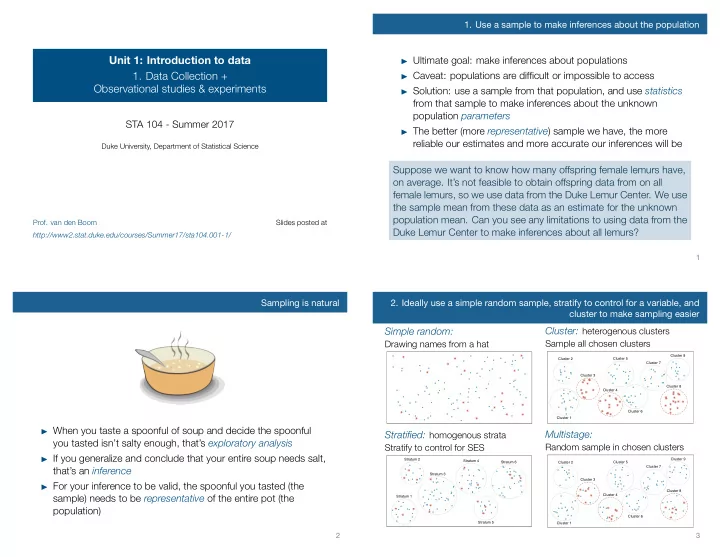
  • 2. Ideally use a simple random sample, stratify to control for a variable, and

cluster to make sampling easier

Simple random:

Drawing names from a hat

  • Stratified: homogenous strata

Stratify to control for SES

  • Stratum 1

Stratum 2 Stratum 3 Stratum 4 Stratum 5 Stratum 6

Cluster: heterogenous clusters

Sample all chosen clusters

  • Cluster 1

Cluster 2 Cluster 3 Cluster 4 Cluster 5 Cluster 6 Cluster 7 Cluster 8 Cluster 9

Multistage:

Random sample in chosen clusters

  • Cluster 1

Cluster 2 Cluster 3 Cluster 4 Cluster 5 Cluster 6 Cluster 7 Cluster 8 Cluster 9

3

slide-2
SLIDE 2

Clicker question

A city council has requested a household survey be conducted in a suburban area of their city. The area is broken into many distinct and unique neighborhoods, some including large homes, some with only apartments, and others a diverse mixture of housing structures. Which approach would likely be the least effective? (a) Simple random sampling (b) Stratified sampling, where each stratum is a neighborhood (c) Cluster sampling, where each cluster is a neighborhood

4

  • 3. Sampling schemes can suffer from a variety of biases

▶ Non-response: If only a small fraction of the randomly sampled

people choose to respond to a survey, the sample may no longer be representative of the population

▶ Voluntary response: Occurs when the sample consists of

people who volunteer to respond because they have strong

  • pinions on the issue since such a sample will also not be

representative of the population

▶ Convenience sample: Individuals who are more easily

accessible are more likely to be included in the sample

5

Clicker question

A school district is considering whether it will no longer allow high school students to park at school after two recent accidents where students were severely injured. As a first step, they survey parents by mail, asking them whether or not the parents would object to this policy change. Of 6,000 surveys that go out, 1,200 are returned. Of these 1,200 surveys that were completed, 960 agreed with the policy change and 240 disagreed. Which

  • f the following statements are true?
  • I. Some of the mailings may have never reached the parents.
  • II. Overall, the school district has strong support from parents to move

forward with the policy approval.

  • III. It is possible that majority of the parents of high school students

disagree with the policy change.

  • IV. The survey results are unlikely to be biased because all parents were

mailed a survey. (a) Only I (b) I and II (c) I and III (d) III and IV (e) Only IV

6

What type of study is this? What is the scope of inference (causality / generalizability)?

http://www.nytimes.com/2014/06/30/technology/ facebook-tinkers-with-users-emotions-in-news-feed-experiment-stirring-outcry.html

7

slide-3
SLIDE 3
  • 4. Experiments use random assignment to treatment groups, observational

studies do not A study that surveyed a random sample of otherwise healthy adults found that people are more likely to get muscle cramps when they’re stressed. The study also noted that people drink more coffee and sleep less when they’re stressed. What type of study is this? What is the conclusion of the study? Can this study be used to conclude a causal relationship between increased stress and muscle cramps?

8

  • 5. Four principles of experimental design:

randomize, control, block, replicate ▶ We would like to design an experiment to investigate if

increased stress causes muscle cramps:

– Treatment: increased stress – Control: no or baseline stress

▶ It is suspected that the effect of stress might be different on

younger and older people: block for age. Why is this important? Can you think of other variables to block for?

9

  • 6. Random sampling helps generalizability,

random assignment helps causality

Random assignment No random assignment Random sampling

Causal conclusion, generalized to the whole population. No causal conclusion, correlation statement generalized to the whole population.

Generalizability No random sampling

Causal conclusion,

  • nly for the sample.

No causal conclusion, correlation statement only for the sample.

No generalizability Causation Correlation

ideal experiment most experiments most

  • bservational

studies bad

  • bservational

studies

10

Summary of main ideas

  • 1. Use a sample to make inferences about the population
  • 2. Ideally use a simple random sample, stratify to control for a

variable, and cluster to make sampling easier

  • 3. Sampling schemes can suffer from a variety of biases
  • 4. Experiments use random assignment to treatment groups,
  • bservational studies do not
  • 5. Four principles of experimental design: randomize, control,

block, replicate

  • 6. Random sampling helps generalizability, random assignment

helps causality

11