What is Matter? The Simplest Form of Matter: Elements of the - - PDF document

what is matter
SMART_READER_LITE
LIVE PREVIEW

What is Matter? The Simplest Form of Matter: Elements of the - - PDF document

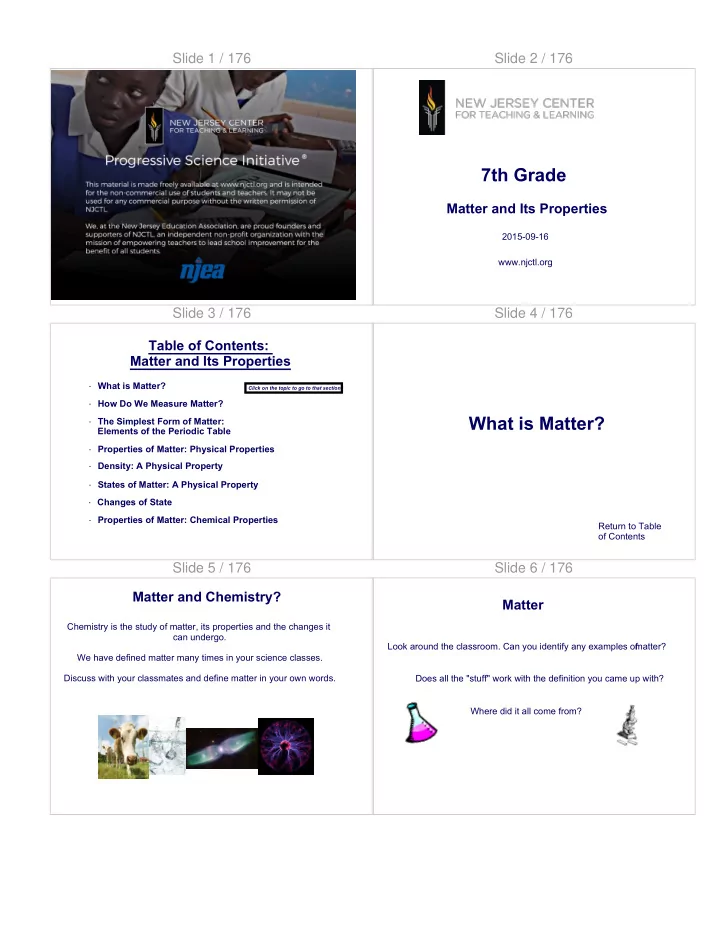
Slide 1 / 176 Slide 2 / 176 7th Grade Matter and Its Properties 2015-09-16 www.njctl.org Slide 3 / 176 Slide 4 / 176 Table of Contents: Matter and Its Properties What is Matter? Click on the topic to go to that section How Do We


slide-1
SLIDE 1

Slide 1 / 176 Slide 2 / 176

7th Grade

Matter and Its Properties

2015-09-16 www.njctl.org

Slide 3 / 176 Table of Contents: Matter and Its Properties

Click on the topic to go to that section

· What is Matter? · The Simplest Form of Matter: · Elements of the Periodic Table · States of Matter: A Physical Property · Properties of Matter: Physical Properties · Changes of State · How Do We Measure Matter? · Density: A Physical Property · Properties of Matter: Chemical Properties

Slide 4 / 176

What is Matter?

Return to Table

  • f Contents

Slide 5 / 176

Chemistry is the study of matter, its properties and the changes it can undergo. We have defined matter many times in your science classes. Discuss with your classmates and define matter in your own words.

Matter and Chemistry? Slide 6 / 176

Look around the classroom. Can you identify any examples of matter? Where did it all come from? Does all the "stuff" work with the definition you came up with?

Matter

slide-2
SLIDE 2

Slide 7 / 176 What Are Atoms?

All the matter in the universe is composed of basic building blocks called atoms. An atom is the smallest indivisible and indestructable unit of matter. If you made a tiny dot with the tip of a sharp graphite pencil, that little dot would have about four billion billion carbon atoms in it. Atoms are really small!

Slide 8 / 176 What Are Atoms?

Atoms are the basic unit of matter. How are atoms like legos? Discuss with your classmates?

Slide 9 / 176 What Are Atoms?

Atoms are the basic units of matter and indivisible. You can break the lego house into individual lego pieces, but individual legos cannot be broken down further and still be functional legos. Similiarly, matter can be broken down into atoms, but atoms cannot be further divided and maintain their properties and function.

Slide 10 / 176 Atoms and Elements

Like the lego house below is made up of different types of legos, matter is made up of different types of atoms called elements. Amazingly, all of the matter in the Universe is made up of only around 100 different elements in various combinations. Almost 99% of the human body is made up of just 6 different elements!

Slide 11 / 176 Atoms and Elements

Gold Silver Graphite (Carbon) Neon Gas

Remember, one tiny dot

  • f this contains about

4 billion billion atoms of the element carbon. Elements are pure substances made from only one type of atom.

Slide 12 / 176 Atoms and Elements

Some pure substances, called compounds, are made up of combinations of different types of elements.

Water Salt Chalk Bronze Elements: hydrogen &

  • xygen

Elements: sodium & chlorine Elements: calcium, carbon &

  • xygen

Elements: copper & tin

slide-3
SLIDE 3

Slide 13 / 176

1 Which of the following would NOT be classified as matter? A air B water C water vapor D wood E all are examples of matter

Slide 13 (Answer) / 176

1 Which of the following would NOT be classified as matter? A air B water C water vapor D wood E all are examples of matter

[This object is a pull tab]

Answer

E

Slide 14 / 176

2 All matter is made up of individual units called _______. A compounds B atoms C pure substances

Slide 14 (Answer) / 176

2 All matter is made up of individual units called _______. A compounds B atoms C pure substances

[This object is a pull tab]

Answer

B

Slide 15 / 176

3 _______ are pure substances made up of one specific type of ______. A atoms, element B atoms, compound C elements, compound D elements, atom

Slide 15 (Answer) / 176

3 _______ are pure substances made up of one specific type of ______. A atoms, element B atoms, compound C elements, compound D elements, atom

[This object is a pull tab]

Answer

D

slide-4
SLIDE 4

Slide 16 / 176

Proton - Positive Charge Neutron - Neutral Charge Electron - Negative Charge

The Makeup of Atoms

Atoms are made up of 3 parts, known as subatomic particles . Each particle has a different charge.

Memory tricks have been underlined for you!

Slide 17 / 176 How Did We Get the First Atoms?

We have talked about the Big Bang in years past as well. Take a few minutes to review what you know about the Big Bang. Write down some ideas here.

Slide 18 / 176 How Did We Get the First Atoms?

When the Big Bang first happened, the universe was very hot. (20,000,000,000,000,000,000,000,000,000* times hotter than our Sun!) *That number is 20 octillion ! After a few minutes, it cooled down to the point that protons and neutrons were able to join together.

Click here to learn more!

Slide 19 / 176 How Did We Get the First Atoms?

Soon after the Big Bang, these particles captured

  • bjects called electrons .

This is because opposite charges are attracted to each other. When this happened, the first two elements (and consequently the first atoms) were formed. Hydrogen and Helium Does anyone have an idea what the first two elements formed were? Hint: think about the periodic table. Move this box for the answer once you have your idea.

Slide 20 / 176

Because you will need this information later, keep in mind this old phrase: "Opposites Attract" What this means is that, just like a magnet, the positive proton and the negative electron attract each other!

Proton Electr

  • n

Opposites Attract Slide 21 / 176

The center of the atom is called the nucleus . Protons and neutrons are found there. Electrons move around the nucleus in the electron shell . The space between the nucleus and the electron shell is empty.

How are Atoms Arranged?

We now know that an atom is made up of protons, neutrons, and electrons... but how are these 3 particles arranged in the atom?

slide-5
SLIDE 5

Slide 22 / 176

Let's imagine an atom filled the distance from New York to Ohio. That is about 1030km. At this scale, the nucleus would only be about the length of a football

  • field. A football field is only 100m.

Relative Size of Atomic Particles

A proton would be about the height of a three story apartment building! That is about 9m. And an electron would be about the width of a blueberry. A blueberry is only 1cm. What does that tell us about this drawing of an atom?Is it accurate?

Click here to watch a TedEd video on the size of an atom.

Slide 23 / 176

+ +

  • Proton

Neutron Electron

Helium atom

+

  • Proton

Electron

Hydrogen atom

The First Two Elements

Pull the tab to the left for more information! We will go into more detail about the elements when we talk about the Periodic Table.

H

Hydrogen 1.00

1

He

Helium 4.00

2

Slide 23 (Answer) / 176

+ +

  • Proton

Neutron Electron

Helium atom

+

  • Proton

Electron

Hydrogen atom

The First Two Elements

Pull the tab to the left for more information! We will go into more detail about the elements when we talk about the Periodic Table.

H

Hydrogen 1.00

1

He

Helium 4.00

2

[This object is a pull tab]

More Info.

Hydrogen is the most common element (about 75% of the universe!) It is made up of one proton and one electron. Helium is the 2nd most common element in the universe. It exists almost exclusively as a gas. It has 2 protons and electrons.

Slide 24 / 176

4 Which subatomic particle has a neutral charge? A Proton B Neutron C Electron

Slide 24 (Answer) / 176

4 Which subatomic particle has a neutral charge? A Proton B Neutron C Electron

[This object is a pull tab]

Answer

B

Slide 25 / 176

5 Which of the following subatomic particles are found in the nucleus of an atom? A Proton B Neutron C Electron D Both A and B

slide-6
SLIDE 6

Slide 25 (Answer) / 176

5 Which of the following subatomic particles are found in the nucleus of an atom? A Proton B Neutron C Electron D Both A and B

[This object is a pull tab]

Answer

D

Slide 26 / 176

6 Label the parts of the atom. A 1. Proton

  • 2. Electron
  • 3. Neutron

B 1. Electron

  • 2. Neutron
  • 3. Proton

C 1. Neutron

  • 2. Proton
  • 3. Electron

+ + +

  • 1_

2_ 3_ D 1. Electron

  • 2. Proton
  • 3. Neutron

Slide 26 (Answer) / 176

6 Label the parts of the atom. A 1. Proton

  • 2. Electron
  • 3. Neutron

B 1. Electron

  • 2. Neutron
  • 3. Proton

C 1. Neutron

  • 2. Proton
  • 3. Electron

+ + +

  • 1_

2_ 3_ D 1. Electron

  • 2. Proton
  • 3. Neutron

[This object is a pull tab]

Answer

A

Slide 27 / 176

How Do We Measure Matter?

Return to Table

  • f Contents

Slide 28 / 176

We have previously defined the amount of matter - or the amount of "stuff" - as its mass. Mass is measured in grams (g) or kilograms (kg). (1 kg = 1,000 g*)

Mass

"kilo" = 1,000

Slide 29 / 176

Many times we use the words weight and mass interchangeably (or we use them to mean the same thing). However, this is wrong! Can you remember what the difference is between weight and mass? Talk about it with your partner.

Weight vs Mass

slide-7
SLIDE 7

Slide 30 / 176

Weight is the measure of the force of gravity on an object. Weight is measured in pounds (lbs) or Newtons (N) . On Earth, all objects are attracted to the center of Earth by the force

  • f gravity.

The force of gravity can be more or less on the Moon or on

  • ther

planets, depending on their sizes.

Weight Slide 31 / 176

On the other hand, the amount of matter (stuff) in an object does not change with the object's location. While your weight (gravitational force) may change if you travel to the moon, the mass (amount of "stuff") in your body does not change. This is because the gravity on the moon is much less than it is on Earth. Why is this? Therefore, the weight of an object changes with its location.

Weight vs Mass Slide 32 / 176

7 A person's mass on Earth would be __________ when they go to the moon. A more B less C the same

Slide 32 (Answer) / 176

7 A person's mass on Earth would be __________ when they go to the moon. A more B less C the same

[This object is a pull tab]

Answer

C

Slide 33 / 176

8 A person's weight on Earth will be ____________ compared to when they travel to the moon. A more B less C the same

Slide 33 (Answer) / 176

8 A person's weight on Earth will be ____________ compared to when they travel to the moon. A more B less C the same

[This object is a pull tab]

Answer

A

slide-8
SLIDE 8

Slide 34 / 176

9 Objects weigh less on the moon than they do on Earth because the moon has less ___________. A mass B gravity C both A & B are correct D neither A nor B are correct

Slide 34 (Answer) / 176

9 Objects weigh less on the moon than they do on Earth because the moon has less ___________. A mass B gravity C both A & B are correct D neither A nor B are correct

[This object is a pull tab]

Answer

C

Slide 35 / 176

The amount of 'space' that matter occupies is called its volume. Volume is measured in milliliters ( mL) and cubic centimeters ( cm³). 1 milliliter (mL) = 1 cubic centimeter (cm 3)

Volume Slide 36 / 176

To find the volume of a regular, box-shaped object you can measure its sides and multiply its measurements: Volume = (length) x (width) x (height) Measurements have units so you also multiply the units. Units = (cm) x (cm) x (cm) = cm³

Calculating Volume of Regular Objects

h l w

Slide 37 / 176

10 What is the volume of a solid which has a length of 8 cm, a width of 4 cm and a height of 2 cm?

Slide 37 (Answer) / 176

10 What is the volume of a solid which has a length of 8 cm, a width of 4 cm and a height of 2 cm?

[This object is a pull tab]

Answer

Volume = l x w x h V = (8 cm)(4 cm)(2 cm) V = 64 cm3

slide-9
SLIDE 9

Slide 38 / 176

11 How many cubic meters of dirt would it take to fill in a swimming pool that measured 18 meters long, 6 meters wide and 2 meters deep? A 216 m B 26 cm C 216 m3

Slide 38 (Answer) / 176

11 How many cubic meters of dirt would it take to fill in a swimming pool that measured 18 meters long, 6 meters wide and 2 meters deep? A 216 m B 26 cm C 216 m3

[This object is a pull tab]

Answer

C

Slide 39 / 176

To find the volume of an irregular object you will need a graduated cylinder.

Calculating Volume of Irregular Objects Slide 40 / 176

Volume of the diamond

  • 1. Pour water into a graduated cylinder. Record the amount of water.
  • 2. Place the object into graduated cylinder.
  • 3. Record measurement of water level after the object was submerged.
  • 4. Subtract original water level from ending water level.

To find the volume of this object: Slide 41 / 176

Example: The volume of the water was 30 mL. After dropping the diamond into the graduated cylinder, the total volume increased to 46 mL. 46 mL - 30 mL = 16 mL The volume of the diamond is 16 mL.

Volume of the diamond

Calculating Volume of Irregular Objects Slide 42 / 176

12 An irregular object is dropped into a graduated cylinder containing 30 mL of water. After the object is added, the water in the cylinder measures 55 mL. What is the volume of the irregular object? A 85 mL B 25 mL C 25 cm D 55 mL

slide-10
SLIDE 10

Slide 42 (Answer) / 176

12 An irregular object is dropped into a graduated cylinder containing 30 mL of water. After the object is added, the water in the cylinder measures 55 mL. What is the volume of the irregular object? A 85 mL B 25 mL C 25 cm D 55 mL

[This object is a pull tab]

Answer

B

Slide 43 / 176 Lab: Measuring Matter

In this lab, you will demonstrate your ability to measure the mass and volume of various objects. You will need to find the volume of both regular and irregular objects!

Slide 44 / 176

The Simplest Form

  • f Matter:

Elements of the Periodic Table

Return to Table

  • f Contents

Slide 45 / 176

The number of protons in an atom determines which element it is. In the 1800’s scientists discovered different elements have different properties because they have different numbers of protons and electrons.

The Atomic Theory

+ + + + + + + + + + + + + ++ + +

  • -

+ + + + + + +

  • +

+ 3 3 4

  • 9

9 10

+

+ Element: Lithium Element: Fluorine

Properties: pale yellow, reactive gas at room temperature Properties: silvery reactive metal,solid at room temperature

+ +

Slide 46 / 176

In the mid-1800s, a Russian chemist named Dmitri Mendeleev created his own version of the periodic table of elements by arranging the elements based on their properties, or characteristics. He noticed that in doing this, there was a noticeable pattern in the atomic mass or atomic weight of the elements.

The First Periodic Table of Elements Slide 47 / 176 Modern Periodic Table of Elements

Mendeleev's format of the periodic table was used until around 1913. At this time Henry Moseley, a British scientist, discovered the way to measure the number of protons in an element. Having this number made it easier to describe the atoms of each

  • element. Soon after, the table was rearranged using this amount, known

as an element's atomic number .

slide-11
SLIDE 11

Slide 48 / 176 The Periodic Table of Elements

The table below lists every known element in the universe. They are listed left to right based on their atomic number.

Click here for a printable Periodic Table.

Slide 49 / 176

7

Nitrogen

N

14.007

1 Atomic Number 2 Element Symbol

Element Name

3 Atomic Mass 1 Atomic Number is the number of protons in one atom of the element. 2 Element Symbol is a 1- or 2-letter symbol that represents the element. 3 Atomic mass is the average combined number of protons and neutrons.

Reading the Periodic Table Slide 50 / 176

Hydrogen Magnesium Iron Silicon Carbon Nitrogen Oxygen Chlorine Helium Neon

Most Common Elements in the Galaxy Slide 51 / 176 How is the Table Arranged?

The current table is arranged into seven horizontal rows called periods . The period number tells you the number of layers there are in the atom's electron shell.

Slide 52 / 176

Because the pattern of properties repeats in every period, the elements in each group have similar characteristics. The Group number tells you the number of electrons in the atom's

  • utermost shell. Ex: Elements in Group 17 have 7 electrons in their
  • uter shells. (For Groups 13-18, you subtract "10")

The table is also arranged in 18 vertical columns called groups that are numbered from left to right.

How is the Table Arranged? Slide 53 / 176

13 The periodic table is arranged in horizontal rows called: A Columns B Groups C Periods

slide-12
SLIDE 12

Slide 53 (Answer) / 176

13 The periodic table is arranged in horizontal rows called: A Columns B Groups C Periods

[This object is a pull tab]

Answer

C

Slide 54 / 176

14 The current periodic table is arranged from left to right according to increasing atomic mass. True False

Slide 54 (Answer) / 176

14 The current periodic table is arranged from left to right according to increasing atomic mass. True False

[This object is a pull tab]

Answer

False

Slide 55 / 176

15 The periodic table is arranged in vertical columns called: A Columns B Groups C Periods

Slide 55 (Answer) / 176

15 The periodic table is arranged in vertical columns called: A Columns B Groups C Periods

[This object is a pull tab]

Answer

B

Slide 56 / 176

16 The group number tells us the: A Atomic number B number of electron shells the atom uses C number of outer electons the atom has

slide-13
SLIDE 13

Slide 56 (Answer) / 176

16 The group number tells us the: A Atomic number B number of electron shells the atom uses C number of outer electons the atom has

[This object is a pull tab]

Answer

C

Slide 57 / 176

17 The period number tells us the: A Atomic number B number of electron shells the atom uses C number of outer electrons the atom has

Slide 57 (Answer) / 176

17 The period number tells us the: A Atomic number B number of electron shells the atom uses C number of outer electrons the atom has

[This object is a pull tab]

Answer

B

Slide 58 / 176 Activity: Build an Atom

"Build an atom out of protons, neutrons and electrons and see how the element, charge, and mass change." Click the picture above to access the web activity.

Slide 59 / 176

Properties of Matter: Physical Properties

Return to Table

  • f Contents

Slide 60 / 176

Every type of matter has two kinds of properties: physical and chemical. A physical property is a characteristic that can been observed without changing the substance into a new one. Physical properties include: hardness, texture, density, flexibility, color, the ability to dissolve, magnetism, melting point, boiling point and the substance's physical state (solid/liquid/gas).

Physical Properties

List some physical properties

  • f this brick wall.
slide-14
SLIDE 14

Slide 61 / 176

Some physical properties of substances are unique. Therefore, these properties can be used to determine mystery objects.

Using Physical Properties to Identify Substances

Imagine if someone wanted to sell you this "gold" coin. You can use the known physical properties of gold in order to test if the seller is telling you the truth. We will be looking at the physical properties of various elements in the Periodic Table.

Slide 62 / 176 Physical Properties of Elements

Elements of the same group are sometimes said to be in the same

  • family. This is because elements that are grouped together often have

similar properties. Below, the elements are grouped into their respective families.

H

1

Nonmetals Alkali Metals Alkaline Earth Metals Transition Metals Other Metals Lanthanides Actinides Metalloids Halogens Noble Gases

B Si Ge As Sb Te Po

Slide 63 / 176

Look around the room. How many objects do you see that are made of metal? What are some physical properties

  • f the metals you see? Make a list.

Metals

Remember: Physical properties include hardness, texture, flexibility, color, the ability to dissolve, magnetism and if the object is solid, liquid, or gas.

Slide 64 / 176

Metals are malleable which means they are able to be hammered or rolled into flat sheets or shapes. Some metals are attracted to magnets.

Properties of Metals Slide 65 / 176 Slide 66 / 176

The following slides will introduce the various families of the Periodic Table as well as list some general characteristics of elements that are a part of each family. Remember, elements of the same family have similar traits .

Click here for a blank printable Periodic Table of Elements.

Use the link below to print blank copies of periodic table to fill in and color as you discuss families. Be sure to include a key on your paper.

Families of the Periodic Table

slide-15
SLIDE 15

Slide 67 / 176

Alkali Metals Alkaline Earth Metals React by losing 1 electron React by losing 2 electrons Never found uncombined in nature Never found uncombined in nature Most reactive metals 2nd most reactive metals Sodium (Na) and Potassium (K) most important Alkali metals Magnesium (Mg) and Calcium (Ca) most important Alkaline Earth metals

Elements that are found in Group 1 are called Alkali Metals. Elements in Group 2 are called Alkaline Earth Metals. Not only are their names similar, but their properties are as well:

Alkali Metals vs Alkaline Earth Metals

*We will be looking more at how elements react with each other in the 2nd Unit of this school year!

Do you notice anything similar about the names of the elements in these two groups?

Slide 68 / 176

18 Does malleability mean a metal can be hammered into a flat sheet? Yes No

Slide 68 (Answer) / 176

18 Does malleability mean a metal can be hammered into a flat sheet? Yes No

[This object is a pull tab]

Answer

Yes

Slide 69 / 176

19 Alkali Metals react with other elements by gaining one electron. True False

Slide 69 (Answer) / 176

19 Alkali Metals react with other elements by gaining one electron. True False

[This object is a pull tab]

Answer

False

Slide 70 / 176 Transition Metals

Transition Metals are in Groups 3 through Group 12. Transition metals are less reactive than Groups 1 & 2. They are hard and shiny and are usually good conductors of electricity. Color and label this section.
slide-16
SLIDE 16

Slide 71 / 176 Lanthanides

Lanthanides are actually a part of Period 6, but they are typically moved to the bottom of the Periodic Table to make it easier to read. They are usually soft, malleable, shiny metals that have high conductivity. They are mixed with other metals to make alloys ; a mixture of a metal with at least one other element, usually another metal. Color and label this section.

  • r

Slide 72 / 176 Actinides

Color and label this section. Below the Lanthanides, you can find the Actinides , which are a part of Period 7. Only four elements in the Actinides occur naturally on earth. They are Actinium, Thorium, Protactinium and Uranium. All other elements, heavier than uranium, were created artificially in labs. The nucleus of each of these elements is unstable causing it to break apart.

  • r

Slide 73 / 176 "Other Metals" and Metalloids

Some of the elements in Groups 13 through 15 are metals. They are not as reactive as the metals on the left side of the table. Metalloids are elements that are similar to both metals and nonmetals. They are hard, brittle and can conduct electricity. "Other Metals" are in gray. "Metalloids" are in olive green.

Slide 74 / 176 Nonmetals

A nonmetal is an element whose properties are opposite of metals. Most nonmetals are poor conductors of heat and electricity. Solid nonmetals are brittle (break easily) and dull. Color and label this section.

Don't forget about Hydrogen (H)!

Slide 75 / 176 Halogens

The Halogen family (found in Group 17) is the most reactive nonmetal

  • group. The elements in this group are

dangerous to humans when uncombined. The physical properties of these elements vary - some elements are solids, some are liquids and some are gases at room temperature!

Bromine - a liquid Chlorine - a colorless gas Iodine - a solid

Notice that all of the halogens end in

  • ine!

Slide 76 / 176 The Noble Gases

The elements in Group 18 are known as Noble Gases . Noble gases do not gain, share or lose electrons, which means that they do not react with other elements . What do the names of all of the Noble Gases end in?

Xenon Neon Krypton

slide-17
SLIDE 17

Slide 77 / 176

20 All of the elements in Group 18 will be a ____ at room temperature. A Solid B Liquid C Gas

Slide 77 (Answer) / 176

20 All of the elements in Group 18 will be a ____ at room temperature. A Solid B Liquid C Gas

[This object is a pull tab]

Answer

C

Slide 78 / 176

21 A useful property of a metalloid is its ability to conduct electricity. True False

Slide 78 (Answer) / 176

21 A useful property of a metalloid is its ability to conduct electricity. True False

[This object is a pull tab]

Answer

True

Slide 79 / 176

22 Noble gases react very easily with other elements. True False

Slide 79 (Answer) / 176

22 Noble gases react very easily with other elements. True False

[This object is a pull tab]

Answer

False

slide-18
SLIDE 18

Slide 80 / 176

23 Where on the periodic table are the transition metals found? A Far right B Middle C Far left

Slide 80 (Answer) / 176

23 Where on the periodic table are the transition metals found? A Far right B Middle C Far left

[This object is a pull tab]

Answer

B

Slide 81 / 176

The Physical Properties mentioned on the previous slides apply to all pure substances. This includes both elements and compounds . A compound is formed when two or more different elements join together, or "bond." For example: H2O is made up of Hydrogen and Oxygen atoms.

Compounds

O H H

Slide 82 / 176

A molecule is the smallest possible part of a compound. Just like an atom is the smallest possible part of an element, a molecule is the smallest possible part of a compound.

Molecules

This box is filled with the compound "water." Each individual part of this compound is called a molecule of water.

Slide 83 / 176 Molecules

Molecules are formed when one or more atoms chemically bond together. Water is formed when 2 Hydrogen atoms and 1 Oxygen atom combine. It is important to realize that when these two elements combine to form water, their properties change. Hydrogen and Oxygen on their own are completely different than water.

H H O

2 Hydrogens

H H

1 Oxygen

O O H H Slide 84 / 176 Molecules

The structure of molecules can range from two or more of the same atoms or two or more different atoms. Ozone - O3 Salt - NaCl Glucose (Sugar) - C6H12O6

Na Cl O O O

slide-19
SLIDE 19

Slide 85 / 176 Build a Molecule: Water

We know this is a compound because it includes more than just 1 atom. This is a compound because two different elements are combining. What do the H and the O stand for in the chemical formula above?

H - _______________________ O - _______________________ H2O Slide 86 / 176

Oftentimes in a chemical formula, you will see a small number after the element symbols. This number is called the subscript. This number tells you how many atoms of each element there are in the

  • compound. The number goes along with the element before it.

If there is no number, then there is one atom of that element. How many H atoms are there? - _____ How many O atoms are there? - _____

H2O Build a Molecule: Water Slide 87 / 176

A molecule is represented by a chemical formula which shows the elements in the compound and the ratio of atoms in that specific compound. Carbon Dioxide: CO

2

# of C atoms = # of O atoms = RATIO of Carbon to Oxygen: 1 2 1:2

Ratio of Atoms Slide 88 / 176

24 What is the ratio of Carbon atoms to Hydrogen atoms in Propane (C3H8)? A 3:8 B 8:3

Slide 88 (Answer) / 176

24 What is the ratio of Carbon atoms to Hydrogen atoms in Propane (C3H8)? A 3:8 B 8:3

[This object is a pull tab]

Answer

A

Slide 89 / 176

25 What is the ratio of Nitrogen atoms to Hydrogen atoms in Ammonia (NH3)? A 3:1 B 1:3

slide-20
SLIDE 20

Slide 89 (Answer) / 176

25 What is the ratio of Nitrogen atoms to Hydrogen atoms in Ammonia (NH3)? A 3:1 B 1:3

[This object is a pull tab]

Answer

B

Slide 90 / 176

26 The ratio of carbon-hydrogen-oxygen atoms in glucose (C6H12O6) is 6:12:6. True False

Slide 90 (Answer) / 176

26 The ratio of carbon-hydrogen-oxygen atoms in glucose (C6H12O6) is 6:12:6. True False

[This object is a pull tab]

Answer

True

Slide 91 / 176 Activity: Build a Molecule

"Starting from atoms, see how many molecules you can

  • build. Collect your molecules and see them in 3D!"

Click the picture above to access the web activity.

Slide 92 / 176

Density: A Physical Property

Return to Table

  • f Contents

Slide 93 / 176 Demo: Density Column

Have you ever wondered what makes an object "sink"

  • r "float?"

Why does the red substance below float to the top of the test tube? Why does the blue substance sink?

slide-21
SLIDE 21

Slide 94 / 176

Density is a measure of how much mass is contained in a given volume. Density is a measure of how much ‘stuff’ there is in an object, and how tightly that ‘stuff’ is packed together. To calculate for density, the following formula is used: Density = Mass / Volume

  • r

D = M / V

Density Slide 95 / 176

Mass is measured in grams (g) and volume may be measured in cubic centimeters (cm

3). Therefore, one unit for density is

grams per cubic centimeters (g/cm

3).

Units for Density

There are two different units for density: We have already learned that volume can also be measured in milliliters (mL) and we know that 1 mL = 1 cm 3. Therefore, density can also be measured in grams per milliliter (g/mL) .

Slide 96 / 176

27 Which of the following is a unit for density? Choose all that apply. A Grams (g) B Grams per milliliter (g/mL) C Milliliters (mL) D Pounds (lbs) E Grams per cubic centimeter (g/cm

3)

F Cubic centimeters (cm

3)

G Kilograms (kg)

Slide 96 (Answer) / 176

27 Which of the following is a unit for density? Choose all that apply. A Grams (g) B Grams per milliliter (g/mL) C Milliliters (mL) D Pounds (lbs) E Grams per cubic centimeter (g/cm

3)

F Cubic centimeters (cm

3)

G Kilograms (kg)

[This object is a pull tab]

Answer

B and E

Slide 97 / 176

Density is a physical property of a substance. Each element and compound has a unique density. Therefore, density can be used to identify an unknown substance.

The Density of Matter

The density of this mask is 19.3 g/cm3.

Copper - 8.96 g/cm 3 Gold - 19.3 g/cm 3 Bronze - 7.7 g/cm 3 What is the mask made of?

Slide 98 / 176

The density of water is 1 g/cm3. Objects with a density that is lower than water will float . Objects with a density that is greater will sink .

Demo: Will it Float?

Predict whether each object will float or sink and answer the questions that follow this demonstration!

slide-22
SLIDE 22

Slide 99 / 176

The formula for Density is mass/volume

.

Density is expressed as grams per cubic centimeter (g/cm³ ).

Density = mass volume

D = m/v

Calculating Density Slide 100 / 176

28 What is the density of an object with a mass of 130 g and a volume of 8 mL?

Slide 100 (Answer) / 176

28 What is the density of an object with a mass of 130 g and a volume of 8 mL?

[This object is a pull tab]

Answer

D = M/V D = (130 g)/(8 mL) D = 16.25 g/mL

Slide 101 / 176

29 What is the density of a piece of wood that has a mass

  • f 25 g and a volume of 29.4 cm³?

Slide 101 (Answer) / 176

29 What is the density of a piece of wood that has a mass

  • f 25 g and a volume of 29.4 cm³?

[This object is a pull tab]

Answer

D = M/V D = (25 g)/(29.4 cm3) D = 0.85 g/cm3

Slide 102 / 176

30 A liquid has a volume of 5 mL and a mass of 20 grams. What is its density? A 4 g/ml B 80 g/mL C 4 mL

slide-23
SLIDE 23

Slide 102 (Answer) / 176

30 A liquid has a volume of 5 mL and a mass of 20 grams. What is its density? A 4 g/ml B 80 g/mL C 4 mL

[This object is a pull tab]

Answer

A D = M/V D = (20 g)/(5 mL) D = 4 g/mL

Slide 103 / 176

31 A solid with a mass of 30 grams and a volume of 10 mL has a density of 3 g/mL. True False

Slide 103 (Answer) / 176

31 A solid with a mass of 30 grams and a volume of 10 mL has a density of 3 g/mL. True False

[This object is a pull tab]

Answer

True D = M/V D = (30 g)/(10 mL) D = 3 g/mL

Slide 104 / 176

Using algebra, the density formula can be rearranged to solve for mass and volume: mass = density x volume M = DV volume = mass / density V = M/D

Variations of the Density Formula Slide 105 / 176

32 An ice cube that measures 5.8 cm x 5.8 cm x 5.8 cm has a density of 0.917 g/cm

  • 3. What is its mass?

Slide 105 (Answer) / 176

32 An ice cube that measures 5.8 cm x 5.8 cm x 5.8 cm has a density of 0.917 g/cm

  • 3. What is its mass?

[This object is a pull tab]

Answer Volume = 5.8 cm x 5.8 cm x 5.8 cm = 195.112 cm3 M = DV M = (0.917 g/cm3) x (195.112 cm3) M = 179 g

slide-24
SLIDE 24

Slide 106 / 176

33 The density of copper is about 9 g/cm³. What would the volume of a copper object be if its mass was 45g?

Slide 106 (Answer) / 176

33 The density of copper is about 9 g/cm³. What would the volume of a copper object be if its mass was 45g?

[This object is a pull tab]

Answer V = M/D V = (45 g)/(9 g/cm3) V = 5 cm3

Slide 107 / 176 Demonstrations

Density Column Demo Will it Float Demo These demonstrations will help in your understanding of density.

Slide 108 / 176 Lab: Determining Density

Now that we have learned how to calculate for density, you will use your skills to find the density of various

  • bjects and then determine whether

each would sink or float in water!

Slide 109 / 176

States of Matter: A Physical Property

Return to Table

  • f Contents

Slide 110 / 176 States of Matter

As mentioned before, we will study three different "states," or forms, of matter in this unit: Solid Liquid Gas When you identify a substance as a solid, liquid or a gas, you are identifying one of its physical properties.

slide-25
SLIDE 25

Slide 111 / 176

Which of the objects below do you think is easiest to hold in your hand? Order from easiest (1) to hardest (3). Explain your choices. The gas inside of this balloon The water of Niagara Falls A solid rock

States of Matter Slide 112 / 176

Solids have definite shape and definite volume. This means that a solid will not freely change what it looks like . Look around the classroom and identify several objects that meet this criteria. Do those objects have a definite shape and a definite volume?

Solids

The pencils to the left are solids. If left alone, they will maintain this shape and size.

Slide 113 / 176

Look around the classroom and identify ten objects that meet this criteria and write them down here. This should be an easy task.

Solids

Do those objects have a definite shape and a definite volume?

Slide 114 / 176

The particles of a solid are strongly attracted to each other . Solids will keep their shape because of this strong attraction. The particles don't move past each other , but vibrate. There are two types of solids: crystalline and amorphous . Pull

Solids Slide 115 / 176 Slide 116 / 176

The particles of amorphous solids are NOT arranged in a regular pattern. Amorphous solids do NOT have a distinct melting point (we will discuss melting point later in this unit).

Amorphous solids

slide-26
SLIDE 26

Slide 117 / 176

34 What are the characteristics of a solid? A Definite shape B Definite color C Definite volume

Slide 117 (Answer) / 176

34 What are the characteristics of a solid? A Definite shape B Definite color C Definite volume

[This object is a pull tab]

Answer

A & C

Slide 118 / 176

35 An object with a definite shape will also always have a definite volume. True False

Slide 118 (Answer) / 176

35 An object with a definite shape will also always have a definite volume. True False

[This object is a pull tab]

Answer False

Slide 119 / 176

36 In which type of solid do the particles form a regular, repeating pattern? A Crystalline B Amorphous

Slide 119 (Answer) / 176

36 In which type of solid do the particles form a regular, repeating pattern? A Crystalline B Amorphous

[This object is a pull tab]

Answer A

slide-27
SLIDE 27

Slide 120 / 176

37 Amorphous solids melt at a distinct temperature. True False

Slide 120 (Answer) / 176

37 Amorphous solids melt at a distinct temperature. True False

[This object is a pull tab]

Answer False

Slide 121 / 176

The particles of a liquid are attracted to each other, but move more freely than the particles of a solid. Because of this, they are also referred to as fluids . Unlike in a solid, the particles of a liquid are able to move past

  • ne another.

Liquids Slide 122 / 176

Because the particles move freely around, a liquid has no definite shape. A liquid has a definite volume but NOT a definite shape.

Characteristics of a Liquid

The particles that make up a liquid have more energy than the particles in a solid. This causes them to move around quicker and keeps them from maintaining a definite shape.

Slide 123 / 176

This concept can be confusing so we will look at an example: First, a student fills this bottle with water. Then, the student then takes this bottle and pours all of the water into an empty pot. In both situations, you have the same amount of water. However, because the bottle and the pot have different shapes, the shape of the water is now different .

Liquids Further Explained Slide 124 / 176

38 What are characteristics of liquids? A No definite shape B Definite color C Definite volume

slide-28
SLIDE 28

Slide 124 (Answer) / 176

38 What are characteristics of liquids? A No definite shape B Definite color C Definite volume

[This object is a pull tab]

Answer

A & C

Slide 125 / 176

39 Liquids always take the shape of their containers. True False

Slide 125 (Answer) / 176

39 Liquids always take the shape of their containers. True False

[This object is a pull tab]

Answer

True

Slide 126 / 176

40 A substance that can flow is called a ___. A Liquid B Fluid C Gas

Slide 126 (Answer) / 176

40 A substance that can flow is called a ___. A Liquid B Fluid C Gas

[This object is a pull tab]

Answer

B

Slide 127 / 176

slide-29
SLIDE 29

Slide 128 / 176

An object that has the ability to flow freely. Just like a liquid, the gas that fills the balloon is called a fluid. What is a fluid? Come up with a definition with your partner.

Gases

Move this box for the answer.

Slide 129 / 176

41 A gas is considered to be a fluid. True False

Slide 129 (Answer) / 176

41 A gas is considered to be a fluid. True False

[This object is a pull tab]

Answer

True

Slide 130 / 176

42 A gas has a definite shape and a definite volume. True False

Slide 130 (Answer) / 176

42 A gas has a definite shape and a definite volume. True False

[This object is a pull tab]

Answer

False

Slide 131 / 176

43 A gas can not change volume easily. True False

slide-30
SLIDE 30

Slide 131 (Answer) / 176

43 A gas can not change volume easily. True False

[This object is a pull tab]

Answer

False

Slide 132 / 176 Activity: States of Matter

"Watch different types of molecules form a solid, liquid, or gas. Add or remove heat and watch the phase change!" Click the picture above to access the web activity.

Slide 133 / 176

Changes of State

Return to Table

  • f Contents

Slide 134 / 176 Changing States of Matter

Matter can freely change from one state (also known as "phase") to

  • another. One of the most common ways for a phase change to occur is

by a change in temperature.

Slide 135 / 176 Energy

Previously, we learned that the difference between solids, liquids and gases is the amount of energy in the particles, or atoms, that make up the object. Energy is tough to define, but in this case, we can say that it is the speed at which the atoms move throughout the object. For example, more energy means that the particles are moving more and will be moving quicker. At right, you can see an example

  • f gas particles in motion.

Slide 136 / 176 The Energy of Matter

Drag the objects below into the correct order based on the amount

  • f energy in the substances' atoms.

Least energy Most energy 1 2 3

slide-31
SLIDE 31

Slide 137 / 176 Applying the Heat

Raising the temperature of an object will cause its particles to move more and to speed up. On the other hand, lowering the temperature will cause the particles to move less and to slow down. Click on the picture above to see this in action.

Slide 138 / 176

Every change of state requires a change in energy. This change can

  • nly occur if energy is added or taken away.

Sometimes this energy can come from a change in pressure, but in this unit, we will focus on a change in heat.

Least heat Most heat 1 2 3

Solid Liquid Gas

Change in Energy - Change in State Slide 139 / 176

Adding thermal energy to a solid increases the temperature of the

  • bject.

Increasing temperature causes the particles to move faster. When this happens, the rigid structure of the solid starts to break apart. The solid begins to change into a liquid.

Solid Liquid Slide 140 / 176

The change in state from solid to liquid is called melting . The melting point for ice is 32° Fahrenheit (0° Celsius). That is the temperature at which ice becomes water.

Melting

In most substances, melting happens at a specific temperature called the melting point . The melting point is different for all

  • bjects.

Slide 141 / 176

If thermal energy is removed, the temperature of the object decreases. Decreasing the temperature causes the particles to move slower. When this happens, the particles align in a rigid structure. The liquid now begins to change into a solid.

Liquid Solid Slide 142 / 176

The change of state from liquid to solid is called freezing. Freezing is the opposite of melting and, therefore, the freezing and melting points are the same . When you put liquid water in the freezer, the water loses energy to the cold air in the freezer. When the water temperature drops to 32° Fahrenheit (0° Celsius) the water will freeze.

Freezing

slide-32
SLIDE 32

Slide 143 / 176

44 Particles of a substance at a warmer temperature have more thermal energy than that same substance at a cooler temperature. True False

Slide 143 (Answer) / 176

44 Particles of a substance at a warmer temperature have more thermal energy than that same substance at a cooler temperature. True False

[This object is a pull tab]

Answer

True

Slide 144 / 176

45 What happens to the particles of a liquid as they lose energy? A The particles move at the same rate. B The particles move slower. C The particles move more rapidly.

Slide 144 (Answer) / 176

45 What happens to the particles of a liquid as they lose energy? A The particles move at the same rate. B The particles move slower. C The particles move more rapidly.

[This object is a pull tab]

Answer

B

Slide 145 / 176

The change of state from a liquid to a gas is called vaporization .

Liquid Gas

Vaporization occurs when the particles in a liquid gain enough thermal energy to form a gas. There are two types of vaporization: evaporation and boiling .

Slide 146 / 176

Boiling occurs when liquid that is below the surface changes to a gas as a result of heating. For example, when water boils, its particles bubble and the gas rises. The temperature at which a substance boils is called its boiling point . Every element and molecule has a unique boiling point, therefore it can help scientists identify unknown substances.

Boiling

Water boils at 100 o C (212o F).

slide-33
SLIDE 33

Slide 147 / 176

Evaporation is vaporization that takes place slowly on the surface of a liquid.

Evaporation

It is this process that causes puddles or bodies of water (as seen here) to dry up. The water gains energy from the ground, the air or the sun. The added energy allows the water molecules on the surface to evaporate.

Slide 148 / 176

The opposite of vaporization is condensation . When a gas condenses, it turns back into a liquid. Condensation occurs when particles in a gas lose enough thermal energy to form a liquid.

Gas Liquid Slide 149 / 176

46 The change of state from a liquid to a gas is called _________. A condensation B sublimation C vaporization

Slide 149 (Answer) / 176

46 The change of state from a liquid to a gas is called _________. A condensation B sublimation C vaporization

[This object is a pull tab]

Answer

C

Slide 150 / 176

47 During _____ water vaporizes only at the surface. A evaporation B boiling C condensation

Slide 150 (Answer) / 176

47 During _____ water vaporizes only at the surface. A evaporation B boiling C condensation

[This object is a pull tab]

Answer

A

slide-34
SLIDE 34

Slide 151 / 176

48 During ___, water vaporizes below the surface of a liquid. A evaporation B boiling C condensation

Slide 151 (Answer) / 176

48 During ___, water vaporizes below the surface of a liquid. A evaporation B boiling C condensation

[This object is a pull tab]

Answer

B

Slide 152 / 176

49 Chemists use boiling points to help identify unknown substances. True False

Slide 152 (Answer) / 176

49 Chemists use boiling points to help identify unknown substances. True False

[This object is a pull tab]

Answer

True

Slide 153 / 176

50 Water freezes at ______

  • C.

Slide 153 (Answer) / 176

50 Water freezes at ______

  • C.

[This object is a pull tab]

Answer

0o C

slide-35
SLIDE 35

Slide 154 / 176

51 Water boils at ______o C.

Slide 154 (Answer) / 176

51 Water boils at ______o C.

[This object is a pull tab]

Answer

100o C

Slide 155 / 176 LIQUID SOLID GAS Phase Change Review

vaporization freezing condensation melting Drag and drop the terms next to the correct arrow.

Slide 156 / 176

You can use the melting and boiling points

  • f substances to

determine whether it would be a solid, liquid, or gas at a given temperature.

Solid, Liquid or Gas?

Solid Liquid Gas

Slide 157 / 176

Let's use water as an example: The melting point (which is also the freezing point) of water is 0o C. The boiling point (or condensation point) of water is 100

  • C.

0o C 100o C

Freezing and Boiling Points Slide 158 / 176

0o C 100o C

If the water is below the freezing point (in this case, less than 0

  • C) then it would be solid ice.

Freezing and Boiling Points

slide-36
SLIDE 36

Slide 159 / 176 0o C 100o C

If the water is above the boiling point (in this case, more than 100o C) then it would be a gas.

Freezing and Boiling Points Slide 160 / 176

0o C 100o C

If the water is between the boiling point and melting point (between 0o and 100o C) then it would be liquid water. At room temperature (20o C) water will be a liquid.

Freezing and Boiling Points Slide 161 / 176

52 Which of these temperatures would fit a sample of liquid water? A 85o C B 110o C C -34o C D

0 o C

Slide 161 (Answer) / 176

52 Which of these temperatures would fit a sample of liquid water? A 85o C B 110o C C -34o C D

0 o C

[This object is a pull tab]

Answer

A

Slide 162 / 176

53 Which of these temperatures would fit a sample of water vapor? A 85o C B 110o C C -34o C D

0 o C

Slide 162 (Answer) / 176

53 Which of these temperatures would fit a sample of water vapor? A 85o C B 110o C C -34o C D

0 o C

[This object is a pull tab]

Answer

B

slide-37
SLIDE 37

Slide 163 / 176

GOLD CHLORINE Plot and Label the following: The melting point, (MP); the boiling point, (BP); and room temperature, (RT, 20°C). Identify the states of matter of the substances at room temperature. Substance Gold Chlorine 1064 2807

  • 100.98
  • 34.6

Melting Point (oC) Boiling Point (oC) State of Matter

Freezing and Boiling Points Slide 164 / 176

54 If aluminum's melting point is 660°C and its boiling point is 2519°C, identify its state of matter at room temperature. A solid B liquid C gas

Slide 164 (Answer) / 176

54 If aluminum's melting point is 660°C and its boiling point is 2519°C, identify its state of matter at room temperature. A solid B liquid C gas

[This object is a pull tab]

Answer

A

Slide 165 / 176

55 If flourine's melting point is -220°C and its boiling point is

  • 188°C, what is it at room temperature?

A solid B liquid C gas

Slide 165 (Answer) / 176

55 If flourine's melting point is -220°C and its boiling point is

  • 188°C, what is it at room temperature?

A solid B liquid C gas

[This object is a pull tab]

Answer

C

Slide 166 / 176

56 Mercury has a melting point of -39°C. Its boiling point is 357°C. What state is mercury at room temperature? A solid B liquid C gas

slide-38
SLIDE 38

Slide 166 (Answer) / 176

56 Mercury has a melting point of -39°C. Its boiling point is 357°C. What state is mercury at room temperature? A solid B liquid C gas

[This object is a pull tab]

Answer

B

Slide 167 / 176

Properties of Matter: Chemical Properties

Return to Table

  • f Contents

Slide 168 / 176 Chemical Properties

We have spent some time discussing physical properties. A chemical property is a characteristic of a pure substance that describes its ability to change into a new substance. Chemical properties can only be observed if the matter undergoes a chemical reaction resulting in chemical change. A chemical reaction between a metal and gas makes table salt.

Slide 169 / 176

Some chemical properties include flammability (or the ability to burn), the ability to rust , corrosion (or breaking down) and reactivity (or the ability to bond with other substances). Matches ignite when you strike them because of a mixture of two substances: phosphorus and potassium chlorate. These substances are highly flammable, but you would not be able to tell until you lit them on fire!

Examples of Chemical Properties Slide 170 / 176

A banana ripens and turns brown as a result of chemical reactions, therefore, ripening is a chemical change.

Examples of Chemical Properties

This one is trickier, so it's helpful to think about the properites of a banana before and after ripening. Fill in the characteristics below: Before a banana ripens: color: texture: taste: After a banana ripens: color: texture: taste:

Slide 171 / 176

Reactivity is the ease and speed with which an element is able to combine or react with another element. Elements in Groups 1 and 7 are very reactive and elements in Group 8 will hardly ever react.

Reactivity of Elements

slide-39
SLIDE 39

Slide 172 / 176 Physical vs Chemical Properties

Physical Properties Chemical Properties sodium metal chlorine gas table salt shiny, soft very reactive very stable (does not react with other substances) very reactive

Slide 173 / 176

57 Elements in group 8 are the most reactive. True False

Slide 173 (Answer) / 176

57 Elements in group 8 are the most reactive. True False

[This object is a pull tab]

Answer

False

Slide 174 / 176

58 Attraction to magnets is a physical property. True False

Slide 174 (Answer) / 176

58 Attraction to magnets is a physical property. True False

[This object is a pull tab]

Answer

True

Slide 175 / 176

59 The ability to corrode (or break down) is a physical property. True False

slide-40
SLIDE 40

Slide 175 (Answer) / 176

59 The ability to corrode (or break down) is a physical property. True False

[This object is a pull tab]

Answer

False

Slide 176 / 176

60 Which of the following is an example of a physical change, but not a chemical change? A Ice melting into liquid water B A candle burning C An exposed metal pipe rusting D An apple slice turning brown

Slide 176 (Answer) / 176

60 Which of the following is an example of a physical change, but not a chemical change? A Ice melting into liquid water B A candle burning C An exposed metal pipe rusting D An apple slice turning brown

[This object is a pull tab]

Answer

A