Urban Organic Waste Management Option for Climate Change Mitigation - - PDF document

urban organic waste management option for climate change
SMART_READER_LITE
LIVE PREVIEW

Urban Organic Waste Management Option for Climate Change Mitigation - - PDF document

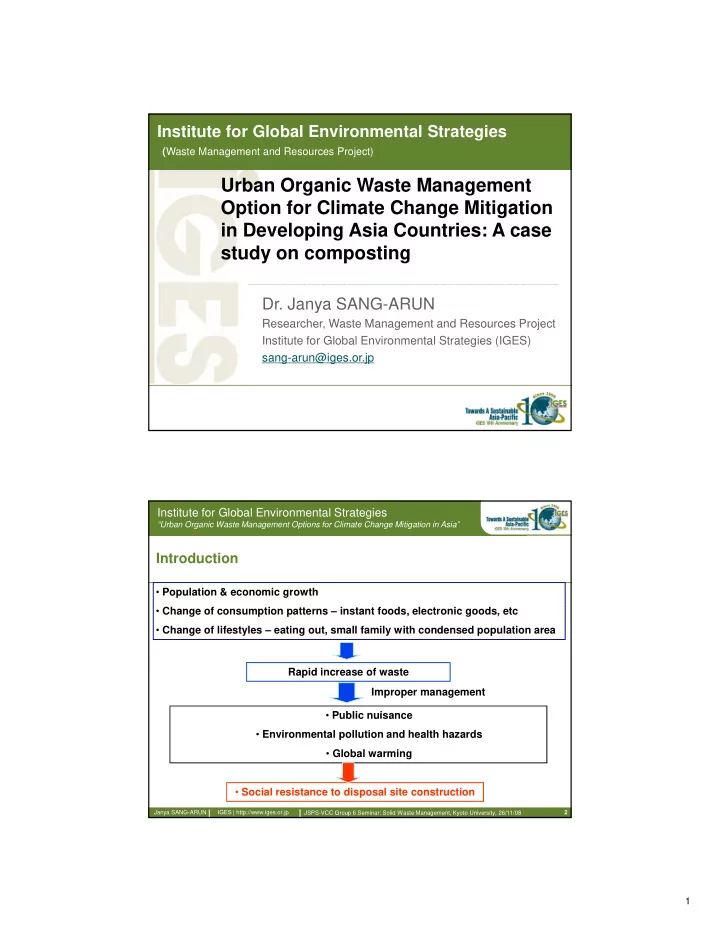
Institute for Global Environmental Strategies ( Waste Management and Resources Project) Urban Organic Waste Management Option for Climate Change Mitigation in Developing Asia Countries: A case study on composting Dr. Janya SANG-ARUN Researcher


slide-1
SLIDE 1

1

Institute for Global Environmental Strategies

Urban Organic Waste Management Option for Climate Change Mitigation

(Waste Management and Resources Project)

in Developing Asia Countries: A case study on composting

  • Dr. Janya SANG-ARUN

Researcher Waste Management and Resources Project Researcher, Waste Management and Resources Project Institute for Global Environmental Strategies (IGES) sang-arun@iges.or.jp Institute for Global Environmental Strategies

“Urban Organic Waste Management Options for Climate Change Mitigation in Asia”

Introduction

  • Population & economic growth
  • Change of consumption patterns – instant foods, electronic goods, etc
  • Change of lifestyles – eating out, small family with condensed population area

P bli i Improper management Rapid increase of waste

Janya SANG-ARUN IGES | http://www.iges.or.jp JSPS-VCC Group 6 Seminar: Solid Waste Management, Kyoto University, 26/11/08 2

  • Public nuisance
  • Environmental pollution and health hazards
  • Global warming
  • Social resistance to disposal site construction
slide-2
SLIDE 2

2

Institute for Global Environmental Strategies

“Urban Organic Waste Management Options for Climate Change Mitigation in Asia”

Objectives and methods

  • 1. Review waste management practice in developing Asia
  • 2. Investigate and estimate potential methane emission from

disposal site (landfill base) of municipal solid waste in developing Asia countries

  • 3. Observe national policy and local practice on composting
  • f urban organic waste in developing Asia

Janya SANG-ARUN IGES | http://www.iges.or.jp JSPS-VCC Group 6 Seminar: Solid Waste Management, Kyoto University, 26/11/08 3

  • 4. Identify policy needs to promote composting for climate

change mitigation

Institute for Global Environmental Strategies

“Urban Organic Waste Management Options for Climate Change Mitigation in Asia”

Results and Discussion

Janya SANG-ARUN IGES | http://www.iges.or.jp JSPS-VCC Group 6 Seminar: Solid Waste Management, Kyoto University, 26/11/08 4

slide-3
SLIDE 3

3

Institute for Global Environmental Strategies

“Urban Organic Waste Management Options for Climate Change Mitigation in Asia”

  • 1. Waste Management Practice in Developing Asia Countries
  • Open dumped and open burning are still widely practiced
  • Low collection rate of waste: some countries are even

lower than 50%

  • Approximately 30-70% of waste composition is food, but

about or less than 10% of waste is composted

  • Ongoing movement for waste management is shifting to

sanitary landfill and incineration which nowadays expected to produce energy from those technology

Janya SANG-ARUN IGES | http://www.iges.or.jp JSPS-VCC Group 6 Seminar: Solid Waste Management, Kyoto University, 26/11/08 5

to produce energy from those technology

  • However, not so many cities can construct sanitary landfill

and incineration, further the operation is improper due to lack of personnel and financial supports: China, Bangladesh, Philippines and Thailand

Institute for Global Environmental Strategies

“Urban Organic Waste Management Options for Climate Change Mitigation in Asia”

  • 2. Potential methane emission from disposal site of municipal solid

waste in developing Asia countries

4500 1500 2000 2500 3000 3500 4000 Kt/yr 1995 2000 2025

Janya SANG-ARUN IGES | http://www.iges.or.jp JSPS-VCC Group 6 Seminar: Solid Waste Management, Kyoto University, 26/11/08 6

500 1000 C h i n a I n d i a I n d

  • n

e s i a T h a i l a n d P h i l i p p i n e s M a l a y s i a B a n g l a d e s h V i e t n a m M y a n m a r C a m b

  • d

i a L a

  • P

D R

slide-4
SLIDE 4

4

Institute for Global Environmental Strategies

“Urban Organic Waste Management Options for Climate Change Mitigation in Asia”

Potential methane emission per capita in developing Asia

14

Currently, methane emission per capita in Malaysia is already approach the level projection for 2025.

4 6 8 10 12 kg/cap/yr 1995 2000 2025

the level projection for 2025. Therefore, new estimation shall be made for Malaysia.

Janya SANG-ARUN IGES | http://www.iges.or.jp JSPS-VCC Group 6 Seminar: Solid Waste Management, Kyoto University, 26/11/08 7

2 4 China India Indonesia Thailand Philippines Malaysia Bangladesh Vietnam Myanmar Cambodia Lao PDR

Institute for Global Environmental Strategies

“Urban Organic Waste Management Options for Climate Change Mitigation in Asia”

How to reduce methane emission from landfill?

1. Reduce organic waste dumped into the landfill

R d f d ti R d f d t ti – Reduce over food consumption Reduce food waste generation – Use the organic waste as a material for other products

  • Animal feed : Pig, Chicken, Duck, Fish, etc.
  • Compost for food production in urban fringe area
  • Biogas production for energy use

2. Pretreatment the organic waste before dumped into the landfill

– Mechanical-Biological Treatment (MBT)

Janya SANG-ARUN IGES | http://www.iges.or.jp JSPS-VCC Group 6 Seminar: Solid Waste Management, Kyoto University, 26/11/08 8

  • Compost-like products with high contamination of heavy metal (This product is

not suitable for agriculture, but being use as a covering material for MBT and later dispose in landfill)

  • Separation of plastic waste for energy use as a Refuse Derived Fuel
  • Around 30% of waste volume decreased, thus can extend the lifetime of landfill
slide-5
SLIDE 5

5

Institute for Global Environmental Strategies

“Urban Organic Waste Management Options for Climate Change Mitigation in Asia”

Example: Mechanical-Biological Treatment in Phitsanulok, Thailand

Janya SANG-ARUN IGES | http://www.iges.or.jp JSPS-VCC Group 6 Seminar: Solid Waste Management, Kyoto University, 26/11/08 9

Source: Suthi Hantragul, Phitsanulok Municipality

Institute for Global Environmental Strategies

“Urban Organic Waste Management Options for Climate Change Mitigation in Asia”

Example: Mechanical-Biological Treatment in Phitsanulok, Thailand

Janya SANG-ARUN IGES | http://www.iges.or.jp JSPS-VCC Group 6 Seminar: Solid Waste Management, Kyoto University, 26/11/08 10

Source: Suthi Hantragul, Phitsanulok Municipality

slide-6
SLIDE 6

6

Institute for Global Environmental Strategies

“Urban Organic Waste Management Options for Climate Change Mitigation in Asia”

Comparison between anaerobic fermentation for biogas and aerobic fermentation of composting

Issues Anaerobic fermentation for biogas production Aerobic fermentation for compost production Technology High and not yet stable Varied from low to medium and stable Management Trained personnel Residents can manage by themselves when low technology applied Cost Higher than composting Low Secondary products Organic materials for soil no

Janya SANG-ARUN IGES | http://www.iges.or.jp JSPS-VCC Group 6 Seminar: Solid Waste Management, Kyoto University, 26/11/08 11

Secondary products Organic materials for soil improvement no Environmental and management risks Higher than composting low

Institute for Global Environmental Strategies

“Urban Organic Waste Management Options for Climate Change Mitigation in Asia”

  • 3. Composting: an alternative to waste management and climate

change

  • Reduce methane emission from waste sector
  • Increase soil carbon storage
  • Potential to earn carbon credit (CDM)
  • Bridge the linkage between waste management and

urban agriculture which important for food supply

  • Possible to apply in all levels: household, school,

community and cities

Janya SANG-ARUN IGES | http://www.iges.or.jp JSPS-VCC Group 6 Seminar: Solid Waste Management, Kyoto University, 26/11/08 12

community, and cities

  • Possible to manage with low cost, but labor intensive

for some methods

  • Generate income (compost and foods) to the

household, community and the city

slide-7
SLIDE 7

7

Institute for Global Environmental Strategies

“Urban Organic Waste Management Options for Climate Change Mitigation in Asia”

Example of income generation from composting

  • Dhaka, Bangladesh

– Waste Concern produced 3.75 tons per day of compost. The compost was sold with 37-74 US$ per ton. The production by Waste Concern will increase if the new composting plant is constructed.

  • Nonthaburi Municipality, Thailand

– The municipality produce compost 0 6 ton/day the compost was

Janya SANG-ARUN IGES | http://www.iges.or.jp JSPS-VCC Group 6 Seminar: Solid Waste Management, Kyoto University, 26/11/08 13

– The municipality produce compost 0.6 ton/day, the compost was sold to farmers with the price of 42.81 – 57.09 US$ per ton. It can reduces around 1.5% of expense for waste management. Institute for Global Environmental Strategies

“Urban Organic Waste Management Options for Climate Change Mitigation in Asia”

Composting policy and lesson learnt in high GHG emission countries (1)

  • China, India, Indonesia, Thailand and Philippines

China

  • China indicates landfill as the common practice, however

composting is also promoted for organic waste management

  • Several large-scale composting plants in China are

i l t d b i t ti l d b t f th

Janya SANG-ARUN IGES | http://www.iges.or.jp JSPS-VCC Group 6 Seminar: Solid Waste Management, Kyoto University, 26/11/08 14

implemented by international donors, but many of them are not being operated due to technical problems and inferior quality of compost

  • Not so many NGOs is active in promoting composting in

China

slide-8
SLIDE 8

8

Institute for Global Environmental Strategies

“Urban Organic Waste Management Options for Climate Change Mitigation in Asia”

Composting policy and lesson learnt in high GHG emission countries (2)

India

  • Emphasize composting for biodegradable waste in its

municipal solid waste management and handling rule in 2000

  • Special funding is arranged to construct large-scale

composting plants (100-700 ton/day), which is contracted to be operated by private company

Janya SANG-ARUN IGES | http://www.iges.or.jp JSPS-VCC Group 6 Seminar: Solid Waste Management, Kyoto University, 26/11/08 15

p y p p y

  • However the success is seen in community and

household composting which initiated by NGO and local government

Institute for Global Environmental Strategies

“Urban Organic Waste Management Options for Climate Change Mitigation in Asia”

Philippines

Composting policy and lesson learnt in high GHG emission countries (3)

  • Emphasize composting in its Ecological Solid Waste

Management Act 2000

  • Most composting project is in small scale in the

community level which initiated by local government and NGOs

Janya SANG-ARUN IGES | http://www.iges.or.jp JSPS-VCC Group 6 Seminar: Solid Waste Management, Kyoto University, 26/11/08 16

slide-9
SLIDE 9

9

Institute for Global Environmental Strategies

“Urban Organic Waste Management Options for Climate Change Mitigation in Asia”

Indonesia Composting policy and lesson learnt in high GHG emission countries (4)

  • Still in drafting new national law to improve waste management
  • Community based and household composting is being promoted

by NGOs Thailand

  • Has no specific mentioning on composting in the national law

but the composting is being promoted under the national

Janya SANG-ARUN IGES | http://www.iges.or.jp JSPS-VCC Group 6 Seminar: Solid Waste Management, Kyoto University, 26/11/08 17

but t e co post g s be g p o

  • ted u de t e

at o a agenda to produce safe-food for exports

  • Composting is being promoted by several departments but the

practices are still in small scale Institute for Global Environmental Strategies

“Urban Organic Waste Management Options for Climate Change Mitigation in Asia”

Example: Composting in Bangkok, Thailand (supported by IGES- Kitakyushu Network)

Janya SANG-ARUN IGES | http://www.iges.or.jp JSPS-VCC Group 6 Seminar: Solid Waste Management, Kyoto University, 26/11/08 18

Source: Mr. Thongchai Baitragul, BMA 2008

slide-10
SLIDE 10

10

Institute for Global Environmental Strategies

“Urban Organic Waste Management Options for Climate Change Mitigation in Asia”

Registration to CDM by waste sector in Asia

  • 303 CDM projects in waste sector registered globally (as

f 24 N 2008)

  • f 24 Nov 2008)

– 84 projects registered by Asia

  • 26 projects registered by Malaysia

– 9 projects sell to Japan – 5 composting projects registered for palm oil waste management » One project sell to Japan » Four projects sell to Denmark – 1 project on composting for palm oil waste is under reviewing

Janya SANG-ARUN IGES | http://www.iges.or.jp JSPS-VCC Group 6 Seminar: Solid Waste Management, Kyoto University, 26/11/08 19

– 1 project on composting for palm oil waste is under reviewing (UK)

  • Most projects are landfill gas recovery

No registration for composting of urban organic waste by Malaysia

Institute for Global Environmental Strategies

“Urban Organic Waste Management Options for Climate Change Mitigation in Asia”

  • 1. Bangladesh: Organic waste composting in Dhaka (18/05/06)

Composting projects registered to CDM in Asia

  • 2. China: Composting of organic waste in Wuzhou (21/07/07)
  • 3. Philippines: Laguna de Bay community waste management

project: avoidance of methane production from biomass decay through composting -1 (18/03/08)

  • 4. India: Avoidance of methane emissions from municipal solid

waste through composting in Puri Municipality, Orissa

Janya SANG-ARUN IGES | http://www.iges.or.jp JSPS-VCC Group 6 Seminar: Solid Waste Management, Kyoto University, 26/11/08 20

waste through composting in Puri Municipality, Orissa (review requested)

slide-11
SLIDE 11

11

Institute for Global Environmental Strategies

“Urban Organic Waste Management Options for Climate Change Mitigation in Asia”

CDM Registered composting project

Project Scale Daily volume of Composting technique Proponent Buyer Ton of CO2 credit waste (ton) (7 yrs) Dhaka, Bangladesh Large 700 ton/day (max.) (160 ton of compost) Static pile aeration NGO The Netherlands 624,816 Wuzhou, China Large 248 ton/day (82 ton of Forced aeration Private company Germany 293,163

Janya SANG-ARUN IGES | http://www.iges.or.jp JSPS-VCC Group 6 Seminar: Solid Waste Management, Kyoto University, 26/11/08 21

China (82 ton of compost) aeration company Laguna de Bay region, Philippines Small (comprise of seven small municipalities)

  • No

indication

  • Windrow
  • Bioreactor
  • Rotating bio-

drum Government The Netherlands 42,403

Institute for Global Environmental Strategies

“Urban Organic Waste Management Options for Climate Change Mitigation in Asia”

Carbon Market

  • The price of carbon market can be checked daily

through at http://www.pointcarbon.com/

  • At the beginning of December 2008, the price of

CERs (secondary: Point Carbon) are around US$18 per ton of CO2.

Janya SANG-ARUN IGES | http://www.iges.or.jp JSPS-VCC Group 6 Seminar: Solid Waste Management, Kyoto University, 26/11/08 22

Note: 1 CER = 1 ton of CO2

slide-12
SLIDE 12

12

Institute for Global Environmental Strategies

“Urban Organic Waste Management Options for Climate Change Mitigation in Asia”

  • 4. Research findings
  • Composting is an alternative to landfill gas recovery

which possible to obtain CDM credit

  • The registration of composting project to CDM is very

few, tends to increase after the success case of Bangladesh, China and the Philippines

  • The composting in a large-scale & high technology

implementation can be failed easier than the small-

Janya SANG-ARUN IGES | http://www.iges.or.jp JSPS-VCC Group 6 Seminar: Solid Waste Management, Kyoto University, 26/11/08 23

p scale with low technical requirement

  • Many ongoing composting projects have not yet

registered to the CDM

Institute for Global Environmental Strategies

“Urban Organic Waste Management Options for Climate Change Mitigation in Asia”

  • 5. Policy recommendations
  • Composting should be promoted to reduce methane emission from

l dfill i ll h th l dfill i t i d f landfill especially where the landfill gas recovery is not equipped for energy use

  • Waste separation at sources should be promote to ensure the compost

quality

  • The pilot projects can be applied for waste from food and vegetable’s

markets, cafeteria, schools, and other high organic waste generation

  • rganizations

C f

Janya SANG-ARUN IGES | http://www.iges.or.jp JSPS-VCC Group 6 Seminar: Solid Waste Management, Kyoto University, 26/11/08 24

  • Cooperation between the municipality and the peri-urban farmers should

be concerned to ensure the market of compost in the cities

  • The government should support the registration of composting project to

the CDM which motivate the movement in composting within the countries and also other countries

slide-13
SLIDE 13

13

Institute for Global Environmental Strategies

“Urban Organic Waste Management Options for Climate Change Mitigation in Asia”

  • 6. Conclusion
  • Composting should be promoted to reduce organic waste flow to landfill

and also reduce methane emission from landfill which will also resulted and also reduce methane emission from landfill, which will also resulted in increase lifetime of the landfill

  • Composting can be practiced at all level and produce lesser

environmental problem than improper landfilling, therefore the social resistance to composting is not being found in any investigated countries

  • Composting is being practiced in several countries, but the registration

to CDM is very low, therefore the promotion to register composting project to the CDM would help expand the composting of organic waste

Janya SANG-ARUN IGES | http://www.iges.or.jp JSPS-VCC Group 6 Seminar: Solid Waste Management, Kyoto University, 26/11/08 25

project to the CDM would help expand the composting of organic waste in developing countries

  • The composting project requires waste separation at source thus small-

scale composting would be more appropriate than the large-scale system Institute for Global Environmental Strategies

“Urban Organic Waste Management Options for Climate Change Mitigation in Asia”

Ongoing and further activities of IGES-WMR team

  • Utilization of waste biomass (urban and agricultural waste)

for food security, energy use, and climate change mitigation in Cambodia, Lao PDR and Thailand

  • Investigating co-benefits of waste management, particularly

from 3Rs initiatives

  • Supporting development of 3Rs national implementation

plans for target developing Asian countries

Janya SANG-ARUN IGES | http://www.iges.or.jp JSPS-VCC Group 6 Seminar: Solid Waste Management, Kyoto University, 26/11/08 26

p g p g

  • Study on second hand goods and electronic wastes in Asia
  • Investigation on chemical in products and developing

information sharing system to reduce risk of chemical hazard through the product life cycle

slide-14
SLIDE 14

14

Institute for Global Environmental Strategies

“Urban Organic Waste Management Options for Climate Change Mitigation in Asia”

IGES-WMR Team Researchers

Janya SANG-ARUN IGES | http://www.iges.or.jp JSPS-VCC Group 6 Seminar: Solid Waste Management, Kyoto University, 26/11/08 27